Reaching four final interview loops for senior engineering roles with zero offers to show for it is exhausting. You clear the recruiter screen, solve the live coding problems, walk through architecture diagrams, and spend hours talking through team conflicts. Then you wait three days, open an automated email telling you the team chose to move forward with other candidates, and get zero actionable feedback.
When you hear nothing, your brain tries to invent an explanation. You start wondering if you need to grind another hundred coding puzzles, rewrite your resume, or pause until the tech hiring market changes. But none of those reactions address why you reached the final stage in the first place. You're already clearing the initial technical filters. The problem is happening at the final gate.
It isn't a common request, but one applicant in MentorCruise's own application data put it plainly: "After several final interviews without offers, I’d like feedback on where I can improve." That engineer wasn't struggling to get interviews. They were stuck in a feedback blackout.
When an employer won't tell you why a loop ended, you can't fix everything at once. You have to isolate the variables across four distinct explanations: the level you were assessed against, the scope your examples demonstrated, how you performed on the day, and concerns raised during the final panel discussion.
The level you were assessed against
Most candidates assume that a job posting for a "Senior Software Engineer" matches what they do as a senior software engineer today. That assumption breaks down constantly.
Titles don't transfer cleanly across company boundaries. As former engineering manager Gergely Orosz documented on The Pragmatic Engineer, titles across companies carry different expectations and compensation, and leveling decisions often come down to nuances. A senior engineer leading an entire product vertical at a fifty-person startup might be calibrated as a mid-level engineer at a large tech company. Conversely, an individual contributor handling deep system plumbing at an enterprise firm might be evaluated against a staff-level bar somewhere else.
In behavioral evaluations, interviewers don't evaluate your technical competence in a vacuum. They score your answers against the rubric for the specific level you applied for. In a practitioner account of engineering evaluations on interviewing.io, former Meta engineering manager Lior Neu-ner explained that a candidate can receive a no-hire recommendation at a staff level while receiving a hire recommendation at a senior level. The underlying skills are identical, but the answers fail to meet the higher level's expectations.
Look back at the questions you were asked across your loops. Did the interviewers keep asking about how you handled multi-team disagreements, budget tradeoffs, or long-term planning? If your answers focused purely on your own direct team, you may have been evaluated against a rubric that demanded a broader level of seniority than the job title implied. Go back to the job descriptions and compare how much each role expected you to own. If a recruiter ever mentioned your level, like being a better fit one level down, take it seriously. It's the closest you'll get to a direct answer.
The scope your examples show
Level determines where the bar sits, but scope is the specific evidence you bring to clear it.
In the same former interviewer's account on interviewing.io, behavioral interviewers evaluate the direct scope demonstrated in your project stories. For a senior engineering role, the baseline expectation is showing that you led projects across an entire team. For a staff role, the rubric demands evidence of leading projects across multiple teams or an entire organization.
This is where experienced engineers often run into trouble. If an interviewer asks about a major technical project, an engineer who loves the craft will naturally explain the technical implementation. You might spend twenty minutes detailing how you designed a caching service, handled database failovers, and tuned performance. But if the rubric wanted to see how you got competing teams to agree, unblocked junior engineers, and managed dependencies across teams, your answer missed the scope it was looking for. You proved you can build software, but you didn't prove you can lead at scale.
Review the stories you shared in your behavioral and leadership rounds. Did you default to saying "I wrote the service" instead of explaining how you brought other engineers along? If interviewers repeatedly interrupted you to ask how other teams reacted or how you handled organizational pushback, they were hunting for scope that your stories left out.
How you performed on the day
Single interview rounds are noisy measurements, not objective verdicts.
In interviewing.io's data on repeat interviews, roughly 20% of interviewees were consistent in their performance, while the rest were all over the place. The same analysis found that many people who scored at least one 4 on its four-point scale also scored at least one 2. You can be an exceptional engineer who simply hit an unfamiliar problem, misread a prompt, or drew an interviewer having a difficult morning.
To make matters more difficult, candidates are unreliable judges of their own performance. In interviewing.io's analysis of self-ratings, the R-squared between candidates' own ratings and their interviewers' scores was 0.24 in the first data set and just 0.18 in the more recent one. The same analysis found that impostor syndrome plagues interviewees roughly twice as often as Dunning-Kruger. You might spend three days dwelling on a stumbling response that the interviewer barely noticed, while completely missing a miscommunication in a round you thought went smoothly.
Interviewers evaluating the same person don't agree either. In Ashby's recruiting benchmarks, nearly half of the one-point disagreements between interviewers fell between 2 and 3 on its 1 to 4 scale, crossing the line between yes and no. Across interviews generally, a 2013 meta-analysis by Huffcutt, Culbertson, and Weyhrauch found a mean interrater reliability of .44 for separate interviews run by different interviewers, against .74 for panel interviews where evaluators sit together. Interrater reliability is how closely different interviewers' scores for the same candidate line up. At .44 in the meta-analysis, two interviewers who see you separately often come away with quite different verdicts.
Noise doesn't explain a pattern that repeats, though. Line up the rounds across your loops. If the same stage went wrong in most of your loops, say system design every time, that's a skill gap you can practice. If a different stage went wrong each time, noise is a fair part of the explanation, and rewriting all your prep would be the wrong move.
Concerns raised in the final decision
Even when you do well across your individual technical screens, things can unravel during the final hiring committee debrief.
Process structure plays a decisive role in whether decisions stay objective. A 2022 meta-analysis by Sackett, Zhang, Berry, and Lievens, published in the Journal of Applied Psychology, found that structured interviews emerged as the top-ranked selection procedure, although hiring methods predict job performance considerably less well than previously thought. Google says in its re:Work guide that structured interviews were more predictive of job performance than unstructured interviews across functions and levels, and that rejected candidates who had a structured interview were 35% happier than those who didn't.
When companies rely on unstructured discussions, subjective perceptions take over. In a 2012 study of elite firms published in the American Sociological Review, sociologist Lauren A. Rivera found that concerns about shared culture were highly salient to employers and often outweighed concerns about absolute productivity.
Some companies intentionally introduce an outside voice to challenge local hiring decisions. Amazon says its hiring loops include a Bar Raiser, an interviewer brought into the loop as an objective outsider to assess candidates for the specific role and for long-term success at Amazon. In the former Meta interviewer's account, an individual interviewer's decision isn't final either. A concern that an outside interviewer or hiring manager raises about your long-term fit can still carry weight in the debrief, even after strong individual rounds.
Look back across your loops for any that went well round by round and then stalled after the debrief, interviewers who pressed on why this company or why now, and anyone from outside the team in the final room. If that's your pattern, ask the recruiter before the next loop which competencies the final round assesses.
When a final decision goes against you, you almost never get a candid explanation. Ashby also found that scorecard completion tends to be higher for hired candidates than for those who aren't. So when you're turned down, there may simply be less on file about why, and less for the recruiter to pass on.
Getting feedback employers don't volunteer
Getting ghosted after twenty hours of interviewing is frustrating, but you don't have to accept the blackout as permanent.
First, ask the recruiter directly. Some companies do give finalists feedback: in Survale's 2025 candidate experience research, CandE Winners gave 20% more feedback to finalists than all other companies combined in 2025. That doesn't mean yours will, so make the question easy to answer in a sentence. Would I have been a hire at a different level? Was there one round or competency that decided it? Was the concern raised in the final discussion rather than in a single interview? "Any feedback?" tends to get the same polite email again.
If polite requests yield nothing, data protection laws in several jurisdictions grant you the legal right to request your recruitment records. These are practical steps for requesting your data, not legal advice:
- If you're in the UK, Information Commissioner's Office guidance, currently under review, confirms that candidates can make a subject access request for interview notes recorded during the hiring process. Employers must respond without delay and within one month, though confidential references are exempt.
- If you're in the EU or EEA, the European Data Protection Board's access guidelines say the employer must provide a summary of the interview, including subjective comments on your behaviour written by HR during the interview, subject to national exemptions. The same guidelines say the company must respond within one month, extendable by up to two months for complex requests, and that protecting other people's rights means redacting names or private details, not refusing the request. In France, data regulator CNIL's recruitment guide says candidates can request evaluation sheets, interview notes and test results, with interviewer names redacted, and that employer confidentiality agreements can't be used to deny the request.
- If you're in California, the California Privacy Protection Agency's FAQ says the state's privacy law covers job applicants who are California residents, at businesses that meet its thresholds, though it doesn't mention interview notes specifically. Under the same FAQ, covered businesses must confirm receipt within 10 business days and respond within 45 calendar days, with a possible 45-day extension up to 90 days total if they notify you, and they can deny requests where disclosure would restrict their ability to defend legal claims.
To make the request, email the company's privacy or data protection contact. State which role you interviewed for and the dates, and ask for a copy of your personal data from that process, including interview notes, scorecards or evaluation sheets, and test results. Ask your recruiter informally first, though. Submitting a legal data request can strain your relationship with that employer. The notes may also be thin or missing entirely. But if you've reached four final rounds without an explanation, seeing an unvarnished scorecard from one process can show you whether the breakdown was your technical depth, your project scope, or your communication.
What to change first and what to leave alone
The worst thing you can do after a string of late rejections is start four new application processes with the exact same approach.
First, check reapplication policies before trying again with the same firms. Google's Careers Help page says candidates must wait 90 days before re-applying for the same job, and that candidates reapplying for technical roles are most successful when they've added 12 to 18 months more experience. The same page limits applicants to up to three jobs within a rolling 30-day window. Trying to re-interview for the exact same seat next month won't work.
Instead, isolate what to fix:
- If the breakdown was scope, leave your coding practice alone. Rework your project stories to emphasize cross-team leadership, architectural tradeoffs, and mentoring. You can use this software engineer behavioral interview guide to restructure your examples around team impact.
- If the breakdown was leveling, leave your technical prep alone too and audit the job descriptions. Compare the team size, architectural ownership, and organizational influence asked for in those postings against your day-to-day background. If you keep missing the senior bar at large scale-ups, test an application at a company where the senior role focuses more on individual contribution.
- If the breakdown was a final-decision concern, leave your technical prep alone and work on how you explain your motivation and how you work with people.
- If the same stage keeps failing on the day, don't rewrite your entire engineering background. You already have the technical knowledge to reach the final room. What you need is an objective evaluation of how your communication, pacing, and answers sound to an interviewer.
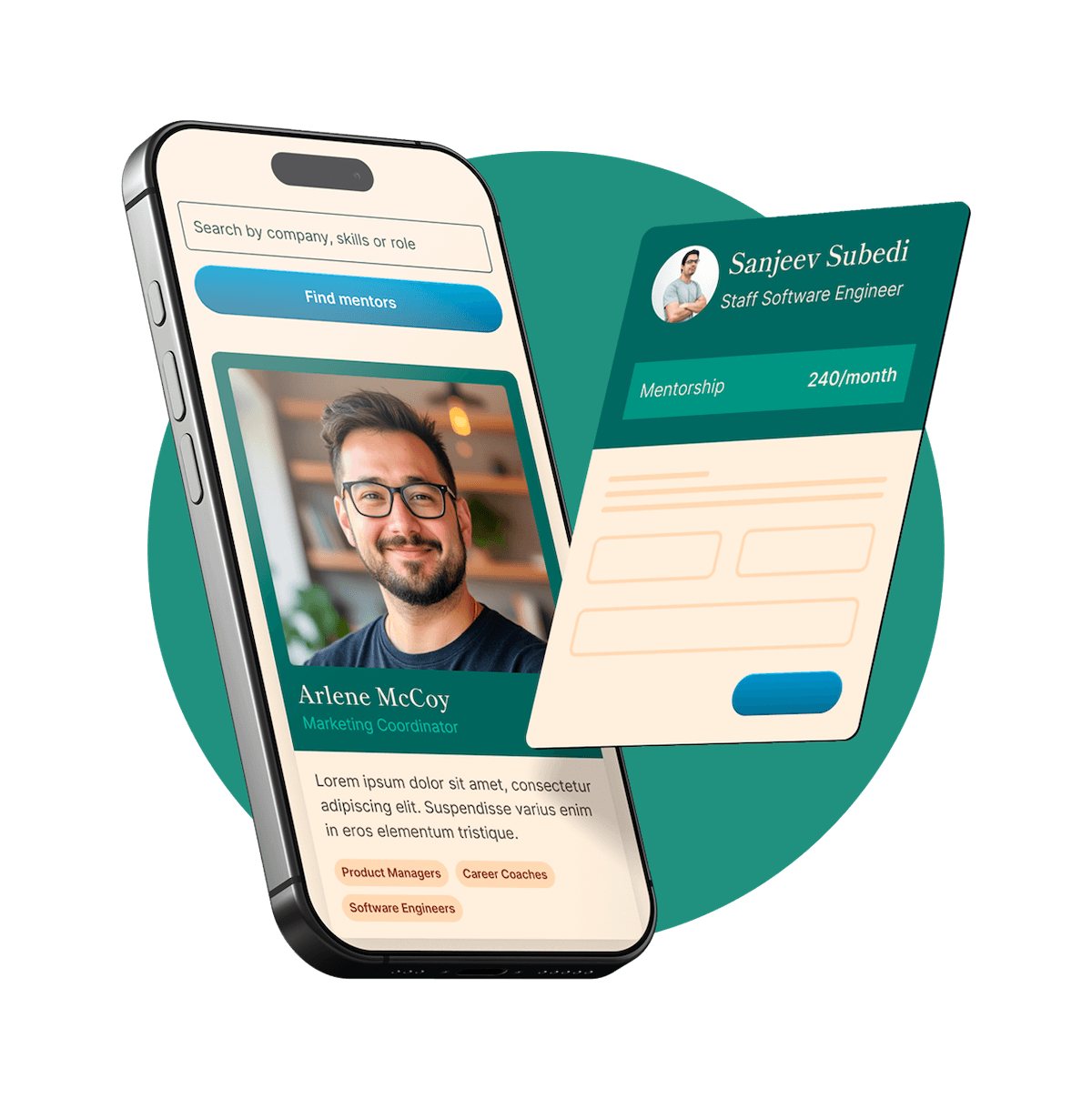
When employers stay silent, how you performed on the day is the explanation you can test without them. A mock interview with an experienced engineering mentor on MentorCruise puts an outside interviewer in the round your loops point to. Bring your notes from the last loops and ask for specific feedback on what they saw. It can't tell you what a past panel decided, and it won't guarantee an offer, but it gives you the direct, line-by-line feedback those four final rounds didn't.