
Becoming an Engineering Manager was one of the biggest changes of my career. What made me a successful engineer did not automatically make me a good manager. Suddenly, the job was less about solving technical problems myself and more about helping other people succeed.
As an engineer, I could usually see the results of my work. The system worked or it did not. The project shipped or it did not. Management was different. Many of the problems involved people, competing priorities, unclear expectations, and decisions where there was no obviously correct answer.
I had to learn how to give difficult feedback, support people through performance problems, manage conflict, and create clarity when I did not have complete information. I also had to stop jumping in and solving every problem myself. Something that felt helpful to me could prevent someone else from developing the judgment they needed.
Having someone outside my management chain to talk with gave me space to think honestly. I could work through difficult conversations, question my own assumptions, and admit when I had no idea what I was doing. My coach did not give me a script for every situation. He helped me slow down, look at the problem from different perspectives, and decide what kind of manager I wanted to become.
That made the coaching useful. It was not another person telling me what to do. It was someone helping me think more clearly about decisions that were mine to make.
This year, I was lucky enough to return the favor
I coached engineers and engineering managers working through many of the same questions I once faced.
Some were deciding whether to become managers. Others were trying to grow as technical leaders, looking for new jobs, preparing for interviews, improving their résumés, or deciding what they wanted from the next stage of their careers.
I recently reviewed all the goals people brought to coaching with me this year. The most common categories were:
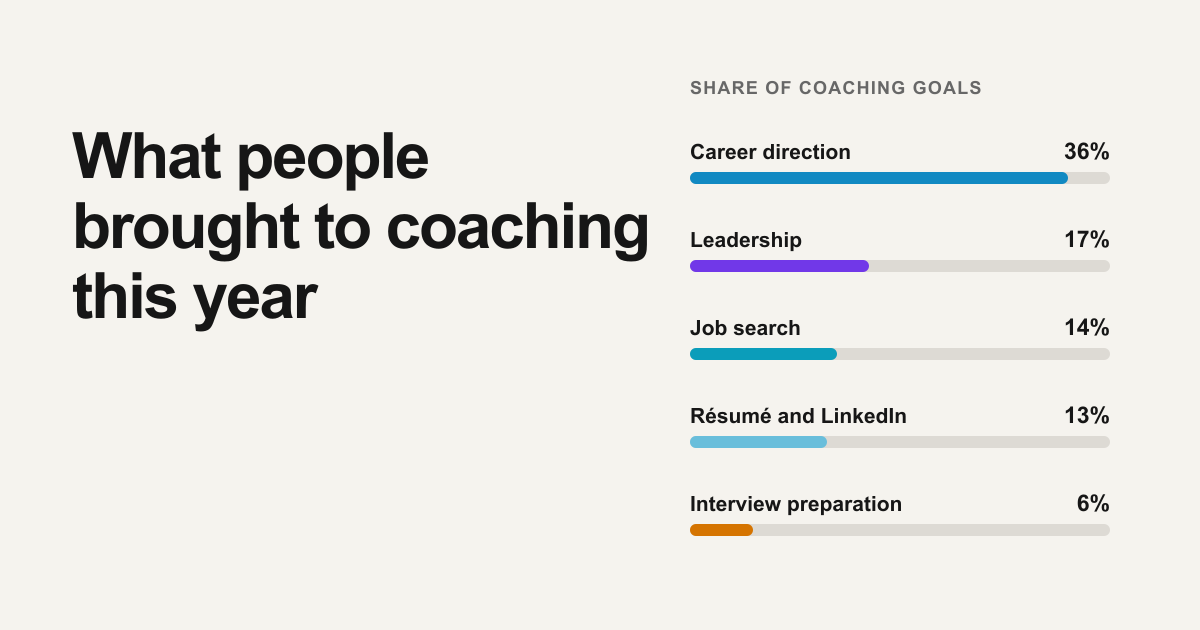
Job-search questions are often tactical. Which companies should I target? How should I describe my experience? How do I prepare for the interview? Career-direction questions come before those. Do I want another version of my current role? Should I become a manager? Do I still enjoy the work I am doing? Am I unhappy with my career, or am I exhausted by my current environment?
A better résumé will not answer those questions. Neither will sending more applications.
One client had several good options
One engineer I worked with had already built a successful career as a senior individual contributor. He was considering several possible paths, including continuing as a technical leader, moving into engineering management, or exploring roles in business development, sales, and support. His problem was not that he had no opportunities. He had several reasonable ones.
We started by getting specific about what those jobs actually involved. Titles can be misleading, especially in technology companies. Two roles with similar titles can have completely different expectations, while roles in different functions can require many of the same skills. We talked about the work he enjoyed, the problems people already trusted him to solve, and the parts of his job that gave him energy. We also looked at what he wanted to spend less time doing.
The discussion about management was particularly important. Becoming a manager would not simply be the next level of his engineering career. It would change the work. He would spend less time producing technical output directly. He would become responsible for hiring, feedback, performance, team health, prioritization, and decisions that affected other people’s careers. His success would increasingly depend on the success of the people around him.
We also discussed the difference between being interested in leadership and wanting the daily work of management. Many engineers enjoy mentoring, setting technical direction, and influencing decisions. That does not necessarily mean they will enjoy managing performance or handling difficult people problems.
As a coach my role was not to sell him on management. It was to help him understand the choice.
He eventually chose the management path and has since grown into the role. He has developed a clearer understanding of how decisions get made, when to take a firm position, when to look for common ground, and how to approach senior leaders with the right context..
Direction comes before tactics
This experience reflects a pattern I see in coaching. People sometimes arrive asking for help with a résumé, LinkedIn profile, or interview. Those may be the immediate tasks, but they are not always the real problem.
Before improving a résumé, we need to know what job it is supposed to help someone get. Before preparing for an interview, we should understand whether the role moves the person toward the career they want.
I usually start by separating the decision into smaller questions.
- What does the person want more of in their work?
- What do they want less of?
- Which parts of their experience provide evidence that a particular path might fit?
- What could they test before making a major change?
An engineer considering management might mentor someone, lead a cross-functional project, or take responsibility for a difficult team problem. Someone considering a different function can talk with people doing that work and learn what an ordinary week actually looks like. Small tests produce information. They are often more useful than trying to think your way to perfect certainty.
It is tough out there right now
Engineers are dealing with layoffs, a difficult job market, rapid changes in AI, and constant pressure to keep up. People who built successful careers over many years are asking whether their skills are still valuable. Managers are trying to lead teams through uncertainty while dealing with uncertainty themselves. Job seekers are applying for roles with hundreds of other candidates and wondering whether their applications are being seen at all.
That pressure can make every career decision feel urgent. Some people react by doing more. They apply to more jobs, collect more certifications, rewrite their résumés again, or try to learn every new AI tool. Others become overwhelmed and do nothing because they cannot identify the right first step.
Activity can feel like progress, but it is not always direction.
Sometimes you need practical advice. Sometimes you need help preparing for a specific conversation or decision. Sometimes you simply need someone who understands the work and can help you separate what you know from what you fear.
I was fortunate to have that person when I became a manager. Getting to provide that same kind of support to someone else has been one of the most rewarding parts of my year.
