Introduction
Before I actually go deeper into how SDLC should become today after AI, I need to shed some light first about how we end up here. If you are not interested in the background, you can skip to the next article which would be focused only on the SDLC changes
One of the major issues that I keep seeing today which is driving me crazy (thanks for the plethora of neurodivergence disorders and issues that I have) is the FOMO craziness when it comes to the usage of AI among incompetent leaders today!
So one of the top achievements AI (or to be more accurate, LLMs) was able to do is to shed a lot of light onto the competence of leaders which used to go unnoticed for a while before. How is that?
A few years ago, before the latest wave of AI/LLMs that was raised by OpenAI less than 7-8 years ago, someone could easily climb the leadership ladder into a large organization or a scale-up, be incompetent and get away with it for years!
If the business itself is booming or has natural dominance and/or major customer loyalty, that leader/exec needs to really screw up badly to destroy things. Otherwise, if they just pretty much did nothing or just operational work, the business was strong enough to sustain itself if not even continue to grow (until the point a very strong competitor joins the queue).
Take Google for example, used to be one of the major leaders (if not the main leader) when it comes to AI. Why wouldn't it be? With Google Brain + DeepMind + Google Research / Machine Intelligence, massive planetary data scale that they collected through dozens of products over decades of near monopoly in areas like search, Mobile OS, web browsers, Ads, Maps, Analytics and more and almost endless access to funds (e.g. by 2018/2019, Google had access to over $100B in liquid resources, which far exceeded the access any startup or scaleup had at that time). All of that in addition to roughly 45K of the brightest engineers and researchers in the field of computer science and engineering in the entire world
And then what happened?
A company called OpenAI, using about a total of 100 headcount (total headcount not just engineers and researchers) and funds that was in the ballpark of $30M, released GPT which made Google AI looks like a joke (at least in-front of general public and investors). Especially given the fun fact that one of the major researches that made GPT possible was the "Transformers” research that was published by Google back in 2017
So let's take a moment and make that clear again. On one side we have Google which had:
- Tens of thousands of the most brilliant engineers and researchers on the top of the planet
- Access to almost endless funds
- Planetary scale data that no one else had anything similar to which was collected over decades of near market full monopoly on a plethora of business domains and areas
- Top notch research papers that literally helped to shape the definition of AI
On another hand, we had OpenAI, a “not for profit org” that had:
- Less than 100 total headcount (probably less than half are engineers and researchers)
- About $30M in total funds (or less)
- No previous products or data that is secured over decades or near market dominance
- Access to research that was mainly done by others (like Google itself)
For me personally, that was a MAJOR and HUGE leadership failure for Google that should have immediately resulted in a total change of the entire leadership (even if they were able to catch up later, the fact that they lost the strategic connection to the market, is a major red flag)
That example above is exactly what AI is doing today. Previously it used to need a competitor like OpenAI to shed the light on how your leadership is incompetent, now it doesn't need that anymore. Why?
Because of FOMO!
Since LLMs were good and stable enough around the end of 2022, every single leader out there, especially the incompetent ones, woke up one day and found that the world is moving way faster than it used to be, which made it almost impossible to just keep doing the “let's continue to do whatever we used to do” behavior as before. So what did they end up doing?
The worst thing possible: let's just come up with the most random decisions we could think up about and hope that one of them produces something useful:
- Let's put some random percentage of AI usage and penalize anyone who is not doing that. Or
- Let's put some random tokens consumption targets and penalize anyone who is not doing that (putting back decades dead metrics similar to lines_of_code as a metric and severely violating Goodhart's law, which is like 101 leadership not_to_do)
- Let's put some random quantifiable metrics like number of PRs per week or similar (again, violating Goodhart's law)
That led to publicly shameful results that in an ideal world, should have resulted in a massive wave of leaders being fired on the spot. For example but not limited to:
- Amazon's AWS pushing aggressively that engineers should be doing at least 80% of their work using AI at least weekly (source: https://www.ft.com/content/8ee0d3ef-9548-422d-8ff1-ebd48ad4b2ca), which led to multiple very large outages including the instance in which Amazon's Kiro deciding to delete and recreate an environment which led to 13-hours interruption to a cost-management system in an AWS China region (sources: https://www.ft.com/content/00c282de-ed14-4acd-a948-bc8d6bdb339d and https://www.reuters.com/business/retail-consumer/amazons-cloud-unit-hit-by-least-two-outages-involving-ai-tools-ft-says-2026-02-20/) which later caused leadership to get concerned about AI usage, as if they didn't dictate it to begin with! Which they later came back and denied all of this (just to not look like absolute morons as they should be!)
- Klarna hiring freeze that was combined with severe layoffs to just come later with the CEO personally and publicly admitting that they got it all wrong (source: https://www.reuters.com/business/swedens-klarna-shifts-ai-focus-cost-cuts-growth-2025-09-10/)
- Duolingo's declaring itself “AI-First” and pushing employees toward AI usage aggressively which resulted with both employees and customers backlash and reversal of decision (source: https://fortune.com/2026/04/13/duolingo-ceo-luis-von-ahn-ai-usage-requirement-employee-performance-evaluations/)
And a lot more stories like that!
That puts a summary of why leaders should be concerned with looking into the SDLC process itself rather than coming up with random decisions every day hoping that one of them could produce something useful and hence this article.
So one question would come after the above: are the fear of these execs and leaders real? Would their businesses collapse if they don't just adapt AI as soon as possible?
Let's try to answer that question
FOMO Feares: Are they real?
With what's happening in the world, you would assume that a company that doesn't adapt AI as soon as possible and is doing it in any way, shape or form is doomed to collapse. Reality is? It's really far away from that!
Let's take one example, which is Apple. Everyone knows that not only are they very late to enter the AI race, but even until the moment this article is being written, they have not yet come up with any good story related to AI except for the very late, never really arriving as promised, Apple Intelligence!
You would think that not being part of the FOMO wave, Apple would be losing a lot, right?
The numbers say otherwise. Let's look at some of them from Statcounter and Yahoo finances
The first graph is looking into Apple's market share in the mobile market between July 2017 and July 2026 (discarding August as it's not concluded yet).
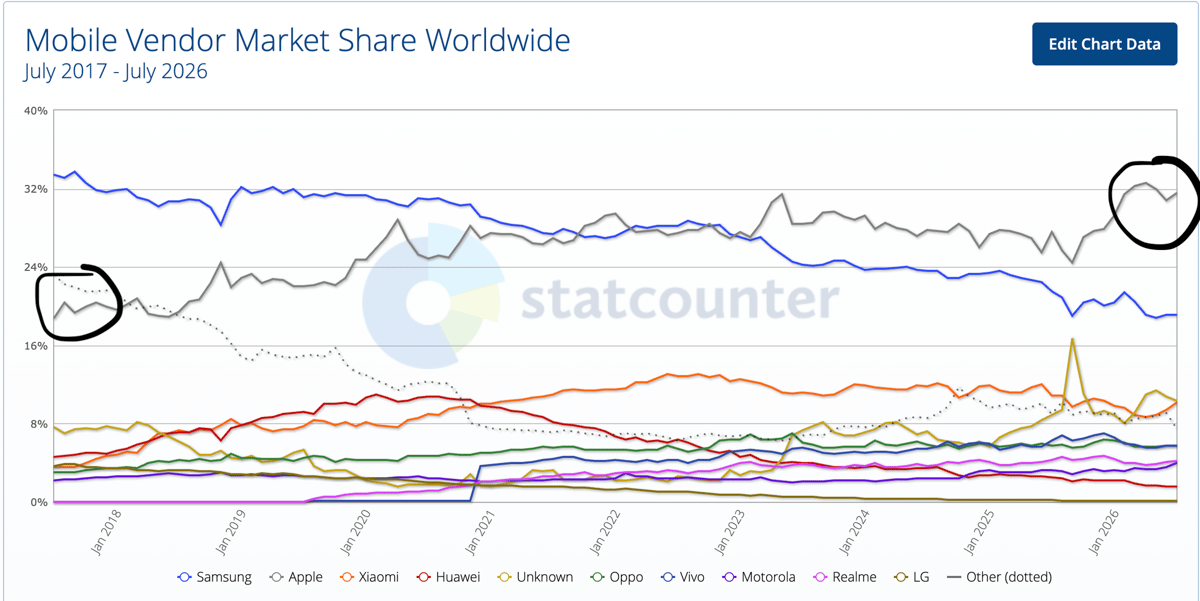
As you see below, Apple started with a global market share of 18.78% and ended up with a market share of almost 32%. So not only did they kept their market share, they almost doubled it!
Look at operating system market share (indicator of Mac devices)
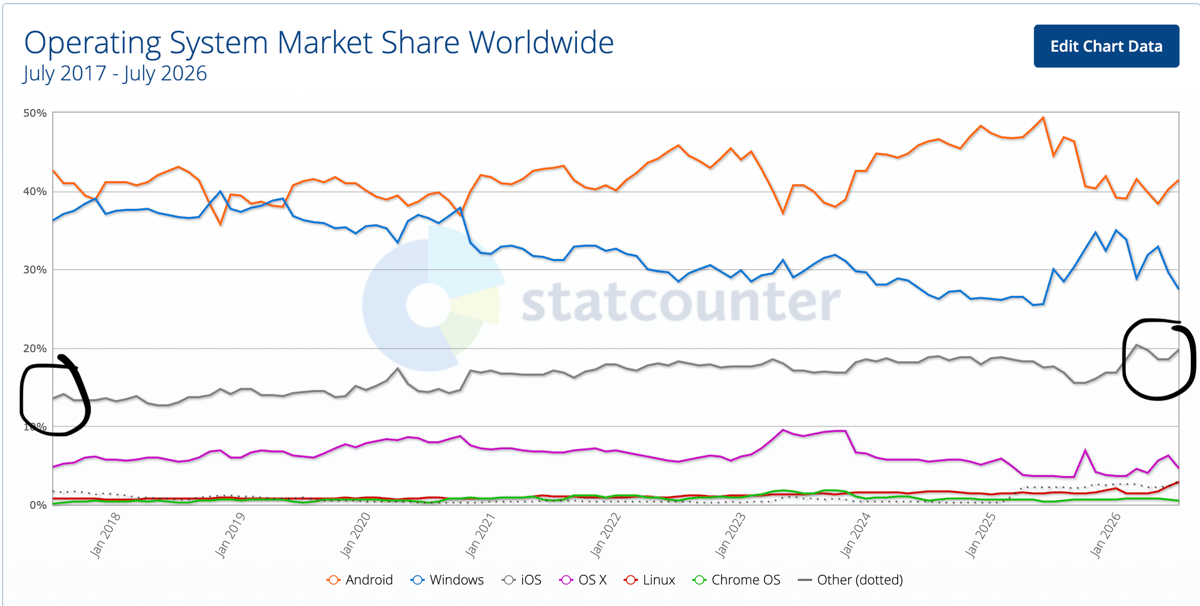
Apple started with a market share of 4.8% and ended up with about 6.25%, so again, not only they kept their market share but increased it as well by over 30% in a market that has been stable for years!
Even looking into their stocks pricing
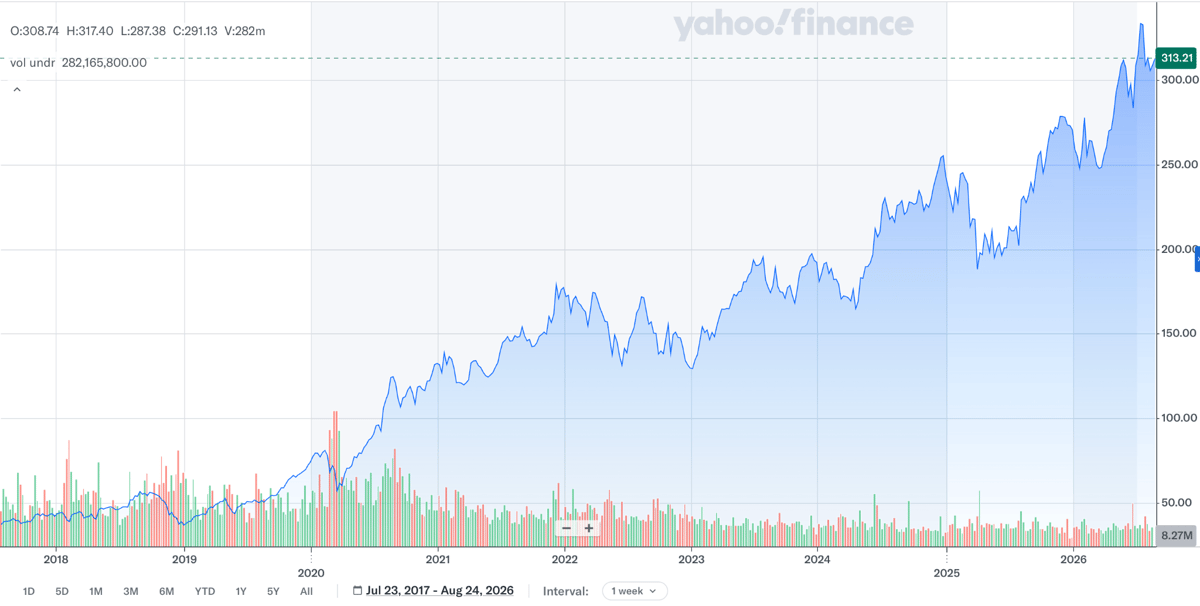
They started with a share price of roughly $37 back in July 2017 to go above $310 today. Again, massive growth of over 8x!
So if FOMO was happening because of real business and product impact, why didn't that impact and affect Apple?
Does this mean that AI is not useful at all?
On the contrary, it's extremely useful but only if it is used in the right way. Otherwise, best case scenario would be you burning through cash as a piece of butter in a very hot oven, or a more probable scenario, end up losing millions or billions of dollars because of outages and technical problems in addition to irreparable damage in your reputation and customer trust.
So how to do it right?
That would be the focus of the second of the artichle.
Stay stuned.