Intro
There is something I've noticed about learning French as a technology professional.
You can know perfectly well what an API is. You can understand authentication, networking, cloud architecture, databases, integrations, scalability, and security. You may even explain these concepts to customers every week in English.
Then someone asks you the same question in French, and suddenly everything disappears.
You know the answer, you know the technology, but you don't know how to say it.
I think this is one of the biggest mistakes engineers make when they decide they need French for their career: they start learning French exactly the same way they would if they were preparing for a vacation, colors, food, clothing, days of the week, random vocabulary lists.
There is absolutely nothing wrong with learning those things. If your goal is to become fluent in French, you eventually need a strong general foundation.
But if you're already an engineer trying to access a bilingual role, work with French-speaking customers, or interview for a position involving Quebec, I think there is another way to approach it.
Start with engineering.
You already know the subject. Now learn how to talk about it in French.
The technical knowledge is already in your head
Let's imagine you're a cloud engineer.
Someone shows you this architecture:
User → Web Application → API → Database
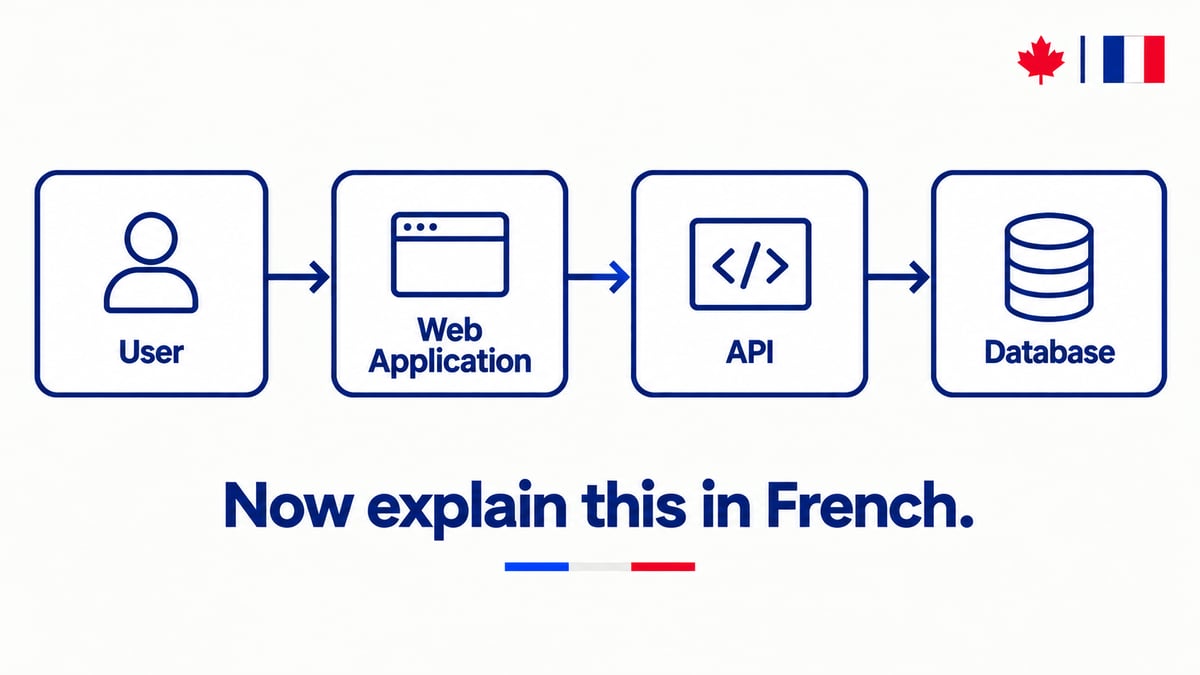
In English, you probably wouldn't struggle to explain it.
You might say:
The user connects to the web application. The application sends a request to the API, the API processes it, and then retrieves the required information from the database. Nothing particularly complicated. Now try saying the exact same thing in French.
You might know utilisateur, you might know application, but then you reach “the API processes the request...” and you stop.
What is “request”? How do I say “processes”? Is database database or base de données? Do I translate API?
And while your brain is doing all of that, you've stopped sounding like the confident engineer you actually are.
That's the gap I find interesting.
It's not necessarily a technical knowledge problem. It's a technical communication problem.
Start with sentences you'll actually use
Instead of learning fifty random French words, I would start with five sentences that you could realistically use at work.
The application communicates with the API.L'application communique avec l'API.
The API retrieves the information from the database.L'API récupère les informations dans la base de données.
This service handles authentication.Ce service gère l'authentification.
The purpose of this component is to improve availability.Le rôle de ce composant est d'améliorer la disponibilité.
We chose this architecture because it is easier to scale.Nous avons choisi cette architecture parce qu'elle est plus facile à faire évoluer.
Five useful sentences. Then change them, replace application with service, replace database with another system, replace availability with security.
Now you're not memorizing French. You're building reusable patterns.
And engineers are very good at patterns.
Don't translate every technical term
Another thing I would avoid is obsessing over translating every English technology word.
Technical French is full of English terminology. Depending on the company and the people you're speaking with, you'll regularly hear words such as API, cloud, endpoint, firewall, cluster, container, token, load balancer, SaaS used directly inside French conversations.
You might hear: L'API expose plusieurs endpoints.
Or: Le service tourne dans le cloud.
Or: On utilise un load balancer devant les serveurs.
Is every one of those expressions perfect academic French? Maybe not.
Does a French-speaking engineer understand exactly what you're talking about? Usually, yes.
And that's an important distinction.
If you're preparing for a technical job, your objective isn't to impress a French professor. Your objective is to communicate clearly with another technical professional.
Learn to explain the “why”
Knowing vocabulary is only the first level.
The more interesting part comes when somebody challenges your architecture.
Why did you choose this design? Why this database? Why an API? What happens if a component goes down? How does the architecture scale?
That's where technical French becomes much more valuable.
For example:
Why did you choose this architecture?
Pourquoi avez-vous choisi cette architecture ?
You could answer:
Nous avons choisi cette architecture principalement pour améliorer la disponibilité et faciliter la mise à l'échelle de l'application.
We chose this architecture mainly to improve availability and make the application easier to scale.
Now you're doing more than translating vocabulary.
You're defending an architecture decision in French.
That's something you might actually have to do during an interview, presentation, discovery meeting, or customer conversation.
Practice the questions you are likely to hear
When people prepare for working in another language, they often focus almost entirely on what they're going to say, but understanding the question quickly is just as important.
Here are some questions an engineer could realistically hear: Comment gérez-vous l'authentification ? — How do you handle authentication? Que se passe-t-il si ce service tombe en panne ? — What happens if this service goes down? Comment les systèmes communiquent-ils entre eux ? — How do the systems communicate with each other? Comment assurez-vous la haute disponibilité ? — How do you ensure high availability? Est-ce que cette architecture peut supporter davantage d'utilisateurs ? — Can this architecture support more users? Pourquoi avez-vous choisi cette technologie ? — Why did you choose this technology?
If you're preparing for a bilingual technical interview, I would practice answering questions like these repeatedly. Not perfectly, but confidently. Those are two very different goals.
Take an architecture you already know
Here is one exercise I particularly like.
Don't start with somebody else's architecture. Use one you already understand.
It could be something as simple as:
Client → API Gateway → Application → Database
Give yourself two minutes and explain it in French. No Google Translate while you're speaking, no script, just try.
You might begin with: Je vais commencer par vous présenter l'architecture globale de la solution.
Then: Ici, nous avons l'application principale.
Then: L'application communique avec l'API... Eventually, you'll get stuck. Perfect. That's exactly where the learning happens.
Write down the phrase you couldn't express, find out how to say it naturally, then start over.
The next time you reach that point, you'll probably remember it. Do that again tomorrow, and again next week. Very quickly, those phrases start becoming automatic.
Learn French around the technology you actually work with
A backend developer and a Solutions Engineer don't necessarily need the same technical vocabulary. Neither does a cybersecurity engineer compared with a data engineer.
So I wouldn't follow exactly the same curriculum for everyone.
If you work in cloud infrastructure, focus on networking, virtual machines, scalability, availability, disaster recovery, identity, and security. If you work in application integration, focus on APIs, authentication, authorization, data exchange, integrations, webhooks, queues, and errors. If you work in Solutions Engineering or Presales, add discovery, requirements, demonstrations, customer challenges, business outcomes, architecture decisions, objections, and presentations.
That's where French starts becoming relevant to your career, rather than simply another subject you're studying.
Learn how to sound like yourself
This part matters to me.
When you speak English professionally, you probably have a certain way of explaining things.
Maybe you say, “Let me simplify this,” “At a high level...,” “The reason we chose this approach is...,” or “There are two things to consider here.”
Those phrases are part of how you communicate. Learn their equivalents. At a high level...Globalement...
The reason we chose this approach is...La raison pour laquelle nous avons choisi cette approche est...
There are two things to consider here.Il y a deux éléments à prendre en compte ici.
Now you're not just learning French vocabulary. You're rebuilding your professional communication style in another language. That's much more powerful.
Don't wait until your French is “perfect”
This is probably the biggest point I would make.
Engineers sometimes approach language learning the same way we approach certifications.
Finish Module 1, finish Module 2, pass B1, pass B2, then, someday, start speaking professionally. I wouldn't wait. Use the French you have now.
If you're at an intermediate level, explain a simple architecture. If you're a beginner, explain one component. If you know only enough to introduce yourself and describe your role, start there.
You don't suddenly wake up one day feeling “ready” to discuss engineering in French. You become ready by discussing engineering in French.
Your accent isn't the problem
I also wouldn't spend too much energy worrying about sounding completely native.
Especially in international technology environments, you're going to meet people with accents from everywhere: France, Quebec, Lebanon, Morocco, Belgium, West Africa, English-speaking Canada, and many more.
Your objective isn't to erase your accent. It's to communicate clearly enough that the other person understands what you're proposing, why you're proposing it, and what happens next. That is professional communication.
If I had to start today
If I were an engineer who already knew some French and wanted to become comfortable using it professionally, here's what I'd do.
I'd choose one technical topic I know extremely well, maybe APIs.
I would learn how to explain what an API is, why we would use one, how authentication works, how two systems communicate, and what happens when a request fails.
Then I would practice answering those questions aloud. After that, I'd choose another topic, maybe cloud architecture, then networking, then security. Over time, something interesting happens. You're not learning completely new French every time.
The same sentence structures keep coming back:
Nous utilisons... Le rôle de ce service est... Cette solution permet de... L'avantage de cette approche est... Si ce service tombe en panne... Those structures become your building blocks. And suddenly discussing a completely new technology in French becomes much easier.
The way I think about it
There are engineers in Canada who are already technically qualified for opportunities involving French-speaking customers or teams.
Their biggest obstacle may not be cloud, architecture, or APIs. Sometimes, it's simply the confidence to take everything they already know technically and express it in French. That's why I don't think engineers should always approach professional French like traditional language students. Use what you already know.
Open an architecture diagram, explain it, get stuck, learn the missing phrase, try again, because you don't need to relearn engineering in French.
You need to learn how to express the engineer you already are, in French!