A founder recently reached out to me via Mentorcruise about AI. He runs a sizeable cross-border e-commerce business, sourcing products internationally and selling them across the US and Europe. They have warehouses and fulfillment partners across markets and are now thinking about expanding into more countries.
The business is growing well. But as we talked, it became clear that growth had also created operational work in the back-end. Employees were coordinating shipments, checking inventory, reconciling financial information, preparing reports and researching new markets. His concern was that he wanted his teams spending more time growing the business, while an increasing amount of their day was going into non value tasks to keep the business running.
They were already considering hiring someone technically strong to focus specifically on AI and automation. My first question was: 'What exactly would you want this person to solve?'
We spent the conversation breaking the business down, looking at where time was going and where AI could realistically help. Three areas stood out.
1. First, we analyzed the business (even before talking about AI)
We started with two buckets: (1) Growth: entering new markets faster, making better commercial decisions and finding opportunities in the data they already had and (2) Efficiency: logistics, finance, reporting and the recurring operational work required to keep the business running.
For
each process, we looked at five things:
i. What
does someone actually do today?
ii. How
often do they do it and how much time does it take?
iii. Which
part requires human judgment?
iv. What
happens if we get it wrong?
v. What
would have to improve for this to be worth building?
That also helped us identify things where AI probably wasn't necessary.
For example, since an employee was manually moving information between two systems based on a fixed condition, I first recommended a normal rule-based automation. If they simply needed to collect structured information from the same websites regularly, scraping may be enough.
The more interesting AI opportunities for the founder business were processes involving messy information, interpretation or judgment: understanding why numbers don't match, identifying unusual situations across lots of data, or pulling together information from several sources to prepare a recommendation.
2. Operations: why check 200 shipments when only 15 need attention?
With products moving internationally and inventory spread across fulfillment centers, the operations team needs to know what is arriving late, what is running low and where somebody needs to intervene.
We mapped what a typical morning could look like. Someone might open the logistics system, warehouse data, sales information and a couple of spreadsheets to understand the health of perhaps 200 open shipments. The team's time wasn't necessarily being spent solving 200 problems. It was being spent checking 200 things to discover the 10–15 that were problems. That gave us a much more specific problem to solve.
We outlined an exception-monitoring workflow that could combine shipment status, expected arrival dates, historical transit times, warehouse inventory and recent sales velocity. Each morning, instead of reviewing everything, the operations team could start with something like:
Product
A — High stockout risk
Current
inventory: 9 days
Incoming
shipment: approximately 6 days late
Estimated
stockout: 14 September
Suggested
next step: check whether inventory can be transferred from another European
warehouse
An employee still made the call but we created a system to get them straight into the situations where a call needs to be made.
We estimated that if a team member currently spends around 90 minutes each morning monitoring shipments, getting that closer to 20–30 minutes would save roughly 5 hours per person every week. We also set a more important measure alongside the time saving: whether the system helped identify potential stockouts earlier.
3. Finance: reduce the investigation behind numbers that don't match
Finance gave us another problem that will probably sound familiar to anyone operating across multiple sales channels.
The company receives sales and payout information from different places, which then needs to be reconciled against refunds, fees, advertising, logistics costs and internal records. Most transactions are straightforward but issues came up when something doesn't match.
Say the finance team sees a €12,000 difference between its internal numbers and a marketplace payout. Someone now has to download reports, filter transactions and work backwards until they understand where that €12,000 went. We broke that into two parts.
The straightforward matching didn't need AI. If an order number, amount and reference all match, normal rules can reconcile it. AI became useful for the messy remainder. It can help read transaction descriptions, group similar discrepancies and prepare a first explanation for the person investigating them.
So instead of starting with an unexplained €12,000 difference, their finance team might see:
€8,400
— fulfillment fees posted in a different reporting period
€2,700
— refunds processed after month end
€600
— possible duplicate storage charges
€300
— unexplained and requires review
Now their employee can check the explanations and spend most of their investigation time on the €300.
And we would measure success by checking the percentage of transactions reconciled without manual investigation. If 50% can initially be reconciled automatically, then 70%, and eventually perhaps 80–85%, you can translate that directly into hours saved during every month-end. Just as importantly, I'd track how often the system incorrectly explains an exception. Saving five hours isn't particularly useful if somebody needs three hours to check whether the AI made something up.
4. Market expansion: could we turn weeks of research into days?
The growth opportunity I found most interesting was the company's plan to enter additional countries. They had Poland as one of the markets under consideration.
Before they launch, the team needs to understand the category, competitors, prices, customer preferences, marketplaces, regulations, logistics and whether its existing assortment is a good fit. Several employees could easily spend a few weeks gathering that information before management even gets to discuss the interesting questions.
We outlined how an initial market assessment could pull together public information on competitors, marketplace rankings, pricing, customer reviews and category trends.
Imagine that first pass finds that several leading products sell between €20–25, customers repeatedly complain about leaking packaging, and certain product claims appear much more frequently in Polish customer reviews than in Germany.
Now the commercial conversation becomes much more concrete. Does our assortment fit that price range? Do any of our products solve the complaints we're seeing? Are those product claims genuinely more important in Poland or is the sample misleading? What happens to the economics after local fulfillment and marketplace costs?
The target we set was aggressive: take an initial market assessment that might normally consume a couple of weeks of analyst time and produce a useful first version within 2–3 days.
And then we created a learning loop where six months after entering a market, go back and compare what the research predicted with what actually happened. Which customer preferences were real? Which competitor assumptions were wrong? Which products performed differently than expected?
That feedback makes the next market assessment better. Otherwise, it's easy for AI to generate a beautiful 30-page report that nobody ever checks for accuracy.

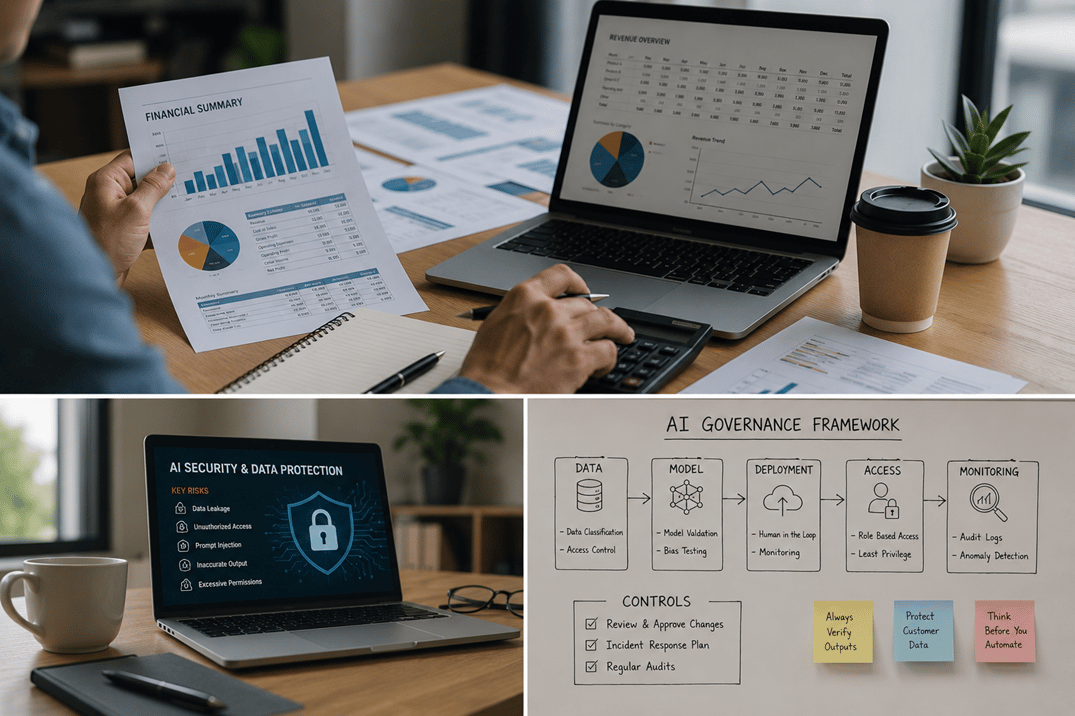
5. We also spent time on something less exciting: what happens when the AI gets it wrong?
This becomes important once AI moves beyond helping someone write an email and starts interacting with actual company systems.
Take the logistics example. An agent that reads shipment information and recommends moving 500 units between warehouses creates one level of risk. Give the same agent permission to execute the transfer itself and the consequences of a bad decision become much larger.
Finance is similar. Helping investigate a €12,000 discrepancy is useful. Giving an agent permission to change financial records or initiate payments is a very different decision.
For every workflow, we defined four things before it goes live:
1. What
can it see? Give it only the data it needs
2. What
can it change? Start with limited permissions.
3. What
requires human approval? Financially meaningful, irreversible or
customer-facing actions deserve a higher threshold.
4. What
gets logged? If something goes wrong, we should be able to reconstruct what the
system saw and what it did.
We also deliberately created tests for the bad/ugly situations.
Give the agent a missing file. Contradictory information. Duplicate transactions. An unusual shipment. Put an instruction inside a document telling it to perform an action it isn't supposed to perform and see what happens. A demo where everything is perfectly formatted tells you surprisingly little about how an AI workflow will behave inside a real business. I'm much more interested in what happens on a bad Tuesday when three systems disagree.
6. Finally, we came back to the AI hire
By this point, the conversation about hiring someone for AI looked quite different. We decided to give them an initial backlog like this:
a. Business
problem
b. What
happens today
c. First
thing to test
d. Target
e. Logistics
monitoring
f. Team
manually checks shipments
g. Exception
monitoring
h. Impact: 90
min → <30 min/day
i. Rules
+ AI exception analysis
g. Market
research
The business teams still need to own the problems because they understand how the work actually happens. The technical person can then work with them to decide what can be automated, where AI adds something, what data is required and how safely it can be implemented.
Over time, I'd want that backlog to keep growing. Operations brings a problem. Finance brings another. Commercial brings another. Some will need AI, some will be solved with fairly boring automation, and some won't be worth the effort.
Where we ended up
What I enjoyed about this conversation was how quickly AI became less abstract once we started talking about actual work. We were discussing why somebody spends 90 minutes checking shipments every morning, why finance has to investigate the same kinds of discrepancies every month, and why researching a new country takes several weeks. By the end, we had three very different opportunities, an idea of what we could build, the numbers we would measure and some boundaries around what the systems should be allowed to do.
That's also where my own experience with AI and automation has changed how I look at these projects. The technology is moving incredibly quickly, so I don't think the valuable skill for most businesses will be predicting which tool they'll be using three years from now. Being able to look closely at how your business works, find the places where technology can genuinely improve it, test those ideas quickly and measure whether anything actually got better feels much more useful.