As a Software Engineering Manager, assessing a report’s promotion readiness has always been an interesting part of the job. And in my experience, much of the discussion focuses on hard skills, but not enough thought is put on the behaviors that might help identifying someone who’s demonstrating signs of promotion readiness.
Throughout the years, I’ve learned to identify patterns of behaviors that might lead to successful promotion cases. Consistently extending impact beyond one’s immediate scope, multiplying impact through others and having a great balance between covering and mastering domains are some of these behaviors, and I’ve seen these patterns help people build stronger cases for promotion.
In this article, I’m happy to elaborate on these behaviors. I believe it can lead individual contributors and managers to reflect and assess promotion readiness beyond the hard skills bullet points, understanding that promotion readiness also happens on the way people behave on a daily basis.
1. Consistent impact beyond immediate scope
An employee ready for promotion is someone who can consistently - and organically - extend their impact beyond their commitments. They can deliver comfortably in their team scope and they’re mature enough to find ways to contribute beyond their immediate responsibilities. They often see opportunities to fix things or make things better and they understand their current role well enough that looking beyond their scope feels almost natural - and operating at a high level is sustainable.
If this feels too abstract, let me describe a counterexample to make it easier to grasp: someone who bites off more than they can chew in order to be seen, and misses their commitments in order to demonstrate impact. It’s that person that might get involved in a big community project and struggle to balance planned work with stretch responsibilities. Or someone who might overengineer a task to look more technical, but deliver a faulty solution that could’ve been made simpler.
As a manager, I have a rule with my reports that promotions must be a result of consistent contributions, and not only a checklist of one-off achievements - as once they get promoted, what was considered exceptional can become part of the new normal.
2. Ability to deliver impact through others
This depends on role and seniority, but people who are outgrowing their current role are often multipliers. They’re not the single person who does all the work by themselves; they know how to amplify their impact by empowering others to work better. This can happen through mentoring colleagues, reviewing their work, inviting them to collaborate or sharing what they know.
An important trait of multipliers is that, once they're well established in their role, they’re good at delegating work in order to grow others. They know how to identify strengths and skills among their peers and put their names forward when discussing collaboration opportunities. They also know when to step back to let someone else shine and when to step in if someone is struggling.
I’ll never forget when, during my years as a software engineer, a senior colleague stepped back from the most important team project of the quarter and suggested that I - a newcomer to the team - should take it on, while they’d still be there to answer any questions. At first I thought they were just throwing me under the bus, but over a coffee with them some time afterwards, they told me his decision was deliberate: I had been doing very well in the team and needed a challenge, and they had had their share of good projects and were just looking for something chill. It worked, and at the end of the project, thanks to what I’d learned, I was no longer someone who needed onboarding, but a developer they could share most of the workload with. And I kept their attitude as a great example of leaders who know when to delegate a task and how that can have a multiplier factor, as we were now two well rounded developers ready to handle similar challenges in the team.
3. Domain expertise
A common trait I’ve observed in my most successful reports is: they learn and master topics fast, to the point of becoming the “go to” person regarding that topic. Some of my strongest reports picked up new topics quickly and became the people their teammates turned to for advice. Over time, they built expertise in several areas, and being able to point to the impact of that expertise helped them make a stronger case for promotion
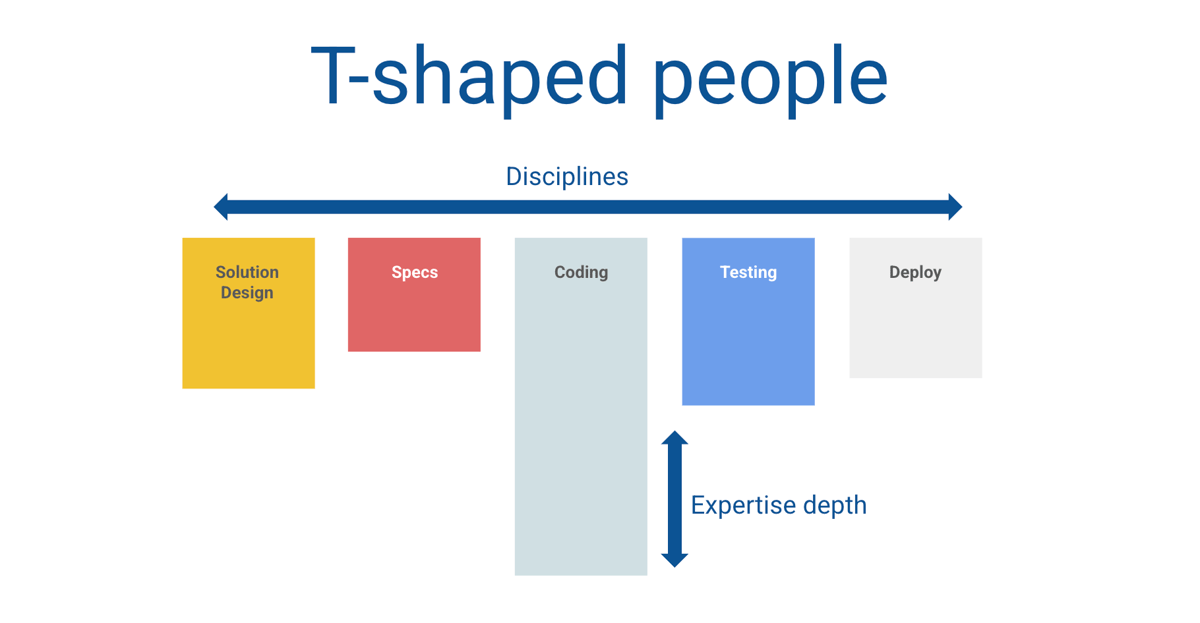
I’ve seen the opposite as well: people with strong contributions spread across several unrelated areas, which made it hard to tell a complete story about the impact they’ve had at the company - and therefore defend a promotion case. For these individuals, my advice was to continue performing with consistent excellence, while also selecting one relevant topic or challenge faced by the company to delve into more deeply, so as to become a go-to authority on it. In software engineering, we call it the “T-shaped” skillset: being competent in a broad set of topics, but showing depth about a few ones in particular.
For someone aiming for a promotion, a good reflection about knowledge domains - and the level of knowledge on each one - can help managers and reports to identify how close to the “T-shaped” skillset the person is. Covering topics with a combination of breadth and depth suitable for the next role and level is a positive sign that a good story is in place for a future promotion readiness assessment.
Conclusion
Demonstrating behaviors of promotion readiness and actually getting a promotion are very different things. Promotions are tied to business needs, company budget and other factors that are unfortunately not always under our control.
But discussions about promotions should be a constant effort between managers and reports. Regular feedback helps people understand where they’re already showing signs of readiness and where they still need opportunities to grow, so that when the opportunity comes, they have high chances of succeeding.