A launch price or a cheap pilot to land the first logos is a legitimate way into a market, and I recommend it more often than people expect. The fault is doing it blind. Over the past month I have had the same conversation with several founders I mentor, all building business software: a growing list of users, many of them free or on launch prices, and nobody able to say what each one actually costs to serve. The user count said the strategy was working. The rest of the numbers could not say anything either way, because nobody had built them to answer the question.
The question I ask is a plain one: if we go through your customers one by one, which of them are you losing money on? The usual answer is a pause, followed by a promise to find out. So start with the arithmetic for a single customer, using round numbers you can swap for your own. Say your software sells at 1,000 a month, and each customer costs you 400 a month to serve once you add up hosting, the artificial intelligence (AI) model calls they make and the support time they take.
- At full price the customer pays 1,000, so you keep 600.
- At 20 per cent off they pay 800, so you keep 400.
- At 50 per cent off they pay 500, so you keep 100.
- On a free pilot they pay nothing, so you lose 400 for every month it runs.
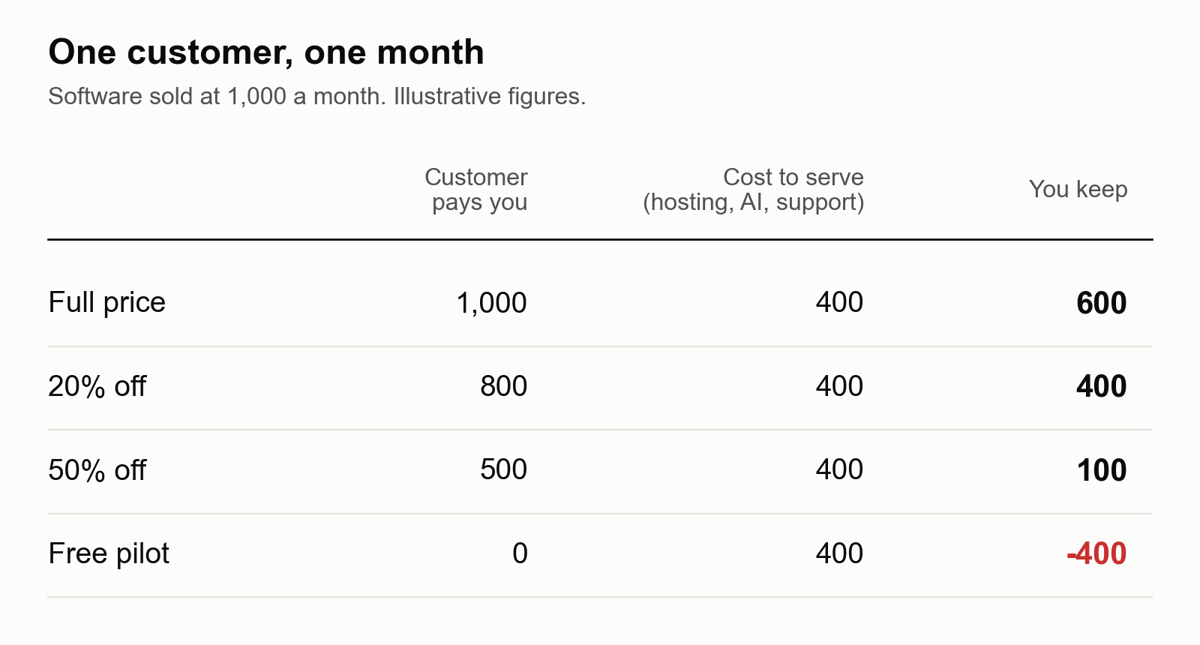
Look at what 20 per cent off does. It takes 200 off the price but a third off the 600 you keep, because the whole discount comes out of your profit while the cost to serve stays exactly where it was. Half price leaves you a sixth of your margin, and a free pilot is not free at all: it is a cost you pay every month for the privilege of being evaluated. Discounts also stack in ways nobody notices until someone checks customer by customer. A launch discount on top of an annual prepayment discount on top of a founding customer rate can leave you serving a customer at a loss while every individual number looks reasonable.
The discount is the cost you can see. The costs that do the damage sit outside the invoice.
- Onboarding: integration, data migration and training, often weeks of an engineer's time before the customer pays a full month.
- Usage: hosting and AI costs rise with every query, so your heaviest users on a flat price can cost more to serve than they pay.
- Free extras: extra seats, extra workspaces or a custom feature thrown in to close the deal, each with its own running cost.
- Founding customer prices: early customers given a special rate that nobody ever reviews, sometimes with a launch discount added on top.
The fix is one sheet per customer that holds all of it: the price agreed, the discount and when it ends, the monthly cost to serve, onboarding spread over the months it covers, and anything given away to close the deal. Total it monthly and every customer ends up with a single number, positive or negative, that you can colour red or green.
This matters most in the negotiation itself. Enterprise buyers ask for a discount as a matter of routine, and their procurement team knows its own numbers to the cent. A founder who is about sixty per cent sure of what a customer costs to serve will agree to whatever keeps the meeting friendly. I have negotiated hundreds of millions in enterprise deals, and as a founder I have still undermined my own position in the final hour of a deal. That final hour is exactly where an uncosted discount gets agreed, so take the decision out of it: before any negotiation, write down the deepest discount and the longest free period you will accept for that customer, and do not cross that line in the room.
Simulate the offer before you make it
How long can you afford to buy a customer? For a fixed period that you chose in advance, and no longer. The customer sheet becomes a simple simulator once you give it these inputs before you make the offer:
- the price and the discount
- how long the pilot or launch price runs
- the monthly cost to serve
- the one-off cost to onboard
Read off two things: the month the customer starts making you money, and the month they have paid back everything it cost to win them. Run it on the same customer, with 2,500 to onboard. A three-month free pilot leaves you 3,700 behind, and at full price it takes until month ten to earn that back. A three-month paid pilot at 20 per cent off is paid back by month six, and a customer who agrees to pay something during the pilot has already told you more than one who has not.
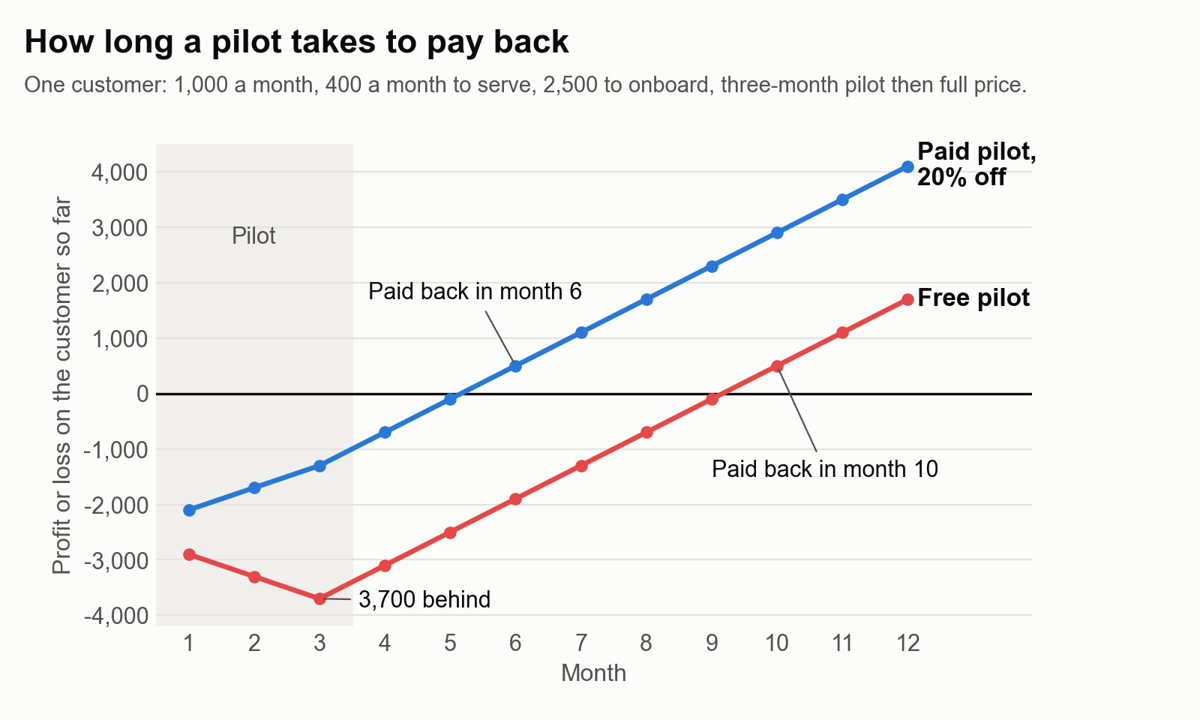
My rule is that a launch offer pays back inside the customer's first year. If the simulator says it will not, change the offer before you sign rather than hoping usage will rescue it. Two things wreck the plan even when the sum is right. The first is the renewal, when the customer asks to keep the launch price because it is the price they have got used to, so decide your answer before they ask, and agree only in exchange for a longer contract or more seats. The second is quieter and more expensive. Your early customers start to make money just as you sign a fresh batch on launch terms, and the business as a whole never improves, because every new customer digs a new hole while the older ones are filling theirs. Run every new customer through the simulator, then look at the total for the business as well as the customer in front of you.
What counts as proof
Proof is one table and one line, reviewed every month.
- The table has every customer in a row, with their net result for the month after all costs, coloured red or green.
- The line is a cash flow forecast for the business that should read loss, loss, loss, and then turn upward as pilots convert and launch prices end.
If the line never crosses into profit, the strategy is broken, which is fixable, but only if you see it in month two rather than month nine. Be straight with yourself about the costs that sit outside the product as well. If your engineers split their time between building and onboarding customers, allocate their cost by share of time, so an engineer who spends two days a week on onboarding puts two fifths of their salary into the cost of winning customers. Take the numbers to your accountant to check before they go to the board or your investors, then report against the forecast every month with your recommendations attached. If your billing system and your customer relationship management (CRM) system disagree on what each customer pays, reconcile them now and expect the first week to turn up customers on prices nobody remembers agreeing. That is the reason to do it, not a reason to wait.
None of this argues against discounting. Buying your first customers is a perfectly good use of money, as long as you treat it like any other investment, with a known cost and a known month when it pays back. Most founders discounting to win customers know neither, and the buyers they negotiate with usually know both.
The lesson: never offer a discount or a free pilot until you can say, customer by customer, what it will cost and the month it will pay back.
If you are discounting to win customers and cannot yet say which of them is red this month, book an introductory call with me on MentorCruise and we will build the customer sheet and the simulator together, before your next negotiation rather than after it.
Ben