AI chatbots like ChatGPT, Claude, and Perplexity are quickly becoming where people go to ask for recommendations — not Google.
They shape buyer intent before someone ever reaches your website, making brand visibility inside LLMs not just useful but strategically essential for long-term growth.
If your brand doesn’t show up in those answers, you’re effectively invisible at the exact moment someone is ready to buy.
The challenge: LLMs don’t share search data, don’t show rankings, and don’t make it obvious why one brand appears over another.
So in this guide, we break down the four signals you can track today to understand how visible your brand really is in LLMs — from first impressions to final conversions.
What to monitor
1. Track impressions -> when LLMs see you 👀
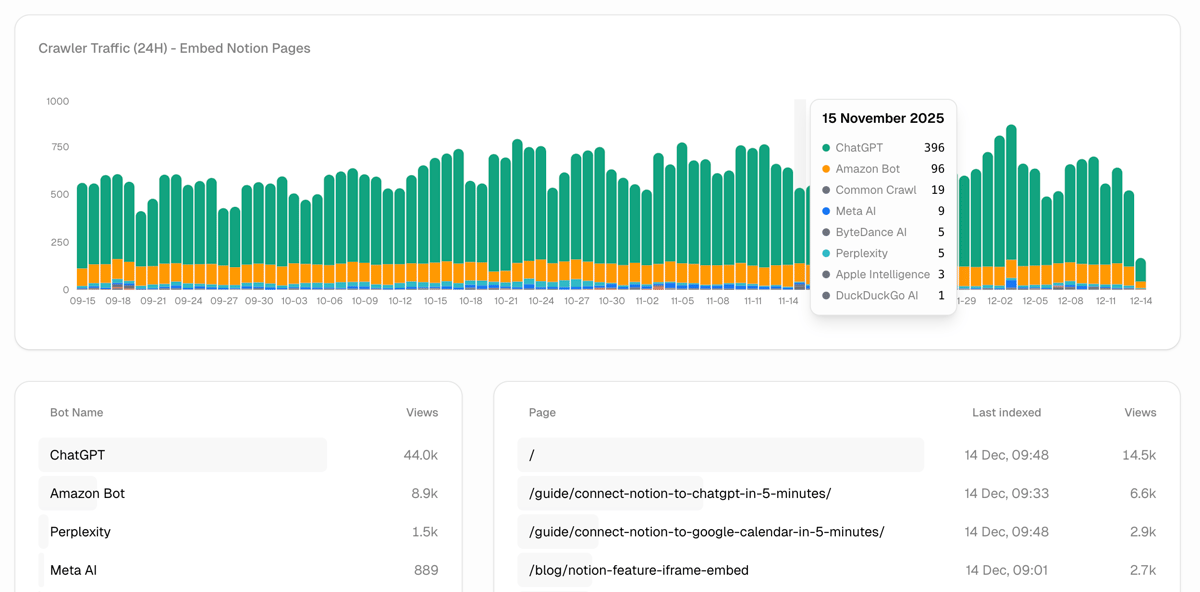
Before you ever get a visit or a lead, an AI model has to 'see' your site.
This happens when AI crawlers from ChatGPT or Perplexity access your content to answer live user questions.
That's an AI search impression — your brand is being read, cited, or mentioned.
Why it matters
If your pages are being fetched regularly, you’re part of the AI discovery ecosystem.
If not, you’re not even in the running.
The caveats
- A crawl doesn’t always mean your content appeared in an answer (over-reporting).
- Some answers pull from pre-trained content, which doesn’t trigger a crawl (under-reporting).
- You can’t know where your content appeared in the answer — top or buried.
Still, impressions are your best indicator of AI visibility trends: are you more or less visible in LLMs over time?
2. Track visits -> when users click-through 🖱️
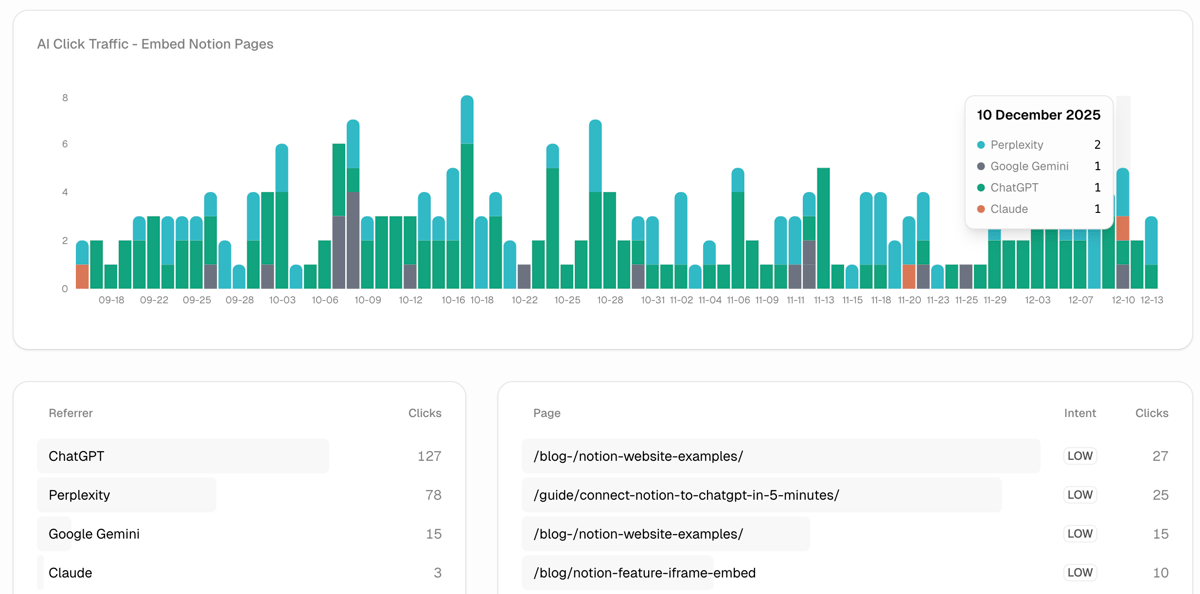
When your brand is mentioned in an LLM answer and a user clicks to visit your website, that’s an AI search visit — the most visible signal of real discovery.
You can spot these in Google Analytics (GA4) by filtering the source e.g. source contains chatgpt
The caveat: massively under-reporting
Most LLMs mentions don’t include links, so when users discover your brand in an answer - what do they do next?They guess the website URL by typing directly in the browser OR search your brand on Google and click on it in the SERP.In both cases, most anlaytics platforms (e.g. Google Analytics) attributes the visit to direct or organic, not chatgpt.
That’s why the real traffic from ChatGPT is often 10x higher than what shows up in analytics.
Even so, tracking the few visible visits you do get is still valuable — they show you are getting traffic and what are your most discoverable pages.
3. Track leads -> when users convert 📝
If a visitor comes from AI search and signs up / books a demo / buys your product, you should know about it.
As explained earlier, analytics can’t report on this accurately — so the only reliable way is self-attribution.
Add a short “How did you hear about us?” field to your signup form. Include “AI search” as one of the options.
That single field will reveal how much of your pipeline originates from AI mentions — and you’ll likely find it’s much higher than what analytics tools suggest.
4. Track share of voice -> when users search your service 🏅
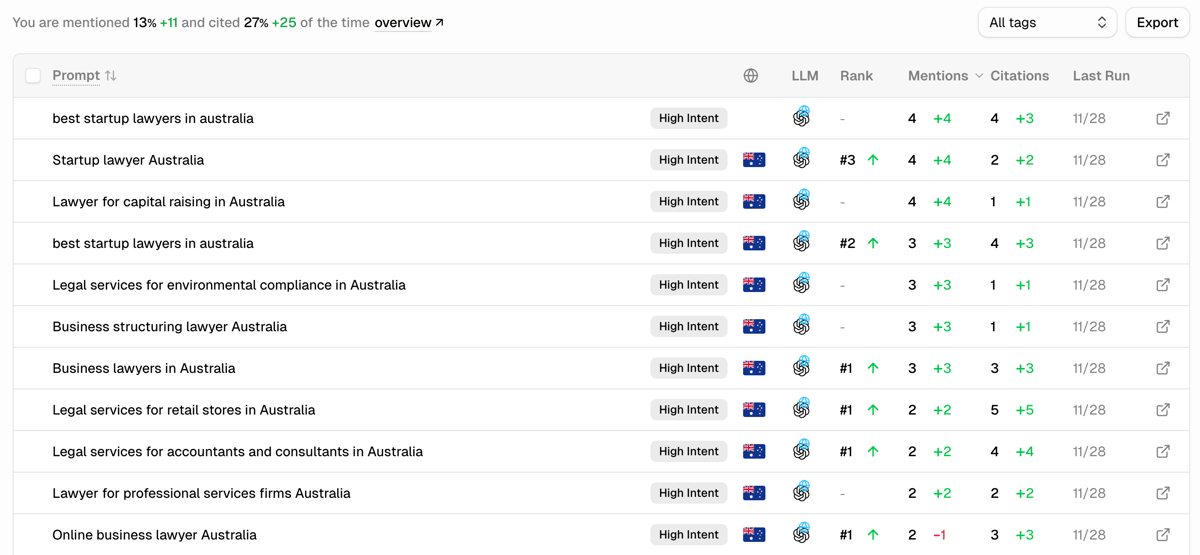
LLMs don't share search data, so it's impossible (today) to know what exact prompts drive impressions, visits and signups to your site.
Until this data becomes available, the best thing you can do is monitor the most important prompts for your brand, and see if you're mentioned or not in those versus your competitors.
There are two prompt categories worth tracking:
- High-intent prompts — “best [category] tool,” “alternatives to [competitor]” - 20 to 100 prompts
- Competitor alternatives — prompts that compare or replace another product - 10 to 30 prompts
By tracking these prompts, you’ll see how often your brand appears % vs your competitors. That’s your AI share of voice.
If you are in multiple markets, you should track each separately e.g. UK share of voice, USA share of voice.
The caveat: LLMs are non-deterministic
LLMs don’t always give the same answer twice — even for the exact same question.
That means your brand might appear in one response but not in another, even seconds apart.
How to get around it:
- Track enough prompts (not just 5 or 10) to smooth out randomness.
- Regular rerun — daily or every other day — to see consistent trends rather than one-off spikes.
You’re not measuring a fixed ranking like in SEO; you’re tracking your visibility probability — how often your brand surfaces across enough prompts and enough run.
How to set this up
Visits data is in most visitor analytics platform, Google Analytics included.
Sign up data is something you can set up and track relatively easily with any CRM.
Crawler data can be extracted from your server logs but it's not always easy to access or use.
Share of voice data can be checked manually, one by one, but i'd be very time consuming.
There are a plethora of tools that help with the last two, but expect to easily spend >$100/month.
We're building Airefs so you can track these metrics without breaking the bank:
- AI search impressions: when LLM crawlers access your content.
- .AI search visits: when users click your brand from LLMs.
- AI share of voice: how often your brand appears across ChatGPT.
To set it up:
- Create an account
- Add your prompts -> share of voice.
- Integrate crawler analytics -> AI search impressions & visits.
Within 24 hours, you'll track impressions, clicks, mentions and citations.
Final Thought
AI search isn’t just a new traffic source — it’s a structural shift in how people discover brands.
Like any new marketing channel, it has its own funnel — impressions, visits, leads, share of voice — and most brands don’t track any of it.
That gap creates a real opportunity, especially for smaller brands that want to compete on visibility rather than budget.