The Lazy Myth That Won’t Die
For months I’ve watched the same shallow hot-takes cycle through LinkedIn like a seasonal flu: “AI will replace juniors.” “Companies don’t need entry-level engineers.” “One senior + ChatGPT = a whole team.”
It’s nonsense. And not even interesting nonsense. It’s the kind of nonsense you hear from people who’ve never built or scaled anything remotely complex.
I wanted to address this earlier, but I didn’t want my response to be yet another “senior tech person ranting from their gut.” I wanted data. A real example. A concrete baseline. The problem is simple: my ADHD refuses to let me waste half a day polishing a case study just to prove an obvious point.
Then yesterday I had to build a prototype anyway for an unrelated reason. The opportunity was too perfect: Do the work. Capture the numbers. Kill two birds with one stone.
The Real-World Scenario
Let’s define the setup.
You have a small team:
- One Senior Engineer
- One Junior Engineer
Their job: build a prototype of a distributed system. Any real engineering leader knows this is not trivial.
Two questions matter:
- With and without AI, how long would the prototype actually take?
- Is replacing the junior with AI actually cheaper or more efficient?
The internet loves theoretical arguments. I don’t. I prefer what happens when you sit down, build something real, and force reality to answer.
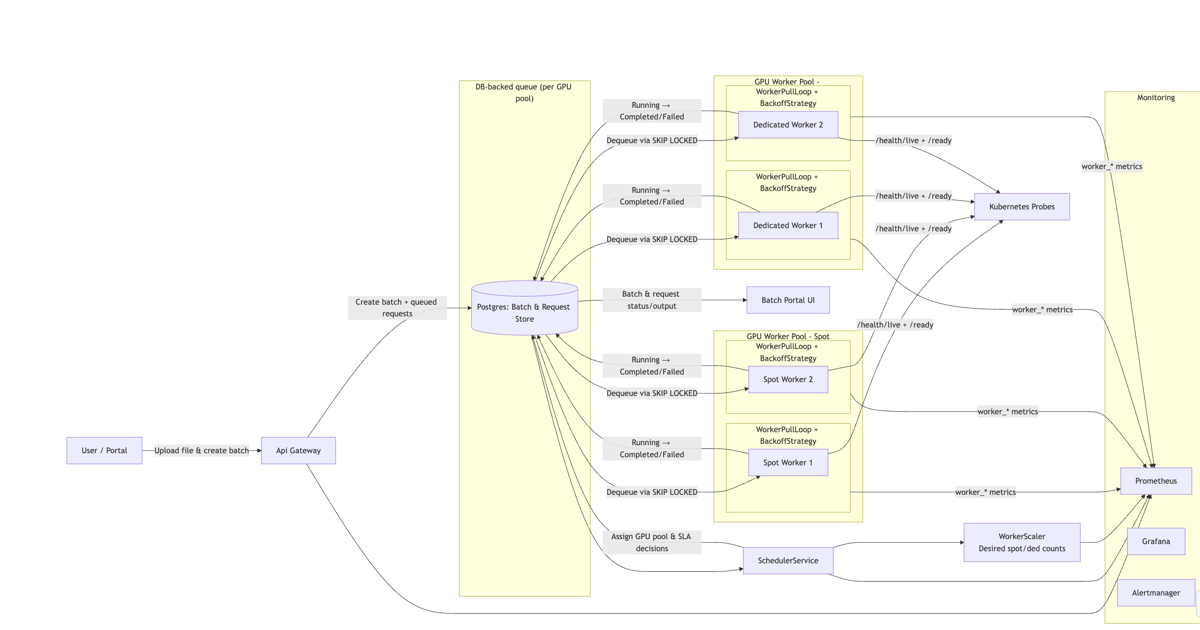
The Prototype: A Mini “OpenAI Batch API”
To make this concrete, I built a small-scale simulation of OpenAI’s Batch Processing API.
This was not “toy code” or a weekend hack. It was a full distributed simulation with:
- Scheduling
- Orchestration
- Workflows
- Monitoring
- Worker pools
- Retries
- APIs
- Ingestion layers
- A basic UI
- CI friction, dependency alignment, exception handling—everything you’d hit in a real system
The only thing missing was actual cloud hooks and live inference, because that wasn’t the point.
This was about engineering complexity, not GPU allocations.
The Baseline: How Long Should This Take Without AI?
In the real world, with a competent senior and a decent junior, a system like this takes:
- 3–6 months of work, depending on the environment, interrupts, and context switching
- The midpoint is around 4.5 months
This is standard. This is normal. This is how real systems get built.
Enter AI: The Productivity Shock Is Real
With AI, the numbers are brutally clear:
- Total time: 15 hours
- Lines of code generated: ~130,000 (not counting comments/blanks)
- Manual code written by me: 0
AI obliterated the timeline. No argument there. The productivity jump is insane.
But here’s the important part:
Only 1 of those 15 hours required senior-level thinking. Architecture. High-level direction. Correcting conceptual drift. The real engineering.
The other 14 hours were spent on:
- Exception fixes
- Structural refactors
- CI headaches
- Dependency nonsense
- Naming
- Formatting
- Aligning generated components
- Chasing compiler errors
- Cleaning up misaligned function signatures
- The low-level grind that juniors usually handle
This is the part that AI still doesn’t replace. It accelerates it, sure, but doesn’t eliminate it.
The Cost Model: The Myth Falls Apart Fast
Let’s talk money because the “AI replaces juniors” argument always pretends that cost is the only metric.
Assume:
- Senior hourly cost: 3X
- Junior hourly cost: X
Scenario A: Senior + Junior
The 14 hours of grunt work would take a junior about 28 hours.
Cost: 28 hours × X = 28X 1 senior hour × 3X = 3X Total = 31X
Scenario B: Senior Alone Using AI
15 hours × 3X = 45X
That’s 45% more expensive.
And this is the best-case scenario—no meetings, no external blockers, no infra requests, no stakeholder noise.
Even fully turbo-charged with AI, replacing the junior is economically stupid.
The Strategic Cost: This Is the Part Leaders Ignore
Everybody loves talking about short-term cost savings. Very few talk about long-term engineering survivability.
Fire all your juniors today and here’s what you’re actually doing:
- You eliminate your future seniors.
- You remove your talent pipeline.
- You set yourself up for catastrophic hiring shortages.
- You will not be able to replace your current seniors when they leave.
- When you eventually have to hire seniors externally, you’ll be quoted prices that make your finance team cry.
This is not hypothetical. Every industry that automated anything has followed the same curve.
History Already Settled This Debate
The oldest example is agriculture.
Before machines:
- Massive labor force
- Slow increase in yield
- High cost per acre
After machines: We didn’t “replace farmers.” We expanded agriculture into a global industry:
- More land
- More crop variety
- More logistics
- More processing
- More manufacturing
- More jobs
The workforce didn’t shrink. The surface area of the work exploded.
AI is the next version of the same pattern.
The Accountant Mindset vs. The Builder Mindset
Companies obsessed with eliminating juniors are thinking like bookkeepers:
“How can we shrink the line items on this spreadsheet?”
Builders think differently:
“How do we expand our capability, surface area, and velocity?”
AI is not a headcount reduction tool. It’s a capacity multiplier.
If you shrink your workforce now because “AI exists,” you aren’t innovating. You’re playing corporate Hunger Games with your future talent pool.
The Right Move: Keep Your Juniors, Scale Your Ambition
If you’re serious about the future:
- Keep the juniors
- Offload grunt work to AI
- Use your seniors where they matter
- Expand your roadmap
- Build more products
- Capture more market
- Increase your economic footprint
- Scale your engineering bandwidth beyond what was humanly possible before
AI’s job is to eliminate the meaningless work, not the people.
If Anything Gets Replaced, It Won’t Be Engineers
The irony is almost comedic.
If someone is getting “replaced,” it’s not the engineers. It’s the leaders who can’t think beyond cutting headcount.
If you can’t understand how capacity scaling, talent pipelines, and long-term engineering strategy work, AI won’t replace your team—it’ll replace your leadership.
The market will do that for you.
A Quick Look at the System Built in ~15 Hours: