This question comes up a lot.
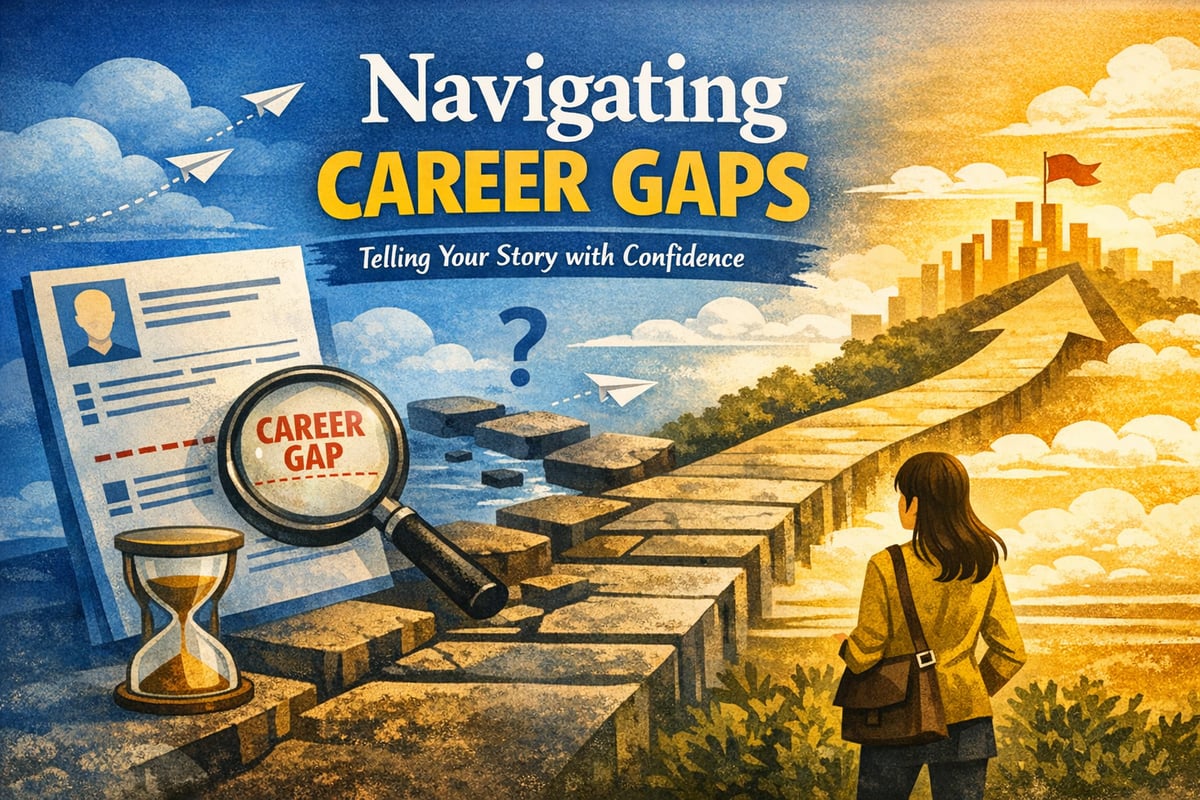
“I have a gap on my CV. Is that going to ruin my chances?”
Many people worry about career gaps because they feel like a visible break in momentum — something recruiters will immediately judge or question. The assumption is often, “If my CV isn’t continuous, it must look like failure.”

But that assumption doesn’t reflect how modern careers actually work.
Layoffs, burnout, caregiving responsibilities, health issues, relocation, career pivots, or simply needing space to reassess are all increasingly common. Most recruiters see gaps every day. What creates hesitation isn’t the gap itself — it’s when the gap is unexplained, over‑explained, or framed apologetically.
In other words, gaps don’t damage credibility on their own. Confusion does.
Career gaps are often identity gaps, not timeline gaps
When people worry about career gaps, they often focus on the visible timeline — the months or years that don’t neatly connect on a CV. But in mentoring conversations, what usually sits underneath the anxiety is something deeper: a quiet shift in identity.
A gap can leave you questioning not just what you did, but who you are now.
Am I still experienced enough?
Do I still have momentum?
Does my past self still make sense in this next chapter?
That internal uncertainty is far more destabilising than the gap itself. And it has a way of leaking into how people write CVs, answer interview questions, and talk about themselves — often without realising it.
This is why two people with identical gaps can come across very differently. One feels defensive, hesitant, or apologetic. The other feels settled, clear, and grounded. The difference isn’t the timeline — it’s whether they’ve reconciled the meaning of that time in their own story.
Explaining your story vs. standing by it
There’s an important difference between explaining your career story and standing by it.
Explaining often sounds like:
- “I know this might look bad, but…”
- “I just want to clarify why…”
- “It wasn’t ideal, but…”
Standing by it sounds more like:
- “I took a break during that period, and I’m clear on where I’m going next.”
- “That time helped me reassess what matters in my work.”
- “Since then, I’ve been deliberate about my direction.”
The second approach isn’t louder or more detailed — it’s quieter. It doesn’t seek approval. It doesn’t ask for permission. It simply states reality and moves forward.
This distinction matters because most interviewers aren’t listening for justification. They’re listening for alignment: does this person understand themselves, and does their next step make sense?
When you stand by your story, you leave less room for doubt — not by filling the space with words, but by occupying it with confidence.
The key reframe that reduces anxiety
Once you stop trying to defend the gap, space opens up for a much clearer narrative.Here’s the single most important thing to understand:
Career gaps only become a problem when they break the story of where you’re going next.
Hiring decisions are forward‑looking. Recruiters are not trying to audit your past — they’re trying to understand:
- What you’re targeting now
- Whether you’re ready for it
- Whether your story makes sense
When the narrative is clear and confident, most gaps fade into the background.
A simple framework to frame any career gap
No matter why your gap exists, it can almost always be handled with the same three steps:
1. Name it briefly
This removes uncertainty.
Examples:
- Career break || Personal sabbatical || Transition period
Avoid drama and detail.
2. Neutralise it
This reassures the reader that the gap is complete and intentional.
Examples:
- Intentional pause || Temporary break || Completed and resolved
You don’t owe anyone your personal history.
3. Re‑anchor the focus on the future
This is the most important step — and the one many people skip.
Examples:
- Now focused on X role || Returning with clarity around Y || Deliberately targeting Z
The goal is to move attention forward, not backward.
One sentence is usually enough. Two is the maximum.
How to talk about gaps in interviews
You don’t need a long explanation. In most cases, a short, confident answer is best.

Here’s a strong example you can adapt:
“I took a break during that period, which was intentional and temporary. What matters more is that since then I’ve been very deliberate about where I’m going next — specifically [role], where I bring strength in [skill 1] and [skill 2]. That clarity is what’s driving my search now.”
Then stop talking.
If the interviewer wants more context, they’ll ask.
Confidence is something you practise, not something recruiters grant you
One quiet truth about career gaps is that confidence rarely arrives after external validation. It usually arrives before it.
Many people wait for their CV to feel perfect, for their explanation to feel airtight, or for someone to reassure them that their gap is “acceptable” before they allow themselves to feel secure again. But confidence doesn’t work that way. It isn’t a reward granted by recruiters or hiring managers — it’s a posture you choose to take before they ever meet you.
This doesn’t mean ignoring doubt or pretending uncertainty never existed. It means recognising that careers are shaped by decisions made in real circumstances, not ideal ones. Stepping away, slowing down, or changing direction doesn’t erase your capability. It simply means your path took a different shape for a while.
This is often where mentoring makes the biggest difference. Not by rewriting the past, but by helping someone reconnect with the parts of their story that still matter: the skills that didn’t disappear, the experience that still holds weight, and the clarity that has often grown during the gap.
Once you see your gap as a chapter rather than a flaw, something shifts. You stop waiting for permission to move on. You stop bracing yourself for judgement. And when you speak about your experience, it sounds less like an explanation and more like a fact.
That steadiness is what people respond to. Not because your career was uninterrupted — but because you are.
A final thought
Most careers are not neat, linear stories — even if LinkedIn makes them look that way. Having a gap doesn’t mean your chances are gone. It simply means your story needs to be told with intention.
You don’t need to erase the gap. You don’t need to justify it.
You need a clear, confident narrative that shows where you are now — and where you’re going next.