Michael sat in yet another quarterly strategy meeting, contributing little. Not because he had nothing to say—he’d led operational transformations across three continents—but because the conversation happened without him now. His insights were acknowledged with polite nods before the discussion returned to the CFO and COO. When had he become background noise in his own area of expertise? Michael was experiencing what thousands of senior professionals face: an executive career plateau.
You’ve spent years building your executive career with deliberate focus. You’ve delivered results, developed teams, and demonstrated leadership. Yet recently, something has shifted. Promotions go to others. Strategic projects exclude you. Your professional growth has stalled, but you can’t quite articulate why—or admit it to yourself. These are classic signs of an executive career plateau.
This article provides a comprehensive framework for recognising and addressing career plateau at the executive level. You’ll gain diagnostic tools used by executive coaches to assess career stagnation, understand industry-specific plateau indicators, and learn why early recognition of executive career plateau is your strategic advantage—not an admission of failure.
Over two decades supporting executive transitions across the UK, USA, UAE, and Saudi Arabia, I’ve observed that the professionals who thrive are those who recognise career plateau signals early. The difference between those who stagnate for years and those who strategically advance? Honest self-assessment and timely action when facing executive career plateau.
The Executive Career Plateau: A Framework for Recognition
Unlike redundancy or poor performance, executive career plateau is insidious. You’re still valued—just not for advancement. You receive positive reviews, perhaps modest increases, but the trajectory has flattened. Your organisational equity has reached its peak return. According to Harvard Business Review research on career management, recognising this pattern early is critical for maintaining long-term career momentum.
Understanding executive career plateau requires examining three distinct dimensions simultaneously. This framework, developed through years of executive coaching practice, helps professionals identify genuine career plateau versus temporary setbacks.
Organisational Signals reveal how your employer views your future. When you’re experiencing career plateau, promotion cycles bypass you repeatedly, with explanations that feel simultaneously valid and hollow. Budget authority remains static whilst peers gain expanded portfolios. Strategic planning sessions occur without your involvement in areas you previously influenced. Succession planning conversations exclude you from next-level roles. Your expertise is sought for execution, rarely for strategy. Mentor relationships with senior leaders have cooled or become transactional.
Market Indicators show how your value is perceived externally during an executive career plateau. Executive recruiters contact you for lateral moves, not upward progression. Your industry peers secure promotions or transitions you’d be qualified for. Your compensation has fallen behind market rates for your experience level. Professional network conversations reveal others’ advancement whilst your situation remains static. Industry evolution introduces skills and experiences you lack access to develop internally. LinkedIn profile views come from competitors seeking your current-level expertise, not senior-level opportunities.
Personal Readiness Factors reflect your psychological and practical preparation when facing career plateau. Your engagement and energy for current responsibilities has noticeably declined. You’ve mastered your role to the point of autopilot execution. Risk tolerance has increased—you’re more willing to consider significant change. You’ve developed a clear vision of roles beyond your current position. Professional learning has plateaued; you’re no longer acquiring new capabilities. Work-life balance has shifted, with personal priorities gaining importance.
The framework’s power lies in examining all three dimensions together. One or two indicators might represent temporary challenges. When patterns emerge across all three? You’re witnessing genuine executive career plateau.
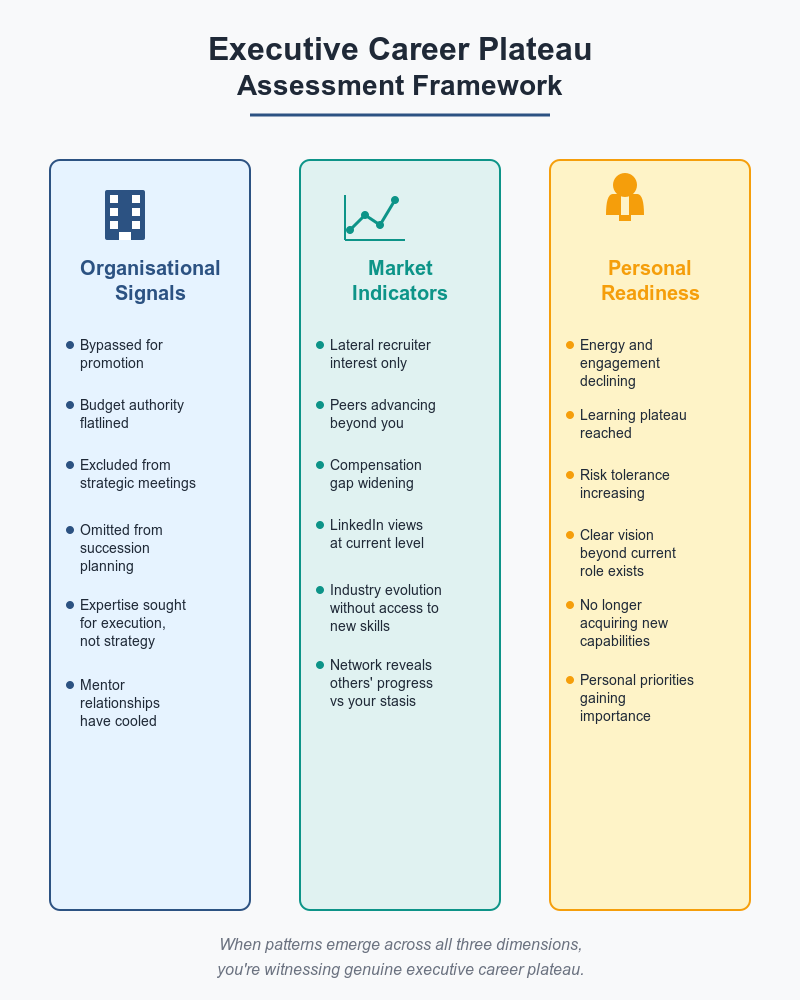
Use this three-dimensional framework to assess whether you’re experiencing genuine executive career plateau or temporary career challenges.
The GCC Factor: When Nationalisation Policies Accelerate Executive Career Plateau
For international executives in the Gulf Cooperation Council region, career plateau recognition carries additional complexity. Government nationalisation policies—Emiratisation in the UAE, Vision 2030’s Saudisation agenda in Saudi Arabia, Qatarisation in Qatar, and parallel programmes across Kuwait and Oman—fundamentally reshape advancement opportunities for expat professionals. These policies can trigger executive career plateau far earlier than in home markets.
Understanding the Nationalisation Impact
These policies aren’t merely ambitious targets; they’re enforced through quota systems, financial incentives for employers, and in Saudi Arabia’s case, the Nitaqat classification system that directly impacts business operations. The practical effect? Organisations actively develop national talent pipelines that will, by design, limit international executive progression over time, often creating an artificial career plateau for expatriate professionals.
The impact varies significantly by level and sector. C-suite positions in specialised areas—technology transformation, international business development, complex technical disciplines—remain largely open to international talent. Governments recognise these roles require expertise not yet developed domestically at scale. If you’re targeting CFO, CTO, or Chief Transformation Officer positions, nationalisation creates less immediate career plateau concern.
Director and senior management levels face considerably more pressure from these policies. These are precisely the roles governments want nationals to occupy as part of leadership development pathways. A Director of Operations or HR Director position you might naturally progress to could be designated for a national candidate, regardless of your performance or tenure—creating an organisational ceiling that defines executive career plateau.
Middle management positions are experiencing the most aggressive nationalisation, particularly in banking, telecommunications, government-linked entities, and large national corporations. If your career path involves progression through middle management ranks, the plateau may arrive far sooner than in your home market.
Sector-Specific Realities
Certain industries maintain strong international executive demand. Technology and digital transformation continues to recruit internationally due to shortages in AI, cybersecurity, cloud architecture, and digital strategy. Healthcare specialisation in complex medical specialties, hospital administration, and healthcare technology remains open. Energy transition sectors including renewable energy, sustainability programmes, carbon capture, and hydrogen economy actively seek international expertise. Professional services—Big Four consulting, legal, and specialised advisory where international credentials matter—maintain demand. International business development roles requiring global networks continue recruiting expats.
Conversely, banking and financial services (particularly retail banking), telecommunications, government-linked entities, education administration, and retail and hospitality management are rapidly nationalising executive roles, accelerating career plateau for international professionals.
Contract Structure Changes Signal Career Plateau
Pay attention to contract renewal terms. The shift from indefinite contracts to fixed-term agreements (common in UAE) or increasingly restrictive renewal conditions often precedes formal nationalisation of your role level. When your organisation begins hiring nationals into roles parallel to yours, or when your renewal comes with expanded “knowledge transfer” responsibilities, recognise these as executive career plateau indicators.
Strategic international executives are repositioning themselves as “knowledge transfer specialists”—experts who explicitly build national talent capability whilst maintaining strategic value. This approach can extend your career runway and delay plateau, but requires honest assessment: Are you genuinely building succession, or are you training your replacement without strategic protection?
Industry-Specific Career Plateau Indicators
Executive career plateau manifests differently across sectors. Recognising your industry’s specific indicators allows earlier, more accurate assessment. What signals career stagnation in technology differs markedly from financial services or healthcare, though the underlying executive career plateau patterns remain consistent.

Technology Sector
The technology industry presents unique career plateau challenges. Rapid evolution means your expertise can become less valued even as you gain experience. Ceiling indicators include younger professionals with current technical stacks advancing past you in architecture or strategy roles. Your skillset becomes increasingly labelled “legacy” even if commercially critical. Product management or technical leadership roles consistently go to candidates with different (newer) experience profiles. Organisational restructuring creates new executive positions you’re not considered for despite relevant experience. Age becomes a factor in team composition discussions, often unstated but observable.
The technology sector’s preference for “digital native” leaders can create executive career plateau as early as mid-40s for some professionals, regardless of capability.
Financial Services
Banking, insurance, and investment sectors display distinct career plateau patterns. Regulatory complexity increases create specialist roles that fragment traditional advancement paths. Digital transformation initiatives are led by externally hired “change agents” rather than internal advancement. Relationship banking roles become less valued as digital channels dominate. Risk and compliance functions expand, but traditional banking executives struggle to transition. Merger and acquisition activity creates redundancy at specific levels, compressing advancement opportunities. Partnership or Managing Director tracks become explicitly closed or infinitely delayed.
If you’re in financial services, executive career plateau often appears when your “book of business” or revenue responsibility stops growing despite maintained performance.
Healthcare
Healthcare executives face the clinical versus administrative divide that often creates career plateau. Clinical professionals (doctors, nurses in management) hit ceiling when they can’t progress without abandoning clinical practice. Administrative executives plateau when healthcare organisations prioritise clinical credentials for senior leadership. Operational excellence matters less than strategic transformation capability in expanding organisations. Private healthcare growth creates new organisations with external executive hires rather than internal promotion. NHS executives face structural limitations in certain bands or trust sizes. Specialised healthcare (mental health, elderly care) has limited senior-level positions.
Healthcare career plateau often relates to the size and type of your current organisation. Leading a 200-bed community hospital limits your next-level options significantly.
Energy Sector
Traditional energy professionals face unique transition challenges that often result in career plateau. Oil and gas expertise becomes less valued as organisations pivot to renewables. Engineering backgrounds struggle to convert to strategic energy transition roles. International experience in traditional energy doesn’t translate to renewable project development. Shrinking traditional energy organisations offer fewer advancement positions. New renewable energy leaders come from technology, project finance, or development backgrounds. Your established expertise in conventional energy becomes a ceiling rather than asset.
Energy sector executives must honestly assess whether their organisation is genuinely transitioning or managing decline—these require completely different strategies to address executive career plateau.
Professional Services
Consulting, legal, accounting, and advisory firms create explicit career plateau. Partnership track timelines become clear; indefinite “senior associate” or “director” status signals plateau. Client relationship ownership determines advancement; supporting roles plateau regardless of technical excellence. Up-or-out cultures force recognition, but many firms now create permanent non-partner senior roles (a ceiling by design). Specialisation that was initially valued becomes limiting when partnership requires business development across practices. Industry focus that built your reputation limits ability to serve broader client base required for partnership.
Professional services makes executive career plateau relatively transparent: if you’re not on partnership track after 8-12 years, you’ve likely reached your firm’s ceiling for your profile.
The Cost of Staying Too Long in Career Plateau
Understanding what you lose by remaining in an executive career plateau creates urgency for honest assessment. Research from the Chartered Institute of Personnel and Development demonstrates that the costs compound over time, making early recognition of career plateau exponentially more valuable than delayed action.
Financial Penalties of Career Plateau
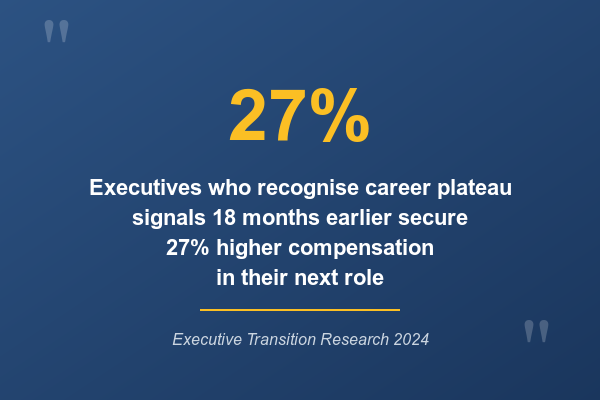
Executive career plateau directly impacts your earning trajectory. Research consistently shows executives who recognise plateau signals within 12-18 months and transition strategically achieve 15-30% compensation increases in their next role. Those who remain in career plateau for 3+ years before transitioning typically achieve only 5-12% increases—or in some cases, lateral moves at similar compensation.
The mechanism is straightforward: Your market value reflects your most recent progression and achievements. A three-year executive career plateau signals to prospective employers that you’ve reached your capability ceiling. You’re negotiating from weakness rather than strength. Meanwhile, your compensation becomes increasingly misaligned with advancing peers, creating a gap that’s difficult to close.
In GCC markets, this effect is amplified. International executives whose contracts aren’t renewed due to nationalisation often face 20-40% compensation reductions when returning to home markets mid-career, particularly if the career plateau gap creates employment continuity concerns.
Professional Relevance Erosion
Career plateau means you’re not developing new capabilities, leading new initiatives, or solving novel problems. Your experience becomes repetitive rather than expansive. Recruiters and hiring executives can spot this executive career plateau immediately. Your CV shows the same responsibilities across multiple years. Your interview examples come from increasingly dated situations. Your professional network hasn’t expanded into new domains. Your expertise, whilst deep, hasn’t broadened.
The professional cost of career plateau accelerates in rapidly evolving sectors. A three-year technology plateau might mean you’ve missed entire technological transitions. In financial services, you’ve missed regulatory changes and digital transformation waves. Your expertise ages in double-time whilst you remain static in executive career plateau.
Psychological Deterioration
Perhaps most insidious is the psychological cost of executive career plateau. Career stagnation erodes professional identity—you define yourself by roles and achievements that are now past-tense. Engagement suffers as work becomes obligatory rather than energising; autopilot replaces strategic thinking. Confidence declines as prolonged career plateau creates self-doubt about whether you’re capable of more. Risk tolerance paradoxically decreases—the longer you experience executive career plateau, the scarier change becomes, creating a vicious cycle.
I’ve worked with executives who experienced career plateau for 5+ years and describe feeling “professionally invisible”—present but not relevant, valued but not valuable. This psychological state makes the eventual transition from executive career plateau dramatically more difficult.
Network Atrophy
Professional relationships require currency. When you’re advancing, people want to maintain connection—you’re a rising asset. When you’re experiencing career plateau, you become less relevant to others’ networks. Your mentors and sponsors shift attention to advancing professionals. Your peers who’ve progressed develop new networks at their levels. Your industry relationships weaken as you’re no longer in strategic conversations or visible leadership.
This network cost is particularly severe for international executives in career plateau. Your home-market network naturally weakens during overseas assignments. If you plateau overseas without building strategic international connections, you’ve lost both networks simultaneously.
Opportunity Cost
Every year spent in executive career plateau is a year not spent building your next chapter. If you’re 45 and experience career plateau for four years, you’re 49 when you finally transition—with less runway to establish yourself in a senior role and build the career equity required for board positions or portfolio careers.
The mathematics are unforgiving: Start your strategic transition from career plateau at 46, and you have 15-20 years to maximise next-level impact. Start at 52, and you have 8-12 years—dramatically different opportunity horizons.
Your Personal Executive Career Plateau Assessment
Abstract recognition of career plateau isn’t sufficient. You need structured assessment that moves beyond feeling to evidence-based evaluation. This diagnostic tool helps you determine whether you’re experiencing genuine executive career plateau or temporary career challenges.
The Career Plateau Diagnostic
Rate each statement on a scale of 1-5 (1 = Strongly Disagree, 5 = Strongly Agree):
Organisational Indicators:
- I’ve been bypassed for promotion at least twice in the past 18-24 months
- My budget authority and team size have remained static for 2+ years
- Strategic planning conversations happen without my involvement in my areas of expertise
- When organisational changes occur, I learn about them the same time as everyone else
- My role in major projects has shifted from leading to supporting
- Feedback emphasises my current contributions but doesn’t reference future potential
- Succession planning discussions exclude me from next-level positions
Market Indicators:
- Executive recruiters contact me for lateral moves, not advancement opportunities
- My compensation has fallen behind market rates for my experience level
- Peers with similar backgrounds have advanced beyond my level
- My LinkedIn profile attracts interest for my current level, not senior roles
- Industry evolution includes skills and experiences I can’t develop in my current role
- When I network, others’ career progression contrasts notably with my static situation
Personal Readiness Indicators:
- My energy and engagement for work has noticeably declined over the past year
- I’ve mastered my responsibilities to the point of routine execution
- I find myself more willing to consider significant career change than previously
- I have a clear vision of roles beyond my current position
- My professional learning has plateaued; I’m no longer acquiring new capabilities
- I increasingly prioritise personal life over professional advancement
- I feel underutilised relative to my capabilities and experience
Scoring Interpretation
70-100 points (Significant Career Plateau): Multiple strong indicators across all three dimensions. You’ve almost certainly reached an executive career plateau. Strategic transition planning should begin immediately. Your market value is at or near its peak in your current context; delay will only erode positioning.
50-69 points (Moderate Career Plateau): Clear patterns emerging, particularly if scores are concentrated in specific dimensions. If organisational and market indicators are high but personal readiness is low, you’re in denial about your executive career plateau. If personal readiness is high but other indicators are lower, you might be experiencing temporary challenges rather than genuine plateau—or you’re recognising early. Requires deeper analysis and three-month reassessment.
30-49 points (Early Warning): Some indicators present, but not yet definitive career plateau pattern. This is actually optimal recognition timing—you have strategic advantage. Begin career options analysis, enhance your professional positioning, and reassess quarterly. You’re recognising potential executive career plateau before it fully forms.
Below 30 points (No Current Plateau): Either you’re genuinely advancing and this article isn’t yet relevant, or you’re not recognising signals. Have a trusted mentor or coach review your assessment for blind spots. Professionals deep in career plateau sometimes score themselves low due to rationalisation.
Critical Warning Signs
Regardless of overall score, these individual indicators demand immediate attention as they signal serious executive career plateau:
- Scored 5 on question 1 (repeated promotion bypass)
- Scored 5 on question 7 (succession planning exclusion)
- Scored 5 on question 10 (peers advancing significantly beyond you)
- Combined score of 13-15 on questions 14, 15, and 17 (engagement erosion and vision beyond current role)
These patterns suggest you’ve moved beyond early career plateau into established ceiling with psychological impact.
Creating Your Baseline
Date your executive career plateau assessment and file it. Repeat quarterly. Career plateau develops gradually; baseline comparison reveals patterns you might not notice month-to-month. Share your assessment with a trusted advisor who’ll give you honest perspective rather than comfortable reassurance about your career plateau situation.
When to Seek External Perspective
Self-assessment of career plateau has inherent limitations. Consider engaging a career coach or executive mentor when your scores suggest plateau but you’re uncertain about interpretation, you recognise executive career plateau but don’t know whether to pursue internal repositioning or external transition, psychological factors are clouding your judgement, you need accountability to move from recognition to action, or you’re in a GCC market and need expertise on nationalisation timing and home market positioning after career plateau.
Recognised Your Executive Career Plateau? Here’s Your Strategic Exit Plan
If this assessment reveals you’ve reached an executive career plateau, you’re facing a critical decision point. The difference between successful executive transition and prolonged career stagnation? Structured strategy and expert guidance.
Case Study: Mo’s Recognition of Executive Career Plateau
Mo’s story illustrates how career plateau recognition unfolds in practice—and why early action matters when facing executive career stagnation.
Background
M0, 43, served as Operations Director for a UK-based healthcare technology company. He’d joined eight years earlier as a senior manager and progressed to director within four years. For the past four years, his role remained essentially unchanged. Annual reviews were positive. His team delivered results. Nothing was wrong—and that was precisely the problem. Mo was experiencing classic executive career plateau.
The Organisational Signals
The first indicator of career plateau came 18 months before Mo took action. The company hired a Chief Operating Officer externally—a role Mo had assumed he was being positioned for. The explanation seemed reasonable: “We needed someone with scaling experience in US markets.” Mo accepted this, rationalising that he’d gain valuable exposure working with the new COO.
Six months later, during restructuring, the COO created a new Director of Strategic Operations position. Mo wasn’t considered. Instead, a younger director from another division was promoted. The feedback? “We need fresh thinking in strategic operations.” Mo felt the sting but told himself he was valued in his current capacity, not yet recognising the career plateau forming.
The pattern became undeniable when succession planning sessions occurred without his involvement. He manager assured him that his role was secure and valued, but stopped discussing his advancement timeline. Budget authority that had grown steadily from 2017-2020 had been frozen since 2021. The executive career plateau was now unmistakable.
The Market Indicators
Mo attended an industry conference and reconnected with peers from early in his career. The contrast was stark: several had progressed to COO or VP Operations roles whilst he remained in career plateau. Recruiters contacted him regularly, but always for lateral Operations Director positions—never for advancement opportunities.
He updated his LinkedIn profile and noticed a pattern consistent with career plateau: profile views came from companies seeking Operations Directors, not COO or VP-level roles. His experience was valued, but at a level he’d already achieved.
Compensation told the story most clearly. Mo’s salary had grown 3-4% annually, but research revealed he’d fallen 12-15% behind market rates for COO-level executives with his experience. He was being paid as a stable Operations Director experiencing career plateau, not an advancing executive.
The Personal Readiness Factors
The psychological shift of career plateau occurred gradually. Mo found himself “going through the motions”—delivering results but without the engagement he’d once felt. Sunday evenings brought dread rather than anticipation. He’d mastered his role to the point where it no longer challenged him.
He began fantasising about different roles: COO at a mid-sized healthcare company, VP Operations at a technology firm, even exploring consultancy. He’d developed a clear vision beyond his current position but no path to get there internally. His executive career plateau had become psychologically as well as organisationally real.
Most tellingly, his risk tolerance had shifted. Previously, he’d prioritised security and steady progression. Now, he felt more willing to consider significant change. The prospect of another year in career plateau felt more risky than a strategic career move.
The Recognition Trigger
Mo’s moment of clarity about his executive career plateau came during a chance conversation with an executive coach at a professional development event. The coach asked a simple question: “When you describe your role, you use past-tense language—’we implemented,’ ‘we transformed,’ ‘we achieved.’ What are you implementing now?”
Mo had no clear answer. His current work maintained systems he’d built years earlier. He’d reached his ceiling. His executive career plateau was undeniable.
The Decision Process
Mo considered two paths from his career plateau: internal repositioning or external transition. He approached his manager for a candid conversation about advancement timeline. The response was sympathetic but clear: “You’re incredibly valuable where you are. We don’t see restructuring that would create COO-level opportunities for 2-3 years, and even then, we’d need to consider external candidates.”
Mo recognised this as confirmation of executive career plateau. He could wait years for possibilities, or he could transition strategically now, whilst his market value remained strong despite the career stagnation.
The Transition
Mo engaged with executive career coaching to develop his strategic exit plan from career plateau. The process took six months: strategic positioning, CV optimisation, and LinkedIn profile transformation in months 1-2; networking activation, recruiter engagement, and targeted applications in months 3-4; interview processes for three COO positions in month 5; and offer negotiation and transition in month 6.
The Outcome
Mo accepted a COO position at a mid-sized healthcare analytics company, successfully transitioning from his executive career plateau. The role offered a 32% compensation increase, equity stake in a growing company, clear path to CEO succession planning, and a portfolio of responsibilities that fully utilised his expertise whilst requiring new capability development.
More importantly, Mo regained professional energy and engagement after years in career plateau. Two years later, he describes the transition as “rediscovering why I chose this career.”
The Lesson
Mo’s story illustrates a critical insight about executive career plateau: recognition isn’t about failure or inadequacy. It’s about honest assessment of organisational reality. Had Mo waited another two years in career plateau, his market positioning would have weakened significantly. By recognising plateau relatively early (four years, not six or eight), he transitioned from strength rather than desperation.
If elements of Mo’s career plateau story resonate, you’re likely experiencing similar patterns. The question isn’t whether you’re as capable as advancing peers—you likely are. The question is whether your current organisation provides the path forward you need, or whether you’re experiencing genuine executive career plateau.
The Psychology of Career Plateau Recognition
Understanding why executive career plateau recognition is psychologically difficult helps you overcome resistance. The same executive capability that built your career can work against you here—strategic thinking, risk management, loyalty, patience. These strengths become barriers when they prevent honest assessment of career plateau.
Identity Attachment
For executives, professional identity isn’t separate from personal identity—it’s integrated. You introduce yourself by title and company. Your social network centres on professional relationships. Your self-worth connects deeply to career success. Executive career plateau threatens this integrated identity.
Recognising career plateau means acknowledging that the identity you’ve constructed—”successful, advancing executive”—no longer reflects reality. The alternative identity—”plateaued professional who needs to make a change”—feels like failure, even when it isn’t. This explains why executives often recognise career plateau intellectually (“yes, I can see these signs”) whilst resisting emotionally (“but my situation is different/temporary/about to change”).
The Sunk Cost Trap
You’ve invested years—perhaps decades—in your current organisation or career trajectory. You’ve built relationships, developed organisational knowledge, earned credibility, made sacrifices. Walking away from this investment when facing executive career plateau feels wasteful.
The sunk cost fallacy operates powerfully in career plateau situations. Logic says: evaluate future opportunities based on future value, not past investment. Psychology says: I’ve put too much in to walk away now, even from career stagnation.
I’ve worked with executives who remained in career plateau for years because “I’m so close to pension vesting” or “next milestone” or “organisational change.” The milestone arrives, nothing changes regarding the executive career plateau, and a new milestone becomes the reason to stay. Meanwhile, opportunity cost compounds.
Financial Golden Handcuffs
Executive compensation often includes elements that vest over time: share options, deferred bonuses, pension contributions, retention incentives. These create powerful financial disincentives to leave career plateau, even when executive career stagnation is obvious.
The calculation becomes: “I could transition from career plateau and potentially earn more long-term, but I’d forfeit £40,000 in unvested shares.” Risk-averse executives (most executives) choose the certain immediate value over uncertain future gains, remaining in career plateau.
This isn’t irrational—it’s risk management. But it can trap you in executive career plateau far longer than strategically optimal, particularly when the financial incentives were designed precisely to retain talent whether or not advancement opportunities exist.
Fear of Professional Irrelevance
For executives over 45, career plateau recognition triggers age-related anxiety. “If I can’t advance here, where I’m known and valued, how will I compete in the external market against younger candidates?” This fear has real foundations—age bias exists, particularly in certain sectors. But it becomes self-fulfilling when it prevents transition during your period of peak market value.
The executive who transitions at 46 after recognising career plateau enters the market from strength. The executive who waits until 52, after years of obvious executive career plateau, enters from weakness. Age-related concerns are real and should be factored into strategic planning regarding career plateau, but they shouldn’t prevent honest recognition.
Breaking Through Resistance
Recognition of executive career plateau requires separating emotional resistance from strategic reality. Ask yourself: If a close friend or mentee described my exact career plateau situation, what would I advise? What would need to change in my current organisation to create genuine advancement opportunity—and is that change realistic within my career timeline? What’s the cost of another 2-3 years in career plateau versus opportunities I could pursue instead?
Strategic career management requires periodic ruthless honesty about career plateau. You can acknowledge your organisation’s value, appreciate relationships, and recognise genuine accomplishments whilst simultaneously accepting that your advancement path lies elsewhere. These aren’t contradictory—they’re realistic assessments of executive career plateau.
The executives who navigate career plateau most successfully are those who move from resistance through recognition to strategic acceptance: “I’ve reached an executive career plateau here. That’s organisational circumstance, not personal failure. My next chapter requires different context. Time to build it.”
What Career Plateau Recognition Isn’t: Avoiding False Conclusions
Executive career plateau recognition requires nuance. Not every setback signals genuine plateau, and premature conclusions can lead to regrettable decisions. Understanding what career plateau recognition isn’t helps you avoid false alarms whilst remaining alert to genuine patterns of executive career stagnation.
Temporary Organisational Transitions
Mergers, acquisitions, restructuring, leadership changes—these create temporary advancement freezes affecting all executives, not necessarily indicating executive career plateau. If your organisation is genuinely in transition, advancement opportunities may be paused rather than eliminated.
Distinguishing factors between temporary freeze and genuine career plateau include timeline (transition periods typically last 12-18 months; genuine executive career plateau persists beyond organisational changes), scope (transitions affect multiple levels and departments; career plateau affects you specifically), communication (organisations in transition usually communicate timeline for stabilisation; plateau involves vaguer “not right now” messaging), and external hiring patterns (organisations in transition often freeze all hiring; executive career plateau scenarios involve external hires for advancement roles whilst you remain static).
If your organisation is in documented transition with clear timeline and you’re valued for retention, reassess in 12 months rather than immediately concluding you’re experiencing executive career plateau.
Project Gaps vs. Career Plateau
Every executive career includes periods between major initiatives. You’ve completed a significant project; the next hasn’t yet materialised. This gap can feel like career plateau but represents project cycles rather than genuine executive career stagnation.
Distinguishing factors between project gaps and career plateau: project gaps last 3-6 months whilst executive career plateau persists across multiple cycles; during project gaps, you’re actively seeking next challenge whereas plateau involves disengagement; project gaps often precede new opportunities whilst career plateau involves being overlooked for emerging opportunities.
If you’re between projects but actively engaged in defining your next initiative with management support, you’re not experiencing executive career plateau—you’re in normal career rhythm.
Single Bypass ≠ Career Plateau
Being passed over for one promotion doesn’t constitute executive career plateau. It might represent another candidate being genuinely better suited for that specific role, timing not being optimal, organisational politics favouring someone else this time, or you needing specific development before advancing.
Give yourself 6-12 months after single bypass. If development feedback is specific and alternative paths forward are clear, you’re not experiencing executive career plateau. If patterns repeat or you’re told to “keep performing where you are,” recognition of career plateau may be warranted.
Industry-Wide Challenges
Sometimes entire industries or sectors experience contraction, regulatory disruption, or transformation that affects executive advancement broadly—not necessarily indicating individual career plateau. The 2008 financial crisis, COVID-19 pandemic, current AI transformation, and energy transition create industry-wide executive challenges distinct from individual executive career plateau.
If your entire industry is contracting or transforming, you may need strategic pivoting rather than concluding you’ve personally experienced executive career plateau. However, don’t use industry challenges to avoid recognising genuine personal career stagnation.
When Reassessment Beats Immediate Action
Certain situations warrant reassessment in 6-12 months rather than immediate transition planning for career plateau: you’ve been in your current role less than 18 months, your organisation is in documented transition with clear stabilisation timeline, you’ve received specific development feedback with actionable path forward, industry-wide disruption affects all professionals at your level, recent personal circumstances have limited your availability, or you’ve just completed a major project and are defining next priorities.
Most importantly: genuine executive career plateau creates multiple consistent indicators across organisational signals, market indicators, and personal factors. If you see strong patterns in all three dimensions persisting across 12+ months, you’re probably not jumping to premature conclusions about career plateau—you’re recognising reality of executive career stagnation.
Your Strategic Advantage: Early Recognition of Career Plateau Creates Better Outcomes
Executive career plateau recognition timing isn’t merely about identifying a problem—it’s about creating strategic advantage. According to McKinsey research on career transitions, the earlier you recognise genuine career plateau, the stronger your position for transition. This advantage compounds over time, making early recognition of executive career plateau exponentially more valuable than delayed acknowledgement.
The 18-Month Recognition Sweet Spot
Research and executive coaching experience consistently show an optimal career plateau recognition window: 12-18 months after plateau indicators first appear. At this timeframe regarding executive career plateau, your performance remains strong and recent achievements are current. Market perception positions you as valued executive exploring advancement, not plateaued professional seeking escape from career stagnation.
Your professional network remains active and current when you recognise career plateau early—relationships haven’t atrophied. Psychological engagement hasn’t yet eroded completely; you’re disappointed but not defeated by the executive career plateau. Financial positioning allows strategic patience—you’re not desperate for any offer. Your CV demonstrates continued achievement rather than years of career stagnation.
This creates negotiating leverage when addressing career plateau. You’re transitioning from position of strength: “I’m valued where I am, but I’m seeking greater challenge and impact.” This fundamentally differs from the positioning of executives who wait years in career plateau: “I’ve been in the same role for five years and need to move.”
The Cost of Delayed Career Plateau Recognition
Contrast the executive who recognises career plateau at 18 months with one who waits 4-5 years in executive career stagnation. The early recogniser’s CV shows consistent progression and current achievements. Their references speak to recent strategic impact despite career plateau beginning. Their professional energy and interview presence convey capability and confidence, not years in career stagnation.
The market views them as sought-after talent, creating competitive dynamics even whilst addressing career plateau. Salary negotiations begin from their current strong position plus advancement expectations. Timeline to new role typically runs 4-6 months from career plateau recognition. Compensation increases typically reach 20-35% when transitioning from early-recognised career plateau.
The delayed recogniser’s CV shows concerning career plateau stagnation requiring explanation. References describe past achievements but can’t speak to recent strategic growth during years of career plateau. Interview presence conveys frustration or resignation about executive career stagnation; their professional story feels defensive. The market views them as someone who “needs” to move after prolonged career plateau, weakening negotiating position.
Salary expectations must account for years of below-market compensation growth during career plateau. Timeline to new role typically runs 8-14 months from finally recognising executive career plateau. Compensation increases typically reach only 5-15% after extended career stagnation, or even lateral moves in some cases.
The mathematics of career plateau are stark. Early recognition can mean 15-30 percentage points higher compensation and 6-12 months faster transition from executive career stagnation. Compounded over remainder of career, this represents hundreds of thousands of pounds in lifetime earnings—and significantly different career trajectories beyond career plateau.
Psychological Advantages of Early Career Plateau Recognition
Beyond financial positioning, early recognition of executive career plateau provides crucial psychological benefits. With early recognition, your identity remains “I’ve strategically decided my next advancement requires different context” versus delayed career plateau recognition’s “I’ve been stuck in career stagnation and finally had to admit it.” The first positioning maintains professional confidence and agency despite career plateau; the second erodes self-belief.
Early career plateau recognition allows strategic transition whilst you still care about your work. You can maintain strong performance, preserve professional relationships, and leave on positive terms despite executive career stagnation. Delayed recognition often means you’ve already mentally checked out from years of career plateau—you’re going through motions, relationships have deteriorated, and you’re emotionally exhausted by executive career stagnation.
Strategic Planning vs. Panic Moves
Early executive career plateau recognition creates runway for strategic planning. You can research target organisations and roles carefully, develop your positioning and personal brand deliberately, build new network connections before you need them urgently, update skills or credentials to strengthen your profile beyond career plateau, and time your transition optimally from career stagnation.
Delayed career plateau recognition compresses this timeline. You’re reacting to years of executive career stagnation rather than planning. You accept roles that are “good enough” rather than optimal after prolonged career plateau. Your urgency escaping career stagnation is detectable to prospective employers, weakening negotiating position.
Leveraging Employment Security
Recognising executive career plateau whilst still employed and valued provides enormous strategic advantage. You can take time to find the right opportunity, not just any escape from career stagnation; negotiate from position of having alternative (your current role despite career plateau); decline offers that don’t meet your criteria without financial pressure; maintain health benefits, income, and professional status during search from career plateau; and use current role as evidence of your value whilst positioning for advancement beyond executive career stagnation.
This leverage disappears the moment you become unemployed—whether through redundancy, resignation in frustration from career plateau, or non-renewal in GCC markets. The executive searching whilst employed despite career plateau commands different market respect than one who’s unemployed after years of career stagnation, regardless of circumstances.
Creating Your Strategic Advantage from Career Plateau
If this article’s assessment suggests you’re experiencing executive career plateau, you have a choice: recognise now and create strategic advantage, or wait until patterns of career stagnation become undeniable and transition from weakened position.
The executives I’ve supported who achieve most successful transitions from career plateau aren’t those with the most impressive credentials or the longest tenure. They’re those who recognise executive career plateau signals early, accept reality of career stagnation with strategic mindset rather than emotional resistance, and execute transition whilst they still have leverage despite career plateau.
Your strategic advantage window from executive career plateau is now. Recognition of career stagnation is the first step. Strategic action is the second. And the timing of both determines your outcomes more than almost any other factor when addressing career plateau.
Conclusion: Recognition as Strategic Beginning
Executive career plateau recognition isn’t admission of failure—it’s demonstration of strategic self-awareness. The executives who build most successful, fulfilling careers aren’t those who never experience career plateau; they’re those who recognise plateau signals early and act strategically rather than reactively when facing career stagnation.
If this article’s assessment framework reveals genuine executive career plateau, you’re now equipped with clarity most executives lack. You understand the career plateau signals, you’ve assessed your situation honestly, and you recognise the strategic advantage of acting from your current position rather than waiting until circumstances force your hand after years of career stagnation.
The most difficult step when experiencing executive career plateau is often the first: admitting that your advancement path lies elsewhere. Once you’ve taken that step acknowledging career plateau, strategic planning becomes straightforward. You’re not giving up—you’re redirecting your considerable capabilities toward contexts that value and utilise them fully, moving beyond career stagnation.
In Part 2 of this series, we’ll explore exactly how to reposition yourself strategically from executive career plateau: the narrative reframing, the practical tools, and the strategic approaches that convert plateau recognition into advancement opportunity beyond career stagnation.
For now, the critical action is recognition of career plateau itself. Take the assessment. Examine the patterns of executive career stagnation honestly. Share your evaluation with a trusted advisor. And if the evidence suggests you’ve reached your ceiling and are experiencing genuine career plateau, accept it without shame or defensive rationalisation.
Your next chapter beyond executive career plateau awaits. Recognition is how it begins.
If you’re an international executive in the GCC region experiencing career plateau accelerated by nationalisation policies, the urgency for recognition and strategic planning regarding your executive career stagnation is even greater. Your timeline for strategic transition from career plateau is compressed; use it wisely.
Ready to Move Beyond Career Plateau Recognition to Strategic Action?
You’ve completed the assessment. You recognise the executive career plateau patterns. Now what?
Strategic executive transition from career plateau requires more than recognition—it requires comprehensive planning, expert positioning, and accountability to ensure you don’t remain in career stagnation analysis paralysis.