Why Your Current Prep Feels Stuck
Most early and mid-career engineers I meet aren’t failing FAANG because they’re not smart enough. They’re failing because the way they’re preparing almost guarantees “close, but no” outcomes.
- Preparation is random: a bit of DSA, a random YouTube video, a weekend of system design, then long gaps.
- Projects are generic or outdated, so they disappear into a sea of similar resumes.
- In interviews, they know the concepts but can’t explain them in a calm, structured way.
- They ignore design (LLD/HLD) until the week before, then panic and binge-watch videos.
If you’ve ever thought, “I do good work at my job, why can’t I crack these interviews?”, this was literally written for you.

It’s Not Just DSA: What FAANG Really Cares About
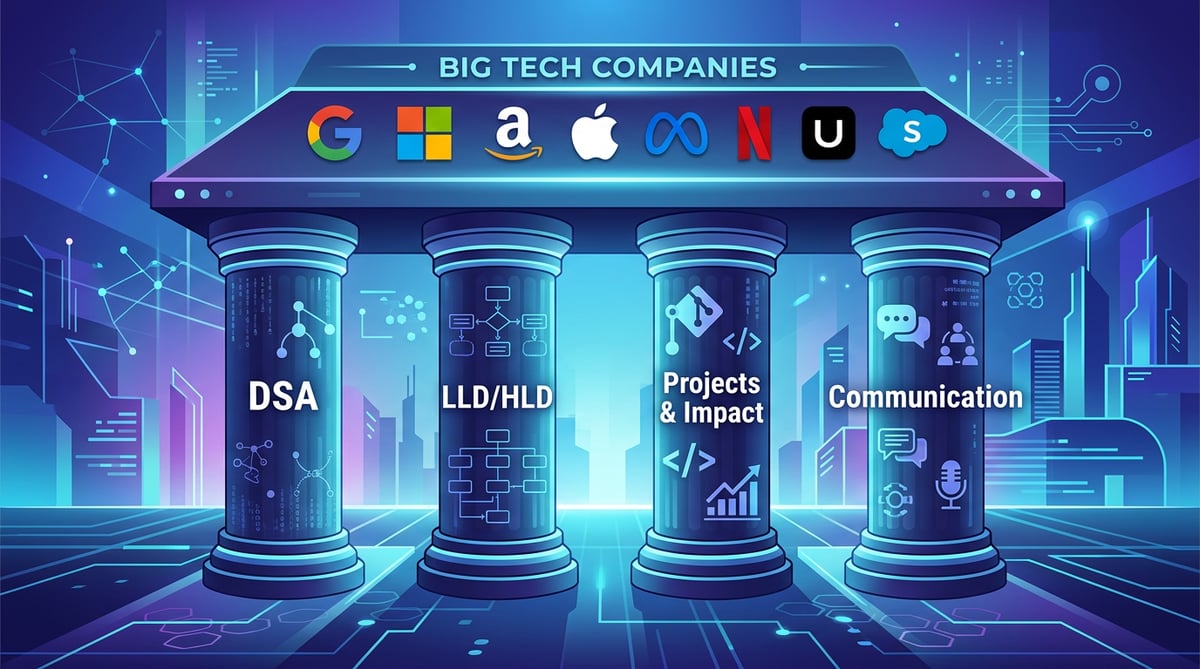
Think of FAANG interviews as four pillars, not one:
- Problem solving (DSA): Can you reason under pressure and write clean, correct code in 45 minutes?
- Design (LLD/HLD): Can you design components and systems that survive real-world scale, failures, and changing requirements?
- Real‑world impact: Have you built things at work or in projects that actually moved a metric, unblocked a team, or helped users?
- Communication: Can you explain your thinking so clearly that people genuinely want you on their team?
Most people over-index on the first pillar and then wonder why they stall.
If You’re Early Career (0–1 Years)
You might be in college, in your first job, or fighting for that first serious internship. The game is a bit different for you.
1. DSA: Solid, Not Obsessive
You don’t need to be a walking algorithms textbook. You do need a spine of fundamentals:
- Arrays, strings, hashing, two pointers
- Linked lists, stacks, queues
- Trees, graphs (BFS/DFS), heaps
- A few core DP patterns (subsequence problems, knapsack-style problems)
The goal is not “I solved 500 problems.” The goal is: “Give me a medium-level problem, and I can talk through my approach calmly, handle edge cases, and code something clean.”
2. Projects That Belong In The AI Era
A basic CRUD app with login and dark mode is not enough anymore in 2026.
Aim for projects that:
- Use AI meaningfully (LLMs, embeddings, recommendation, summarization).
- Feel like real products: they have auth, deployment, logging, error handling—not just a localhost demo.
- Show you can ship end‑to‑end, not just write a single script.
Concrete ideas you can steal:
- An AI resume analyzer that scores resumes against a job description and gives concrete suggestions.
- A support ticket summarizer that groups similar issues and drafts replies for agents.
- A real-time dashboard that streams some live data (market, sports, gaming) with caching and rate limiting.
When an interviewer sees this, they’re not just thinking “ok, code.” They’re thinking “this person understands how software is built today, not five years ago.”
3. LLD: Don’t Skip Just Because You’re “Junior”
Even at 0–1 years, companies will test whether you can structure code beyond a single function.
Common early-career LLD prompts:
- Design a URL shortener (focus on core classes and interactions).
- Design a parking lot system.
- Design a rate limiter library.
What they’re looking for:
- Clear class boundaries and responsibilities.
- Extensibility: can this design survive new requirements?
- Thoughtfulness: do you think about edge cases, tests, and failures?
Use your projects as a playground: refactor them into modules, add interfaces, separate concerns—and then practice explaining those decisions out loud.

If You’re Mid Career (2–5+ Years)
You’re probably already shipping production systems, doing code reviews, maybe mentoring juniors. Yet FAANG still says “DSA + LLD + HLD.” Here’s how to deal with that without burning out.
1. DSA: Remove The Rust, Don’t Start From Zero
You do need to revisit DSA, but you’re not starting at square one.
Focus on:
- Core patterns: sliding window, two pointers, binary search (including “binary search on answer”), graphs, heaps, standard DP patterns.
- Depth over vanity metrics: 150–200 well-understood problems beat 600 rushed ones.
- Being able to say when and why you’d use a pattern, plus its tradeoffs.
Your unfair advantage: you’ve lived through incidents, latency issues, memory leaks, and migrations. Use those stories when you talk about complexity and tradeoffs.
2. LLD + HLD: Where You’re Expected To Stand Out
At mid-career, strong design is not “nice to have”, it’s the main show.
For HLD, interviewers expect you to:
- Start with clarifying questions and non-functional requirements (scale, latency, availability).
- Estimate scale: QPS, data size, read/write ratios, growth.
- Sketch a simple but coherent architecture: clients, API gateway, stateless services, data stores, caches, queues, background workers.
- Talk explicitly about bottlenecks, failures, and tradeoffs instead of just drawing boxes and arrows.
You’re probably already doing something like this in your current job. The work now is learning how to compress months of context into a sharp 45‑minute story.
The Piece Almost Everyone Underestimates: Communication
Knowing DSA and design is necessary. It’s not sufficient.
Anyone can silently type out a solution. What stands out is when you:
- Start by restating the problem and clarifying constraints.
- Lay out a brute-force approach, then an optimized one, and clearly choose between them.
- Narrate while coding: “I’ll start by handling parsing, then build a frequency map, then handle edge cases like empty input.”
- Dry-run your code on an example out loud before running anything.
This is where many great engineers quietly fail, they never learned to make their thinking visible.
Why Mock Interviews Matter More Than You Think
Mock interviews are basically your mirror. They show you things you can’t see yourself.
You quickly discover patterns like:
- Jumping into code without fully understanding the problem.
- Over-explaining basic syntax but ignoring the real tradeoffs.
- Forgetting to mention complexity or edge cases.
- Telling “team” stories where your own impact is invisible.
Run mocks with:
- Friends who are already in big tech or strong product companies.
- Colleagues who are also preparing, so you can trade roles.
- Mentors or structured platforms when you can, to get targeted feedback.
Treat each mock like a gym session: one session, one main weakness identified, one specific improvement next time. That compounding effect over 4–8 weeks is huge.

The Power Of Having A Plan (And The Cost Of Not Having One)
A plan does a few quiet but powerful things for you:
- It removes decision fatigue: you don’t waste willpower every day deciding “what should I study today?”
- It makes progress visible: you can see patterns covered, mocks completed, designs practiced.
- It keeps you honest: if you planned “3 DSA sessions + 2 design sessions + 1 mock per week,” your tracker will call you out when you drift.
Not having a plan has a cost you can literally feel:
- Months pass and you’re “still preparing” with nothing concrete improved.
- You bounce between resources whenever anxiety spikes.
- You burn out before you even start applying seriously.
- Opportunities pass, internship seasons, referral windows, team expansions, because your prep never actually peaks.
That 100% hike, that big jump from your current job, that dream internship, they’re not “impossible.” They’re on the other side of 6–10 weeks of focused, boringly consistent execution.
Why Having A Mentor Accelerates Everything
A good mentor is a shortcut around years of trial-and-error.
They can help you:
- Build a realistic plan for your stage and timeline.
- Prioritize the right topics instead of chasing every new YouTube thumbnail.
- Host mock interviews and give you feedback that’s brutally honest but actionable.
- Translate your work into resume bullets and interview stories that actually land.
Mentors also share the “unwritten rules”: what interviewers actually look for, how different companies weight rounds, how to signal level and ownership. That insider context often makes the difference between “almost there” and “offer letter.”
If you don’t have a mentor yet, start small: reach out to seniors on LinkedIn, join prep communities, or even pair up with a peer slightly ahead of you in the journey. The goal is not perfection; it’s getting out of your own head.
What’s Next: The Stage Where 99% Get Filtered Out
There’s a brutal stage almost no one talks about: your resume never even reaches a human.
You might already have:
- Solid skills and consistent DSA practice.
- Strong projects or serious production work.
- A clear story in your head.
But if your resume doesn’t pass ATS filters or doesn’t scream “FAANG-ready” in 6–7 seconds, it dies in the pipeline.
In my next blog, I’ll go deep on:
How to craft a resume that actually breaks through FAANG ATS filters and makes a recruiter want to call you.
We’ll turn vague bullets into sharp, impact-driven ones and make sure your hard prep doesn’t get wasted before the first round even gets scheduled.
And if you’re reading this thinking, “Is that 100% hike or that first FAANG internship actually doable for me?” the honest answer is: yes, but only if you stop preparing like “everyone” and start preparing like someone who expects to get in.