In life, we all want to improve at the things we are passionate about, Unreal Engine and programming are no exception. Here is a list of areas I personally work on every day to become a better version of myself as an Unreal developer. I’m sharing it in case it helps, motivates, or gives direction to someone else.
In life, we all want to improve at the things we’re passionate about, and Unreal Engine and programming are no exception. Growth in this field doesn’t happen by accident, it comes from deliberate effort, curiosity, and a willingness to continuously learn.
Below is a list of areas I personally work on every day as I try to become a better version of myself as an Unreal developer. It reflects both technical skills and mindset, the things that compound over time rather than quick wins.
This is not a checklist you complete once. It’s a long-term mindset :
Unreal Engine
- Unreal C++, reflection system, TArray, Build.cs, STL-like patterns, engine constraints
- Blueprints, reference viewer, events, Blueprint libraries, and common workflows
- The Unreal framework and how systems connect, UObject, Actor, ActorComponent, GameMode, PlayerController, GameInstance
- Core engine concepts, garbage collection, object lifetime, memory handling, hard vs soft references
- Packaging, cooking, and asset handling
- Replication and multiplayer concepts
One advice I would give to anyone learning Unreal Engine is to use the documentation, but more importantly, read the code. The documentation helps a lot to understand concepts, but the real learning happens when you take time to look at how things are actually implemented.
Reading engine code is not easy at first, and that’s normal. You need to take time to become comfortable with it. Don’t rush. Follow the code paths, try to understand why things are done this way, and accept that you won’t understand everything immediately.
Put breakpoints, step through the code, and see what really happens at runtime. If possible, set up Unreal by building it from the Epic Games GitHub branch instead of using only the Launcher version. It takes more time to set up, but it helps a lot to understand how things work under the hood.
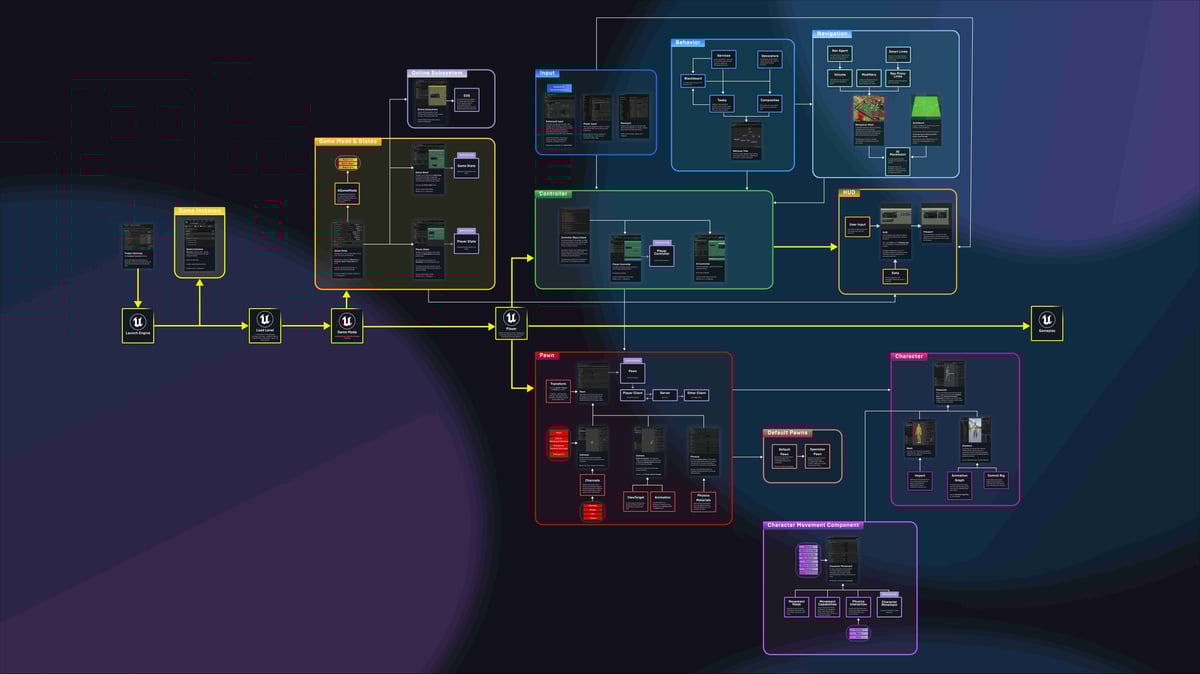
https://dev.epicgames.com/documentation/en-us/unreal-engine/gameplay-framework-in-unreal-engine
Programming
- Naming variables (yes, it matters 🙂)
- Low-level fundamentals, C and basic ASM concepts, at least at a conceptual level
- C++ fundamentals
- Data structures
- Algorithms, arrays, linked lists, stacks, queues, dictionaries, graphs, etc.
- Scripting with Python and Bash
- Version control, working safely with Git
- Reading existing code and understanding context, Unreal examples like Lyra and GAS
- Debugging crashes and logic issues, crash dumps and symbols
- Profiling and finding real bottlenecks, understanding O(n)
- Reading and writing documentation
- Using keyboard shortcuts and tools efficiently
- Participating in and learning from code reviews
- Taking constructive breaks to come back with a clearer mind
- Contributions and open source
Here the key is to not forget to put your head out of the code sometimes. Coding is great, being technical is great, but it’s not the only thing that matters on the market.
Here the key is to not forget to put your head out of the code sometimes. Coding is great, being technical is great, but it’s not the only thing that matters on the market.
That said, I’m pretty sure this part is actually one of the simplest ones. We’re really lucky today, we have the internet, and it allows us to learn almost anything we want, very fast. With the right mindset and a bit of discipline, improving on this side is completely achievable.
Engineering
How problems are approached and solved.
- Understanding the machine
- System design and architecture, UML, brainstorming, and high-level thinking
- Processes and personal checklists
- Writing tests
- Estimation and scoping work
- Structured problem solving
- Decision making and trade-offs
- Communication with non-programmers
- Building a personal knowledge base over time, I use Obsidian
- Continuous integration, basic Jenkins knowledge, and related tools
- Technological watch, I use Speechify to read articles faster
I know that this part is hard, even more when you’re learning everything by yourself, but I can assure you that it’s possible. I’ve met many senior developers who had this engineering mindset and didn’t even go to an engineering school.
You can do it. You simply need dedication, seriousness, and consistency. Over time, your goal becomes this: everything you touch should turn into something solid and well understood.
Career
- LinkedIn, keeping it up to date and truly reflective of what you work on
- A portfolio that shows real projects, not just polished screenshots
- GitHub, sharing code, experiments, and learning in public
- Reputation and loyalty (soo important), built through collaboration, communication, and helping others over time
- Internet presence, being visible, consistent, and genuine across platforms
About the career part, it’s not easy. As developers, it’s usually the part we don’t really want to spend time on, and we’re not great at selling ourselves. But we have to get better at it. You can be the best developer in your country, if you don’t show it, nobody is going to come and get you. You have to do the work yourself 🙂

None of this comes fast. Some days you move forward, some days you don’t. What matters is staying consistent and intentional. The goal isn’t knowing everything, it’s getting better over time.
None of these are mastered quickly. Progress is rarely linear, some days you improve a lot, other days you barely move forward, or it feels like nothing clicked at all. That’s part of the process. Working in complex fields like game development and programming means constantly running into new problems, unfamiliar systems, and moments of doubt.
What truly matters is consistency and intention. Showing up regularly, even when motivation is low, builds momentum over time. Small efforts compound, and the habits you form end up mattering far more than any single breakthrough. Not every day needs to be productive in an obvious way, sometimes learning happens quietly, through reflection, repetition, or even stepping away and coming back with a clearer mind.
The goal is not to know everything. That’s neither realistic nor necessary. The real objective is to get better at learning, thinking critically, and solving problems in a structured way. As those skills improve, picking up new tools, languages, or frameworks becomes easier and faster.
If this list helps even one person stay motivated, gain direction, or feel less alone in the process, then sharing it was worth it.
Yoan.