OUTPUT is not the same as STORY
Sometimes designers starting out fall into a common trap. “The output, of your design, the concept, the prototype, the launched product, can speak for itself.”
But, it doesn’t. A beautiful render is lovely. A seamless clickable prototype, can be delightful. And a tidy timeline is fine. But a single slide showing the outcome — even a beautiful one — is like being handed the chapter of a novel and being told, “Behold, my masterpiece.”
But your audience is only seeing the ending of the story. It’s hard to understand the journey or feel the emotions of that story. You can’t feel the tension, you are unaware of the wrong turns, the breakthroughs, or the meaning.
And the meaning is what people will remember. Think of your favourite films, the story arc, the metaphor and the subtext, these are all lost if you only watch the final act.
This article is about how to find — and tell — the meaningful stories of your work. The part interviewers lean into and that hiring managers recognise instantly. The story of your work and the meaning it reveals can turn a competent portfolio into a truly memorable one.
That sounds great, right? But there is more good news!! You don’t need to invent anything. You just need to learn how to recognise the transformation that’s already there.
Let’s walk through how design stories actually work — and how to uncover them in your own projects.
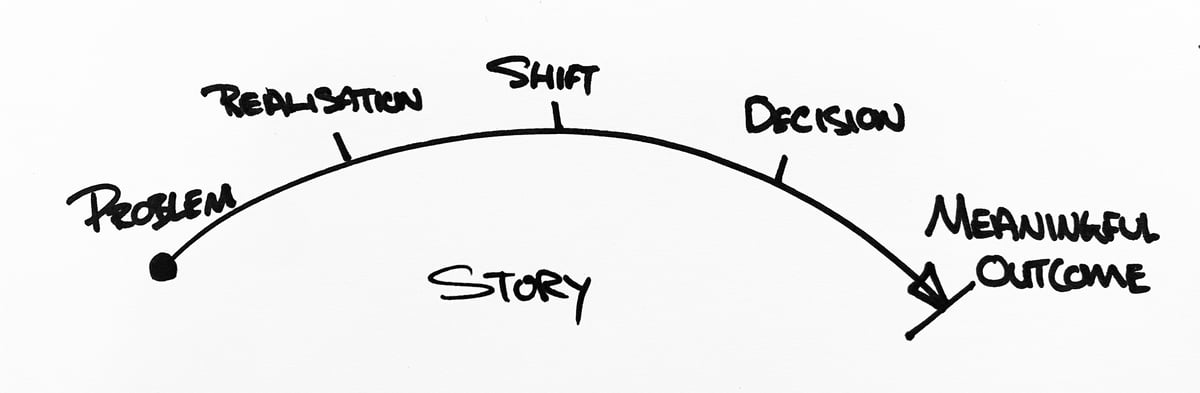
How This Guide Works...
First identify the work you want to include in your portfolio and gather as much visual material, images and prototypes you can in order to remind you of the work flow, the ins and outs. Think of each project as a little story, each one telling a slightly different story detail.
Use the below prompts to help draw out the moments, events, interactions of deliverables of significance of each story.
You don’t need to have responses to all of them, just enough to be able to convert a project into an interesting story, basically a beginning a middle and an end. You may ask: “Do I need all of this for my portfolio?” The short answer is no…. Think of this in two steps, first portfolio: you want to show you have your skills bases covered and create intrigue and curiosity for your other aptitudes like collaboration, empathy and leadership. Then second: interview. Here you can go in depth and provide more depth and nuance in a conversational way bringing the design transformation to life for your audience.
⸻
1. In the beginning…
Every real design story begins with honesty — not just a polished problem statement.
Honesty about:
• the mess you walked into
• the gaps in understanding
• the conflicting priorities
• the assumptions everyone took for granted
• the thing you thought the problem was (but wasn’t)
Designers often hide this part because they think it makes them look less competent. It is understandable… we don’t want to come across as inexperienced or not being in control, maybe even not having a vision. But the truth is, design is messy. Your job is to capture the true messiness of your starting point because your story starts with context, not just with a problem.
A truthful beginning says to a prospective employer: “I see reality clearly.”
And that’s the foundation of all good design.
Tip No.1: When you’re reviewing prior projects for your portfolio
Ask yourself:
• What was genuinely unclear at the start?
• What did we get wrong at first?
• What did the team disagree on?
• What assumptions turned out to be false?
These are the seeds of your story.
Tip No.2: While you’re working on a current project
Remember to capture:
• the early confusion
• first tensions
• contradictory insights
• ridiculous constraints
• the elephants nobody wanted to name
These can become the opening scene of your case study later.
⸻
2. Something Wasn’t Working
And purpose emerges. Every meaningful story has a moment where you realise:
“This isn’t good enough.”
“This doesn’t serve the purpose.”
“We’re solving the wrong problem.”
This is where purpose appears, and it can change everything. Now you are the protagonist in this dilemma and you are defining the problem to solve, the direction to travel and the purpose that motivates you and your team. Identify a purpose that is outwardly directed — toward users, outcomes, clarity — this means ego stops being the driver for the work and your mission as a team can begin.
Suddenly:
• it doesn’t matter whose idea wins
• you’re not defending your work
• you’re following the truth
• you’re more open to seeing what’s actually happening
This is the inflection point where maturity starts to appear. This is where your leadership has affected the course of the journey.
Tip No.3: Practical orientation
Look for the moment where you felt uncomfortable, stuck, or unconvinced. What was it you felt was most important to resolve? That’s usually where the real story begins.
⸻
3. Stepping Into the Unknown
Leaving the comfort zone.
This is the point where you found the courage to question something you “weren’t supposed” to question. Where you follow a thread that doesn’t fit the brief. Where you see a contradiction and decide to chase it.
It doesn’t feel heroic, but it does feels risky. This is where curiosity replaces ego and where instinct and courage wake up. Where a better direction starts to emerge.
Tip No.4: When reviewing your work
Ask yourself:
• When did we challenge an assumption?
• What rule did we break?
• What trail did we follow even though it felt risky?
These are the stakes and design stories need stakes.
⸻
4. The Messy Middle
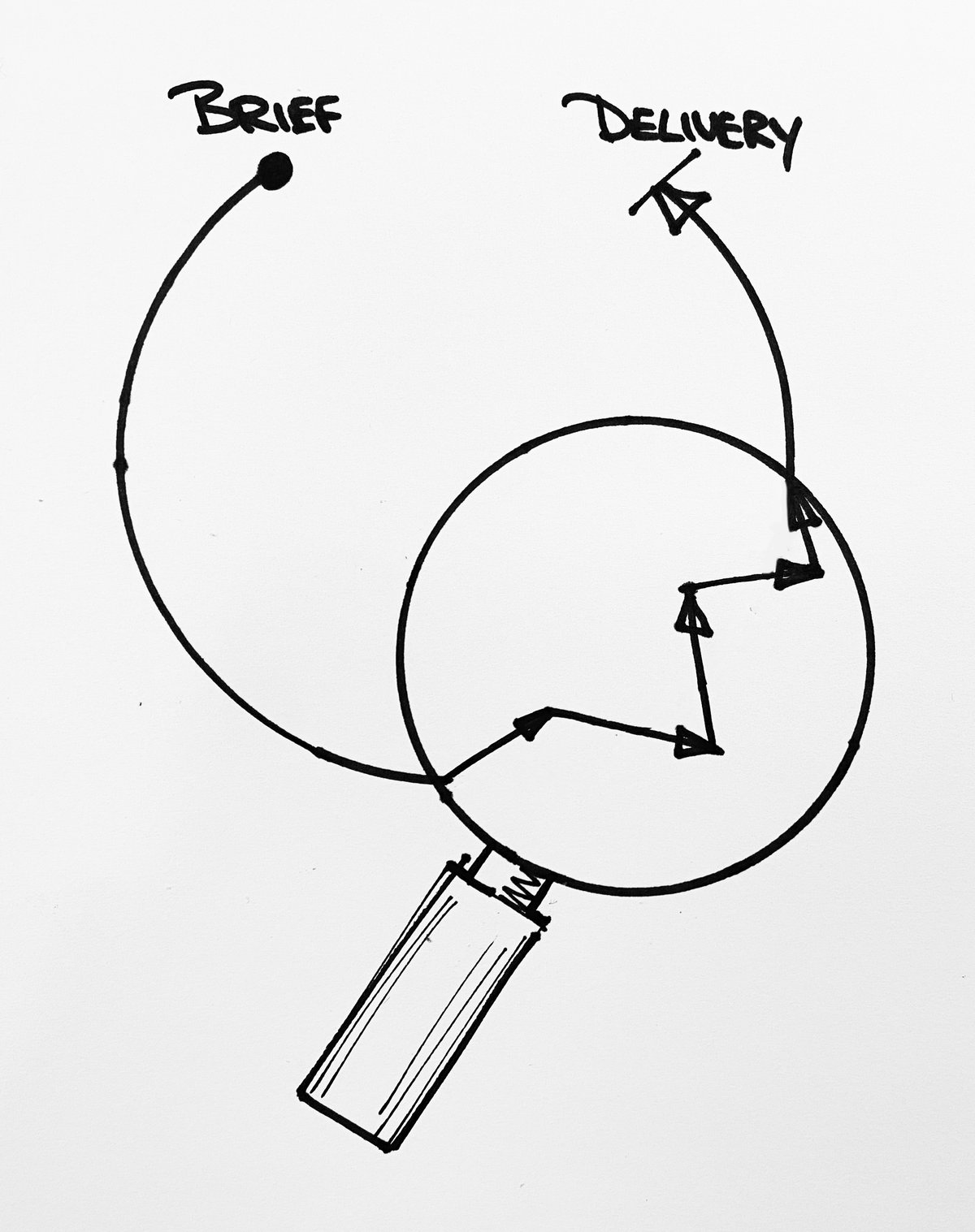
What progress actually looks like.
Let’s be brutally honest: Real design process is not linear. It’s not a clean row of steps. It’s not a neat double diamond.
What it is, is a sequence of moments that matter:
• of insight
• of inspiration
• of articulation
• of misunderstanding
• of reframing
• of breaking
• of fixing
The scariest thing for designers is admitting: “I didn’t have all the answers as I went.” Remember this is not lake of competence, this courage and confidence for your interviewer.
Remember, you value is not in knowing everything — it’s being able recognising a better idea when it surfaces and welcoming it, even when it’s not yours.
This is where your humanity belongs in the story.
Tip No.5: Capture this by noting:
• wrong turns
• surprising comments
• ugly prototypes
• questions you couldn’t answer
• the thing that didn’t work (and why)
These aren’t embarrassments — they’re evidence of thinking.
⸻
5. The Moment It Clicked
The insight that changed everything.
Every strong design story has a turning point:
• something a user said
• a pattern you suddenly saw
• a constraint that sparked creativity
• a dead-end that revealed the real problem
• the sketch that opened a new door
This is the “Oh — wait a second” moment. This is the moment interviewers lean forward. Because this is where meaning enters the story. A great story isn’t only about beauty — it’s about meaning as well.
Tip No.6: Identify this moment by asking:
• What surprised you?
• What shifted your understanding?
• What made the old direction impossible and the new one inevitable?
That’s your pivot.
⸻
6. The Cost of the Breakthrough
Every real insight has a sacrifice.
This is the part designers often hide:
• dropping an idea you loved
• reframing the whole problem
• redoing work
• convincing stakeholders
• resolving conflict
• admitting something wasn’t working
This is not weakness — this is leadership.
This is the moment where growth happens.
Tip No.7: Capture:
• the tough decision
• the thing you let go
• what it took to move forward
This is the emotional heart of the story.
⸻
7. Bringing the Story Home
Explaining the meaning to others.
Here’s another unspoken truth:
Stakeholders are decision-makers. They are not always subject matter experts. That might be you. Your job is bridging the gap. How did you tell the story of the meaning you identified, how did you frame it as a win for your audience? How did you spark curiosity, get your audience invested in the insight and the customer need?
Tip No.8: Ask yourself:
• How did you explain the insight?
• How did you help others see what you saw?
• What language did you use to ensure alignment?
This is where the significance of the work becomes visible.
⸻
8. What Changed?
In the work, in the team, and in you.
The transformation is the story:
• what improved
• what shifted
• what made the design better
• what the team learned
• what you learned
There are three arcs worth capturing:
1. Customer arc: their reality before and after
2. Business arc: how decisions, clarity and viability improved
3. Your arc: what this project taught you
This is what makes a case study memorable.
This is what interviewers remember weeks later.
This is what elevates you from competent to compelling.
⸻
Tip No.9: After having gone through your project with this guide, try to identify at least these three key components and try to bring them to life in your portfolio:
1: The interesting problem to solve
2: The grit of the process and the consequential decisions you made to define the direction
3: The deliverables you devised and the transformation you facilitated for the customer, the business and yourself.
Define at least these three moments first and then piece together the visuals and assets you might have that help you tell that story.
⸻
The Takeaways
Don’t just show the output. Don’t just show the timeline. Tell the story of the transformation. Tell the truth of the work. Tell the meaning behind it. Tell the human journey through it.
Because in the end: Designers who show output are technicians. Designers who show timelines are competent. Designers who show transformation are leaders.
And leaders get hired!
Good Luck!