Launching a mentoring program at scale for thousands of employees might sound overwhelming—but it doesn’t have to be. I’ve built three, including one for 1,400 people, and in this guide, I’ll share the exact steps and materials (mentoring program templates) so you can do it too—with ease.
If you’re wondering how to start a mentoring program at work—in particular launch a corporate mentoring program—even at large-scale—you can do this in weeks—not months. Read on…
Mentoring programs are one of the most effective (and lowest-cost) ways to promote growth and leadership culture inside any organization. When done right, they unlock experience, accelerate development, and strengthen leadership pipelines—all without adding headcount or heavy process.
Mike Weiss is a Senior Engineering Leader and mentoring expert who has launched and led large-scale engineering technical and leadership mentoring programs at multiple companies, including initiatives with more than 1,400 participants. Mike has trained many mentors and has served countless mentees. He helps professionals and organizations unleash the power of mentoring and build thriving mentoring cultures. You can connect with Mike on MentorCruise (click the "sessions" tab to schedule time with me), a paid mentoring platform, for personalized guidance on launching your own mentoring program or for one on one mentoring.
Why Mentoring?
Before you set out to launch a large-scale corporate mentoring program, let’s ask two important questions—What is mentoring and why do it?
There are many definitions of mentoring. My favorite is “leveraging one person’s experience to help another.” By leveraging their experience, a mentor helps their mentee grow, develop, and achieve their goals. When deployed at scale using my approach, a mentoring program is a nearly zero-cost way for an entire organization to harness the power of its expertise and raise the game of all of its employees.
Mentoring may seem manageable on a small scale, but don’t be intimidated about scaling it up to a larger organization. By following these easy, proven steps and taking advantage of my materials, you will be able to launch a mentoring program at scale in no time. The largest mentoring program I have launched was for a business unit of 1,400 people, but I believe that this approach will scale easily to more than twice that number.
The mentoring program that I will illustrate in the following steps supports both technical and career development mentoring, but it is possible to tailor your mentoring program to just one or the other.
Let’s get to it…
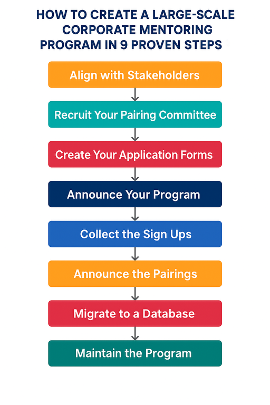
Step 1: Align with Stakeholders
When operating in a corporate environment, it is absolutely critical to have the support of not only your personal leadership chain, but of the executive team for your department, business unit, or company—whatever the scope of your mentoring program. You will need to explain the minimal costs and profound benefits of launching a mentoring program. At minimum, you will need to answer the following questions, whose answers will be revealed in the remainder of this article:
- What are the costs and benefits of launching this mentoring program?
- Who will be involved in launching this mentoring program?
- How long will it take to launch?
- What resources are necessary to launch it?
- How much work is required to maintain the program post-launch?
- Who will maintain it?
- What types of mentoring are supported by the program?
- Who is qualified to be a mentor and a mentee?
Some leadership organizations realize the power and promise of mentoring right off the bat, while others may be skeptical about the benefits of mentoring or costs of running a program like this. As the prospective program administrator, it is your job to persuade/convince them that this is an idea that will have a huge positive impact on the organization.
Step 2: Recruit Your Pairing Committee
Before you drive sign ups, as will be explained later, you will need to recruit a committee of people who know the people in your company to make the mentor/mentee pairings. The mentoring committee should be comprised of people who know the people in their area of the business well. People managers typically work well for this role, but other roles can be useful too.
So, for example, if your company has five business units, choosing one person who has been working for a number of years in each of those business units would be ideal. A pairing committee works well for about 3 to 8 people, but becomes unwieldy at larger than eight people. If you need to scale larger than that, create multiple, separate pairing committees that cover distinct and separate areas of the business. For example, you could have a pairing committee of 5 or 6 people targeted at making mentor/mentee pairings for your R&D org and a separate pairing committee for your sales and marketing org. This relies on the assumption that Sales and Marketing mentees will not be seeking mentees from R&D and vice versa, which isn’t always the case. To handle that, you, as the administrator, will be a part of all pairing committees and can serve as a conduit to communicate information between them.
We’ll talk more about the pairing committee later on, when it is time to make the actual pairings. For now, you just need to recruit suitable people and have them ready to make pairings as soon as you launch the program.
Step 3: Create Your Application Forms
When you launch your mentoring program (in step #4), you will need an online sign up form for mentees and mentors to communicate their abilities and preferences. It is the data on this form that will allow you to incorporate mentors and mentees into the program and form them into mentor/mentee pairs.
Rather than go through each question here, I have created a complete, ready-to-use mentor sign up form and mentee sign up for that you can either duplicate and tailor to your own needs (see download link at the end of the article).
Step 4: Announce Your Program at An All Hands Meeting
This step is deceptively simple, yet absolutely critical. Now that you have application forms and a pairing committee ready to go, you need to drive massive amounts of sign ups. The best way to do this is to ask your executive leadership chain for a 60 second spot at the next all hands meeting. Simply prepare an announcement, using the talking points below, deliver it, and watch the sign ups roll in.
Talking points:
- Introduce yourself and the fact that you are spearheading a mentoring program for your business unit or company
- The program scope covers technical and career development mentoring
- Our philosophy is that “Everyone has something to teach and something to learn”, so all but the most junior and senior people are strongly encouraged to sign up as both a mentor and a mentee.
- You can register as a mentee and/or mentor by signing up using digital forms whose links will be emailed everyone following the conclusion of the all hands meeting.
- Set a timeframe for sign ups. A two weeks deadline usually works well.
- Set an expectation for how long you and your committee will need to complete the pairings. Please see my reference point in step #6 (“Make the Pairings”) for more insight.
IMPORTANT: This works best when you have the highest executive at the all hands speak and set an expectation. For example, you should negotiate with them ahead of time so that upon conclusion of your remarks, they will say something along the lines of:
“Mentoring is a powerful way for us to all raise our games and advance. Our expectation is that all of you will sign up and take advantage of this mentoring program.”
The prospective mentors and mentees need to hear the top executive sanction the program and encourage them to sign up. If you have this piece in place, getting tons of sign ups will be a breeze.
(A launch email, as well as mentor and mentee sign up forms, are part of the downloadable kit whose link is at the end of this article.)
Step 5: Collect the Sign Ups
I used Microsoft Forms for the sample mentor/mentee sign up forms that I provided above. Once your sign up period has expired, use Microsoft Forms to dump your sign up form data into Microsoft Excel, where you can easily view and manipulate it. I like to work with one single Excel workbook and make a tab for the mentee form sign up data and another tab for the mentor form sign up data. You’ll be able to see all of the fields for each form and each the answers to each question from each mentor/mentee. Later, you’ll want to convert this to a SQL database, but for now, the Excel spreadsheet will let you add extra columns and rows to keep track of your pairing activity as the members of the pairing committee update the spreadsheet as they work on making pairings simultaneously.
At this stage, you have all your materials, a pairing committee, and sign ups rolling in. Get ready to make matches and bring your mentoring program to life…
Step 6: Make the Pairings (Mentor-Mentee Matching Process)
Now that you have the sign up data easily accessible, it’s time to engage your pairing committee and make the pairings. Making pairings is not typically a full-time job for most of the pairing committee members, so as a reference point, in a program I launched for 1,400 people, we received about 500-600 sign ups, and it took a committee of 5 or 6 people about 3-4 weeks to complete all of the pairings.
Making pairings should be straightforward because you drove a lot of sign ups with the exposure from the all hands meeting, you got the top executive’s backing, and you encouraged just about everyone to sign up as both a mentor and a mentee. This is going to pay off because it is going in ensure that you have a lot of choices for mentors and mentees.
Note that since we are covering both technical and career development mentoring, it is possible that many mentees will have multiple mentors—one for each type of mentoring.
Making the pairings is more art than science, but as you get used to looking at the pairing spreadsheet, you will begin to see patterns and connections, and making the parings should flow pretty easily. You should be able to make pairings based on the preferences that mentees and mentors expressed in their sign up forms. Some pairings will be really tight matches and others will be less so, but if you were successful in driving a lot of sign ups, you should come pretty close to pairing just about everyone.
Making pairings works very much on a case-by-case basis, so it is hard to give sweeping instructions that apply to everyone, but it is an iterative process of picking a mentee, seeing what they requested and they trying to find a mentor who meets those requirements. Keep in mind that the goal is to match every mentee, not every mentor. If you have unmatched mentors leftover at the end, I provided an email to send to them in the downloadable kit.
Step 7: Announce Pairings, Send Mentor Training
Once you’ve made all the pairings, it’s time to announce to each mentee who their mentor(s) are and to each mentor who their mentee(s) are.
The best way to do this is with a merge email using the email addresses you received on the sign up form. If you’re not familiar with what a merge email is, it is a templated message with fields for things like {First name}, {Last name}, {Mentee name}, {Mentor name}. When you send the email, those fields get filled in with the actual value for each mentor/mentee. Merge emails are supported by many email programs, including Gmail and Outlook, so please consult your email program’s documentation for instructions on how to do it on your specific platform.
Below, I have provided sample correspondence that you can use to do your own merge emails. The downloadable kit contains an email to mentees, an email to mentors (complete with mentor training), and as previously mentioned, an email to unmatched mentors.
Step 8: Migrate to a Database
The Excel spreadsheet was good for pairings and served its purpose, but when you shift gears into maintaining the mentoring program, you will want to convert (import) the spreadsheet into a SQL database so that you can make queries like:
Show me all the mentees missing a career development mentor.
That example was in English, but you’ll need to use the Structured Query Language (SQL), popular database query language, to query the database. In case you don’t have sharp SQL skills, I have included a database template and a list of sample queries in the downloadable kit.
The database template works with the SQLite program, freely available on the internet. You will need to have some SQL skills to get the data imported and transferred, but if you can figure that out, the canned queries that I provided should really automate your work.
Step 9: Maintain the Program
Once you’ve made the pairings and launched the program, almost all of the work is done. The training you sent out to the mentors and mentees will allow them to launch their relationships and the program and those relationships will be largely self-sustaining. There are only two more things to think about:
1) You should have the mentoring committee or some subset of it (maybe just you, the program administrator), meet quarterly to find new mentors/mentees for people who have left the company or to find new mentors/mentees for people who have joined the company over the course of the quarter.
2) Optional: You can host quarterly meetings of the mentors to share tips and exchange best practices. This ensures that your program is learning, growing, and getting better.
3) Recommended: Send out a survey to mentors and mentees to capture feedback on how things are going with mentor/mentee relationships across the program and what needs attention. A tool like Microsoft Forms, like I used for the sign up forms, is perfect for this.
Conclusion
So there it is—how to launch a large-scale corporate program in easy 9 proven steps.
You can download all of the materials I used to launch my mentoring programs in a DIY Mentoring Program Kit at https://kit.mikeweissmentoring.com/
(Apologies but the kit download experience is not optimized for mobile browsers. You can get it to work, but it won’t be a smooth as on a desktop/laptop (preferred)).
Every time I’ve launched a mentoring program in my career, it was followed by email after email from mentors and mentees raving about how valuable their mentoring relationships are, how much they are learning from their mentor or mentee, and how mentoring has helped them advance in their careers.
I hope that you found this article to be helpful and informative. I truly believe in the power of mentoring as a low cost means to transform an organization and help people grow and advance. I hope that this article will enable you and many others to leverage mentoring at your organizations.
If you have questions about any of the content of this article or the downloadable materials, you’d like my eyes on your specific mentoring rollout, or you just want to share your mentoring story, please feel free to reach out to me on MentorCruise (click the "sessions" tab to schedule time with me).
About the Author
Mike Weiss is a Senior Engineering Leader and mentoring expert who has launched and led large-scale engineering technical and leadership mentoring programs at multiple companies, including initiatives with more than 1,400 participants. Mike has trained many mentors and has served countless mentees. He helps professionals and organizations unleash the power of mentoring and build thriving mentoring cultures. You can connect with Mike on MentorCruise (Click the “sessions tab on my MentorCruise profile to schedule time with me), a paid mentoring platform, for personalized guidance on launching your own mentoring program or for one on one mentoring.