Why this works (and why more advice usually doesn’t)
Most people try to “think” their way into clarity. Through client sessions, I've found clarity usually comes from structure and small proof, not more opinions.
When you collect advice from five people, you don’t get one answer. You get five different risk tolerances, five different career histories, and five different biases. None of them are necessarily wrong but none of them are you.
A decision system fixes that by doing two things:
- It forces you to define what matters most right now (not what should matter in some ideal life).
- It turns fear into a testable risk instead of an invisible weight on the decision.
The goal isn’t to pick the “perfect” move. It’s to pick a smart move and protect yourself with a fast test.
The real problem: You are usually optimizing for certainty
Career decisions rarely come with certainty. If you keep waiting to feel 90% sure, you will stay stuck.
A better goal is this:
Make the best decision you can with what you know, then de-risk it with a short experiment.
That is the entire system.
The 20-minute framework
Use this whenever you are choosing between roles, teams, industries, cities, managers, offers, or even whether to stay put.
Step 1: Write the decision in one sentence
Examples:
- I am deciding whether to stay in my current role or move to a new company.
- I am deciding whether to pursue management or deepen as an individual contributor.
- I am deciding whether to accept this offer or keep interviewing.
If you cannot write it cleanly, you are not ready to decide yet.
Step 2: Define your “non-negotiables” (max 3)
These are the dealbreakers. Not preferences or“nice to have.”
Examples:
- I need a manager who gives clear priorities.
- I need a role where I can build, not just maintain.
- I need a compensation floor of X to make the move worth it.
If you list 8 “non-negotiables,” you are avoiding the tradeoffs.
Step 3: Pick 3 decision criteria (and weight them)
Pick what actually matters for your next 12 months.
Example criteria:
- Learning velocity (40%)
- Quality of leadership and team (35%)
- Career leverage (25%)
Now score each option from 1 to 10 against each criterion. Multiply by the weight. Add it up.
This usually forces honesty.
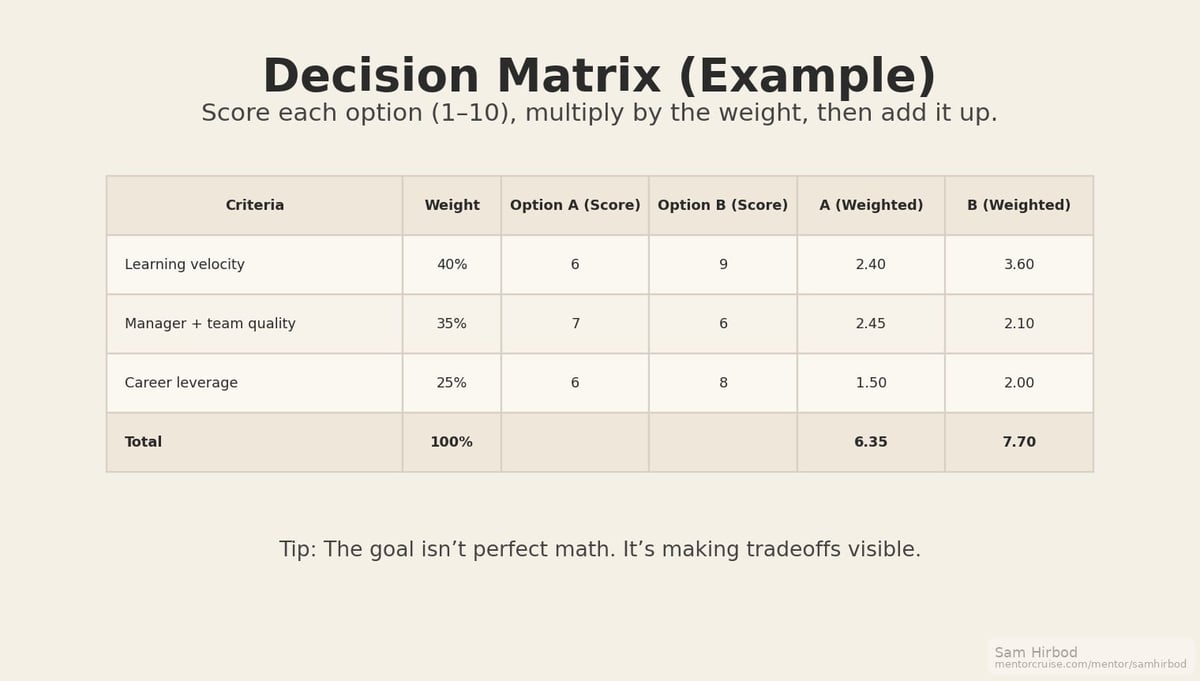
Example: using the framework on a real decision (See image above)
Let’s say you’re choosing between:
- Option A: stay in your current role (stable, known team)
- Option B: take a new role (higher upside, more unknowns)
Your criteria (with weights):
- Learning velocity (40%)
- Quality of manager and team (35%)
- Career leverage (25%)
Score each option (1–10):
Option A: 6, 7, 6
Option B: 9, 6, 8
Weighted score:
Option A: (6×0.40) + (7×0.35) + (6×0.25) = 6.45
Option B: (9×0.40) + (6×0.35) + (8×0.25) = 7.55
This doesn’t make the decision for you, it makes the tradeoff visible. Now you know exactly what you’re buying (learning + leverage) and what you’re paying (team certainty).
Step 4: Name the risk you are most afraid of
Most indecision is fear hiding under logic.
Common hidden risks:
- I will look stupid if I leave and it is worse.
- I will disappoint people if I do not take the promotion.
- I will lose momentum if I switch lanes.
Write the risk plainly; if you cannot name it, it will run the decision.
Step 5: Decide, then design a 14-day experiment
You reduce risk with action, not overthinking.
Examples of 14-day experiments:
- If you are considering management: run “manager reps” by mentoring, leading a project, or owning performance feedback loops for two weeks.
- If you are considering a company: do 5 short calls with current employees in adjacent teams and ask the same 5 questions each time.
- If you are considering a role shift: build one portfolio artifact in 14 days (case study, teardown, mini project) to test your energy and aptitude.
Your experiment should answer one question: “Would this direction energize me and compound my skills?”
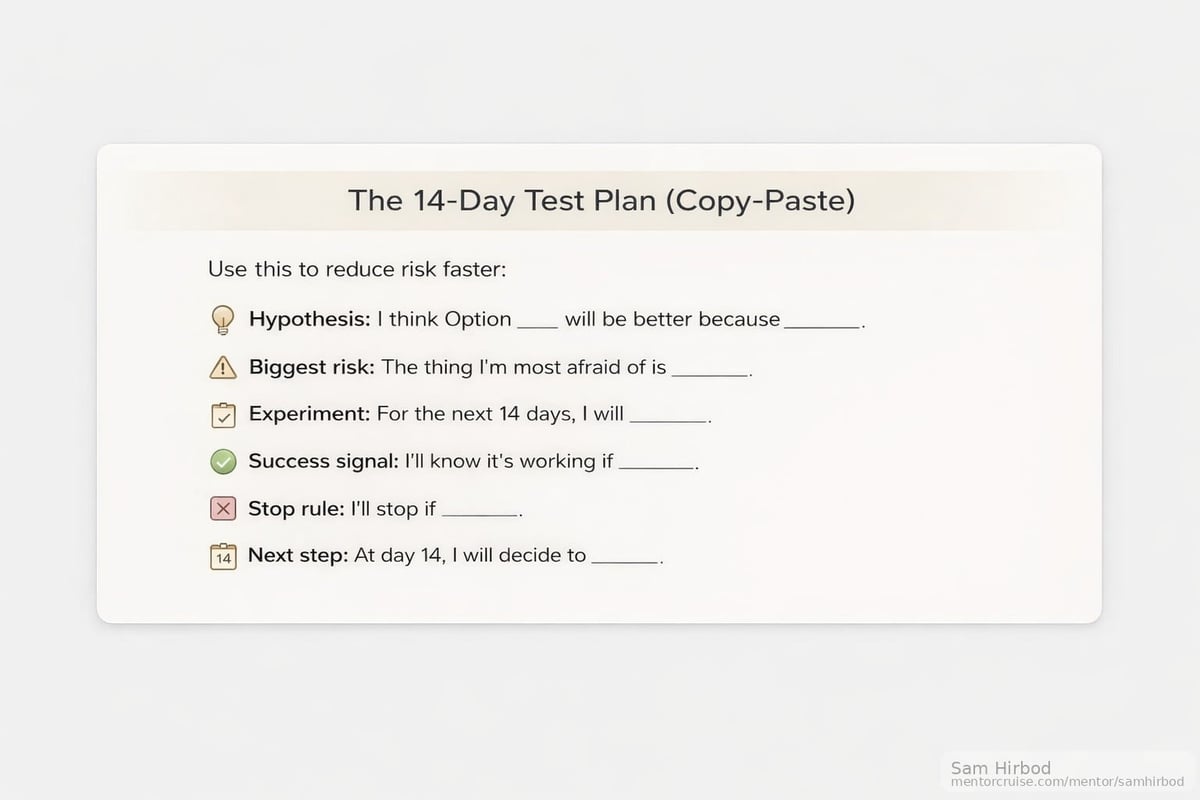
The 14-Day Test Plan (Copy-Paste), see image above
Use this to reduce risk faster:
- Hypothesis: I think Option ___ will be better because ___.
- Biggest risk: The thing I’m most afraid of is ___.
- Experiment: For the next 14 days, I will ___.
- Success signal: I’ll know it’s working if ___.
- Stop rule: I’ll stop if ___.
- Next step: At day 14, I will decide to ___.
The questions to ask before you say yes to anything
Use these questions for a new role, internal transfer, promotion, or even a “stretch” opportunity.
- What problem am I being hired to solve?
If you can’t answer this clearly, you’re walking into vague expectations. Vague expectations are where careers stall.
- What does “good” look like in the first 90 days?
Not in general. In this exact team, with this manager, under current priorities.
- What would make this a bad fit even if I perform well?
This is the trap most high performers fall into: they can succeed almost anywhere, so they ignore fit. Then they burn out while “doing great.”
- What are the constraints I’m signing up for?
Time zones. Travel. Stakeholder complexity. Politics. The pace of change. The maturity of the team. These constraints matter more than the job description.
- If this goes well, what does it lead to?
You’re not just choosing a job. You’re choosing a set of future options. Make sure the upside actually compounds.
TLDR; Choose the option that makes your next step easier, not harder.
A practical rule: choose the path with the better downside
When two options look similar, decide based on downside risk.
Ask:
- If this goes poorly, can I recover quickly?
- If I regret this, is it reversible?
- If this works, does it compound?
The best career moves tend to be the ones with:
- Reversible downside
- Compounding upside
What mentoring is actually good for here
A mentor should not “tell you what to do.”
A good mentor helps you:
- Clarify what matters (criteria)
- Surface blind spots (hidden risk)
- Pressure-test assumptions (market reality)
- Turn indecision into a short experiment (execution)
If you leave a conversation with more options and no decision, you did not get mentored, you got entertained.
Bottom line
Usually, you do not need more advice, you just need a system that turns uncertainty into action.
Define the decision, choose criteria,name the fear and run a 14-day experiment. That's it.
Repeat it every time the fog shows up.
---
This is the exact process I use with clients to choose quickly and test the move before they commit.
If you want help applying this to your situation, bring two options you’re considering and we’ll score them, name the risks, and design a 14-day experiment.
About the author:
Sam Hirbod is an executive and professional coach who helps high performers make clear decisions, sharpen their positioning, and build repeatable career systems that actually hold up under pressure.