Back in 2022 (right before corporate AI went mainstream) I joined a small-but-passionate team of volunteers called IBM Next Toronto, who were running off a $0 budget and a goal to make the office an exciting place to work. I saw their potential and spoke on their behalf at our company-wide end-of-year meeting, securing an internal budget for the first year ever, and was elected Executive Lead just months later.

Image caption: Snapping a selfie with Pepper the Robot before I spoke to over 3000 employees for IBM's end-of-year meeting!
Honestly, I could end the article right here. If you stand up for a group of passionate individuals and give them hope, resources, and trust, it creates a positive impact. But things didn't stop there, and there are many more lessons to learn.
The experience of having to turn away over 100 employees from a packed event (when office attendance hadn't even been mandated yet!) is evidence of our success. To practice principle #2 (spoilers: it's to build from your successes), I'm going to tell you how you can apply my experiences in order to transform your own team and produce high-quality results, no matter the project, and whether or not your team is using AI.
1. Never ask for volunteers 🙋
You will never catch me asking "Who would like to volunteer?", because I've already figured it out beforehand.- Laurel Hall, Never ask for volunteers
I'm a big advocate for "voluntelling"—a word I learned from my undergrad professor, Karin Schmidlin, during my time at the University of Waterloo. You will never catch me asking "Who would like to volunteer?", because I already know who's best suited for the task. This simple trick streamlines projects by removing uncertainty.
✨ Learn from my experience
At the start of my leadership, the IBM Next team members had no specific roles. Whenever a task popped up it would be up to a brave volunteer to raise their hand. This meant that some tasks went unclaimed and were not completed.
Action taken: One of the first actions I took when I stepped up as lead was to identify skillsets and assign recurring tasks to team members who could make the biggest impact.
The team eventually formed teams for marketing, finances, event hosting, and logistics. Tasks were immediately sorted by skill and claimed by the appropriate team.
🛠️ How you can apply this
- Before your next meeting, assign each member to a team, based on their strengths and interests.
- Identify reoccurring tasks and divvy them up between your teams.
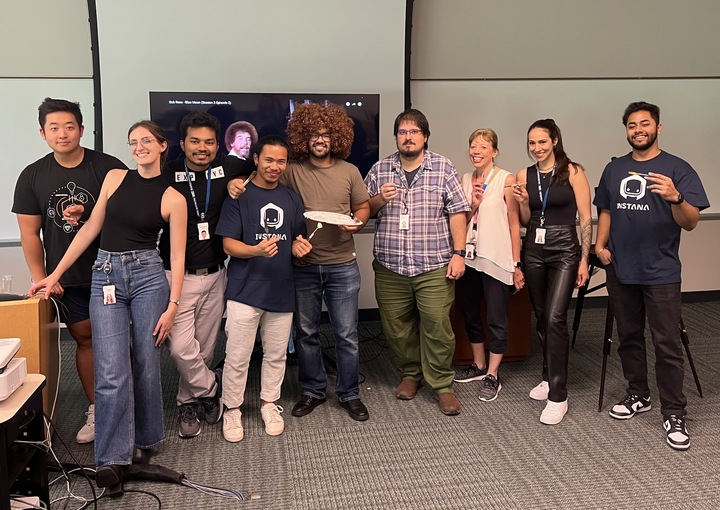
Image caption: Our most-anticipated event: The "Bob Ross Paint-Along". It broke our hearts to turn away a line of 100 employees—and office attendance wasn't even mandatory yet!
2. Build on your successes 🧱
With employees anticipating our next event, it naturally increased attendance without the need to increase our marketing efforts.- Laurel Hall, Build on your successes
Have you noticed your team scrambling at the beginning of every new project? That's a good indication that your team's strategy could benefit from some reworking. Repetitive tasks can easily be turned into standardized processes that get rid of the "Now what?" period at the beginning of your next project.
✨ Learn from my experience
Every month the IBM Next team came up with a brand-new event idea and planned it from scratch. Events were rushed and sporadic, plus lots of valuable time was wasted between events.
Action taken: All the events we planned going forward would now be repeated. Our focus shifted to events like the annual Holiday Family Feud and monthly boardgame meet-ups. With employees anticipating our next event, it naturally increased attendance without the need to increase our marketing efforts.
Going forward, our supplies and marketing materials could be reused, and our future budget was able to be allocated to continually improving the quality of these events.
🛠️ How you can apply this
- Identify a task that starts from scratch for each new project (Hint: watch for the "scramble").
- Turn the repeated task into a standard. Use the time you get back to increase the quality of each iteration.

Image caption: Comparing our annual Holiday Family Feud event the first year versus its second. It's hard not to notice the upgrade!
3. Reflect and review 💭
As hard as it is to remember what happened a year ago, it becomes practically impossible when a key team member is no longer part of the team.- Laurel Hall, Reflect and review
Repetition can help improve efficiency, but without a reflection period, you're doomed to make the same mistakes over and over. Make note of what you did well, along with any opportunities for improvement.
✨ Learn from my experience
IBM Next’s past events had never been documented, meaning that the team had no way to apply what they learned to a future event. As hard as it is to remember what happened a year ago, it becomes practically impossible when a key team member is no longer part of the team.
Action taken: After each event, we met for a retrospective, stating what we did well and how we would improve next time if we suddenly had an unlimited budget. Unrestricted creativity breeds fantastic ideas!
🛠️ How you can apply this
- Gather the team after the event and note down everyone’s feedback in a central space, like a Google Drive folder.
- Revisit those notes before starting your next project. There's no need to start from scratch or repeat the same mistakes!
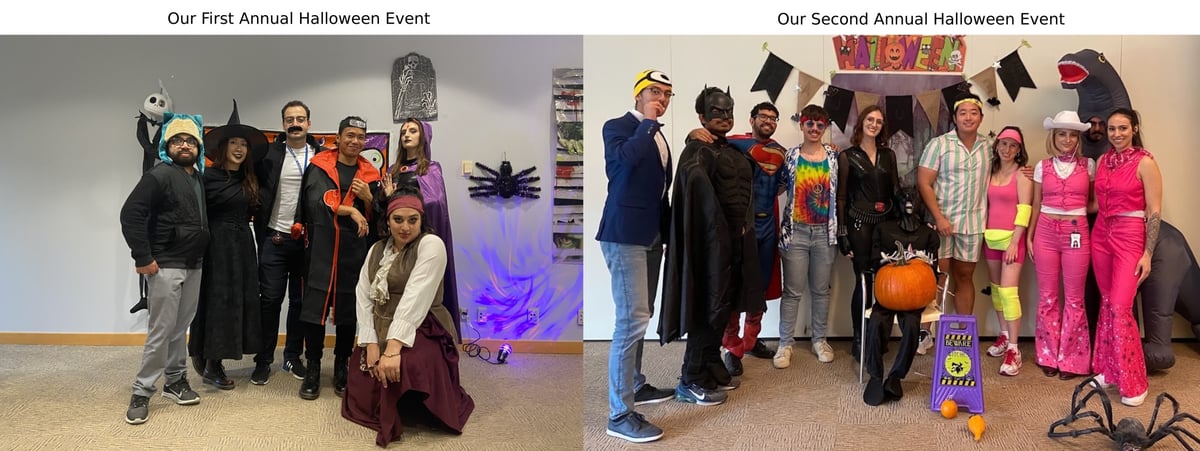
Image caption: Our first versus second annual Halloween event. The team grew—and so did our holiday inventory!
Summary
If you've been listening closely, you'll notice that all of these tips solve a similar problem: reducing "the unknown" during the critical decision points of a project.
As a leader, your job is to understand your team and support their growth. The easiest way to do this is identifying and then reducing friction points:
- By assigning your team members roles in advance, it allows for easy task allocation, allowing your team to anticipate next steps.
- Focusing on what your team is already succeeding at allows them to focus on refining skills—rather than learning from scratch—leading to more efficient and higher quality output.
- Learning from your mistakes is vital, having suggestions ready to implement helps to identify where your efforts should be placed while guaranteeing continual improvement.
Almost a full year later, I sat in front of a team that had tripled in size and doubled the number of events hosted per month, wrapping up my first year as lead with 15 amazing events under our belts.
How'd I make the most of all these individuals' willingness to volunteer? I knew how they worked best.
All of these points were applicable before the corporate adoption of AI, and are still applicable today, now working in tandem with your current tools. That's because one thing hasn't changed: we still work with people that desire a leader who knows them and prepares them for success, working with their skills and igniting their passions, so that they can work efficiently and be proud of the quality work they produce.
After a year of working with IBM Next Toronto, I was presented the "Culture Catalyst" Award, a quarterly cash award for inspiring leaders who highlight feedback and inclusion, reinvent skills, expertise, and promote knowledge sharing. This transformative experience is still a highlight of my career.

Image caption: Virtually accepting the Culture Catalyst Award
About the author
Laurel Hall is a proud LGBTQIA+ biracial leader and technical professional, passionate about corporate culture and diversity, knowledge sharing, and teamwork. She is a graduate of the University of Waterloo Global Business and Digital Arts, specializing in Computer Science and Design Psychology through her studies and time as a Teaching Assistant for User Experience Research and Design under Professor Karin Schmidlin.
Disclaimer: This article and its contents were all produced by passionate humans.