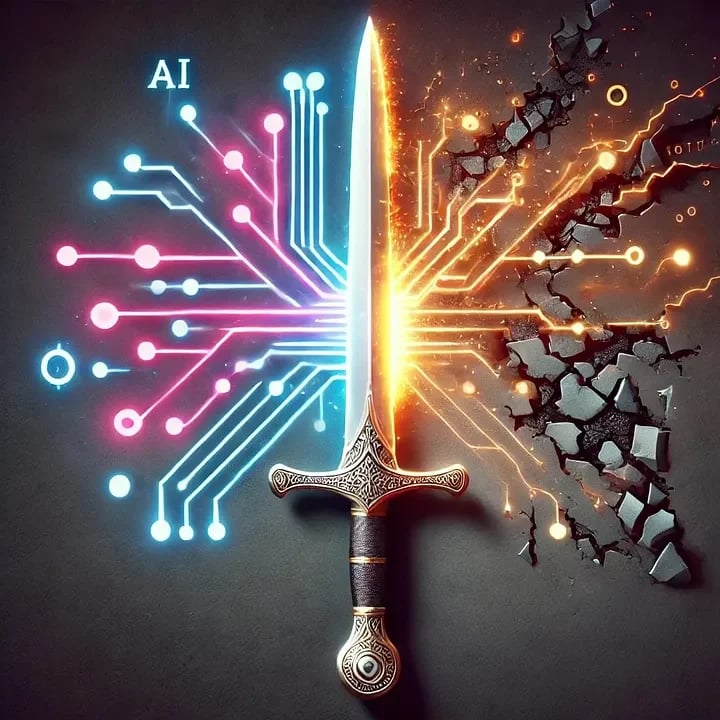
There is a definitive moment, and if you are reading this, you are likely in it, when you realize the technical landscape has shifted. It didn’t happen overnight, but the foundational skills you spent years perfecting now feel like they belong to a previous architectural era.
You remain a high-performing engineer. However, the departmental roadmaps have evolved. Job descriptions now prioritize competencies that fall outside traditional deterministic programming. Between the influx of new machine learning frameworks and demos that appear to bypass standard software development lifecycles and validation processes, a critical question emerges:
How do I leverage my engineering seniority to lead in an AI-driven economy?
This guide is for the senior engineer ready to bridge that gap, and for the leader who has to help their own teams navigating through this transition.
The Industrial Imperative
The urgency of this transition is mirrored in the broader economic data.
According to research by McKinsey & Company, we are witnessing a shift where "generative AI could add the equivalent of $2.6 trillion to $4.4 trillion annually" to the global economy, but this value isn't unlocked by models alone. McKinsey emphasizes that the real hurdle for most enterprises isn't the raw technology, but the fact that "the most difficult part of an AI transformation is often not the technology, but the people and processes."
For the senior engineer, this validates the need to move beyond the keyboard. McKinsey identifies a critical need for "translators", leaders who can bridge the gap between "the technical complexities of AI and the strategic needs of the business."
Identify the Skill Gap
Standard career advice often ignores a hard truth: radical transitions require a temporary surrender of "expert status."
You have built a professional reputation on being the "person with the answers." You architect resilient systems and identify edge cases in code reviews. That expertise is your currency. Entering the AI domain means operating in a space where your comprehension may initially hover at 60%.
This is not "imposter syndrome"; it is a legitimate competency gap inherent in a domain shift. The most effective leaders don't mask this discomfort; they manage it. Acknowledging that your current mental models are incomplete is the first step toward updating them.
Leveraging Your Engineering DNA
The paradox of the Software-Engineer-to-AI-Lead path is that your existing experience is both your greatest competitive advantage and a potential cognitive bias.
- What Transfers: You understand Systems Thinking. You know how to manage technical debt, scale infrastructure, and handle 2 AM service failures. The AI sector is currently saturated with brilliant prototypes that cannot survive production. The leader who bridges the gap between a "research notebook" and a "reliable enterprise system" is the most valuable asset in the room.
- What Shifts: Traditional engineering is deterministic. You write a function; you predict the output. AI systems are probabilistic. They degrade via data drift rather than explicit exceptions.
To lead here, you must trade deterministic certainty for a new instinct: one obsessed with rigorous evaluation frameworks and statistical reliability.
The Execution Roadmap
Leadership in AI isn't granted by a certification; it is earned through high-impact integration.
- Build Pragmatic, Iterative MVPs: Avoid theoretical courses as a starting point. Instead, identify a manual workflow and apply an LLM to automate 80% of it. The value isn't in the elegance of the code, but in navigating the "failure modes", hallucinations, latency, and prompt fragility.
- Master the Vocabulary of Decision-Making: You do not need a PhD in Mathematics, but you must understand the mechanics well enough to conduct a design review. You need to know when to advocate for RAG over fine-tuning, and how to identify when a bottleneck is a retrieval issue rather than a model constraint.
- Lead at the Intersections: AI does not exist in a vacuum; it lives at the intersection of data pipelines and product UX. The AI Lead is the person who "owns" the integration work, building the observability layers and evaluation frameworks that researchers often overlook.
Navigating the Transition Phase
There is an inevitable "middle period" where you may feel caught between two identities. You will be the most senior person in the room regarding system architecture, yet the least experienced regarding Model Optimization.
This phase requires intellectual humility. The ability to say "I need a deeper explanation of this" in a high-stakes meeting is a hallmark of a secure leader. You aren't "behind"; you are simply the first to navigate the friction of re-skilling.
The Evolution of the AI Leader
The transition is complete when your perspective shifts from seeing AI as a "cool tool" to seeing it as a design material, one with specific constraints, costs, and risks.
You become a strategic translator. You facilitate the dialogue between research-heavy teams and production-focused engineering. You balance the "art of the possible" with the reality of "what can we ship by Thursday."
A Note on the Future
For professionals navigating the early stages of this transition, the primary challenge is often less about mathematical mastery and more about a strategic shift in professional identity. In a deterministic programming environment, seniority is traditionally defined by the ability to provide absolute technical certainty. In an AI-driven economy, however, value is increasingly derived from the ability to manage uncertainty and architect systems around probabilistic outcomes rather than rigid logic.
The current market demand is shifting. While there remains a premium on specialized researchers who can explain "Attention" mechanisms and transformer architectures, there is a more significant, unmet need for pragmatic leaders who can integrate these models into existing enterprise workflows. Organizations require leaders who can ensure that AI implementations are not only technically functional but also reliable, observable, and economically sustainable. This involves a rigorous focus on the unit economics of tokens, the latency requirements of the end-user, and the long-term maintainability of the codebase.
Ultimately, the successful AI lead acts as a critical bridge between experimental research and production-grade engineering. By applying established software engineering rigors, such as comprehensive monitoring, versioning, and automated evaluation, to the often-fluid world of machine learning, senior engineers provide the stability necessary for institutional adoption. The fundamental shift in the technical landscape has already occurred; the final variable for senior talent is the speed at which they can realign their existing expertise to meet these new operational requirements.