The Review Nobody Asked Me To Give
A traditional 360 review works like this. A human interviews a couple of your colleagues, gathers a bit of data, forms an opinion, and hands it to you across a table. You take it, whether you agree with it or not, because that's the deal. It's one person's read of a partial picture, dressed up as an objective verdict.
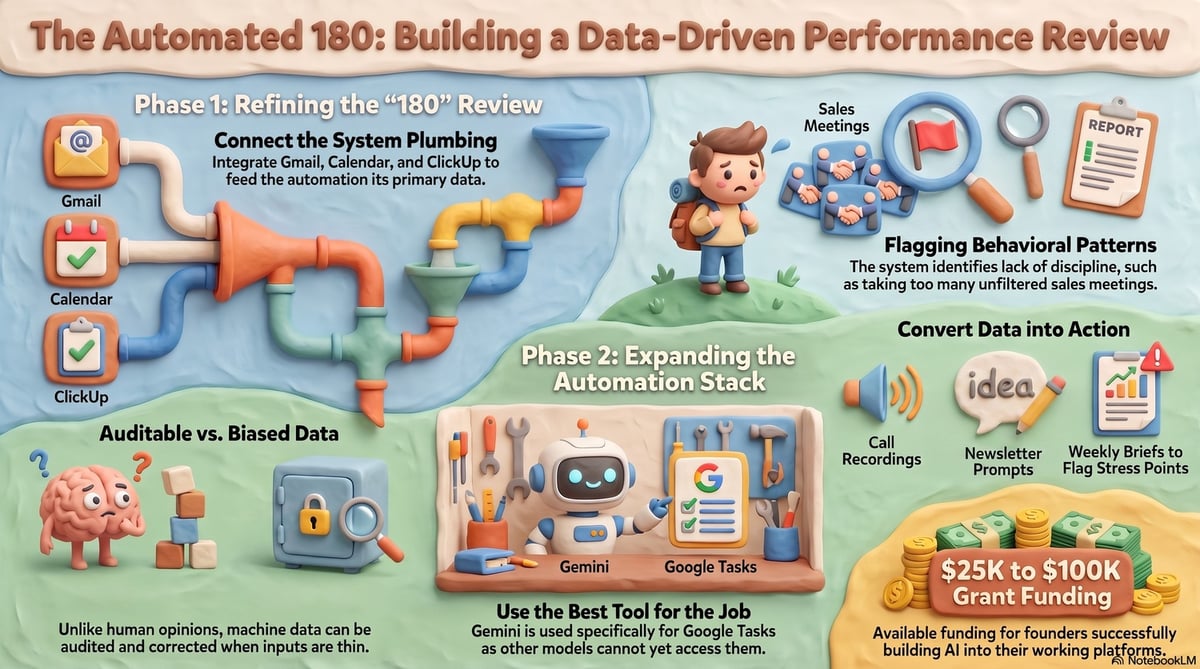
I wondered what would happen if I cut the human out entirely and went straight to the data. Not someone's impression of my week, but the actual week itself. So I built what I've started calling a 180 review: an automation that scans across Gmail, Google Calendar, ClickUp and the rest of my system every week, pulls together everything it can find on how I'm actually operating, and produces a report card against the same metrics my own clients are held to. If I'm going to ask founders to measure themselves honestly, I should be willing to sit under the same lens.
The First Report Was Brutal. It Was Also Wrong.
The first report came back and told me I was scoring three or four out of ten on nearly everything. Not the gentle, constructive brutal I try to give my mentees. The other kind. The kind that makes you want to close the laptop.
Then I looked at why. Half my systems weren't properly connected, so the automation was marking me down on things it simply couldn't see. It wasn't telling me I was failing. It was telling me it was blind in half the room and grading the parts it could see as if that were the whole picture. For about ten minutes that knocked me sideways anyway, because a low number lands before the context does. Then it made me laugh, because that's precisely what happens in a real 360 as well. Someone forms a view from partial information, hands it to you as settled fact, and you're expected to just absorb it and say thank you. At least with a machine, I could go back in, reconnect what was broken, and argue my case with better data instead of just feeling worse about myself.
Fixing the Inputs, Trusting the Number
Once I'd reconnected the missing systems, the scores moved into the sevens. Still room to improve, which is rather the point of doing this at all, but now I trusted the number, because I finally trusted what was feeding it. Garbage in, garbage out is an old line for a reason. It's just as true when the garbage is a half-connected calendar as when it's a bad assumption in a spreadsheet.
It ran again the following week and broke again, in a different place this time. I'd forgotten to connect one system entirely, so the same blind spot problem showed up wearing a different coat. Fixed that too. What I've landed on after a few rounds of this is that the machine is probably about as accurate as a human review, no more and no less, because humans are also working from limited and biased data of their own. Nobody's colleague has full visibility into their week either. The difference is that I can see exactly where the machine's data is thin and go and correct it. You cannot run the same audit on a colleague's opinion of you. You just have to sit there and take it, and hope they were paying attention.
The Uzi Week
The most useful thing the review told me had nothing to do with scores at all. One week it flagged that I'd been taking sales meetings like I was firing an Uzi, saying yes to anything that moved. It was right, and it was uncomfortable precisely because it was right. That week I'd had a run of inbound interest, gotten a bit giddy about it, and said yes to every call going with no filter and no discipline behind the decision. It felt like momentum. It was actually just noise wearing momentum's coat.
The following week I got selective. I said no to more than I said yes to, and I closed two deals in the process. I'm not going to hand the automation full credit for that turnaround, because it mostly reinforced something I already half knew was true. But there's real value in having something say it back to you plainly, with numbers behind it, at the exact moment you might otherwise have talked yourself past the problem entirely. Self-awareness is one thing. Self-awareness with a timestamp on it is a different, more useful thing.
The Other Automations Riding Along
I've built a few other pieces alongside the main review, mostly because once you've got the plumbing in for one automation, the marginal cost of a second and third drops fast. One pulls the top three insights out of my Fireflies call recordings each week and hands them to me as newsletter prompts, which is how most of what you read here actually starts life: as a voice memo recorded on a beach, with my dog flatly ignoring every single command I give her. I still write every word myself. The automation just points me toward what's worth writing about, which is a smaller job than people assume and a genuinely useful one.
Another runs a weekly CEO brief across everything I've got on, flags stress points and urgent items before they become fires, and has already saved me from missing a lead I'd promised to follow up with. Small save, real save.
The Gemini Anomaly
One genuine surprise came out of building all this. Neither Claude nor ChatGPT can create a task in Google Calendar, or even see the tasks that are already sitting there. Only the events. Gemini can do both. So Gemini, which I'd otherwise barely opened in months, now has a specific job in my stack that nothing else currently does.
There's a broader lesson sitting inside that small, slightly annoying discovery. The best model isn't always the one with the right intelligence. Sometimes it's the one with the right plumbing into the system you actually live in. Worth remembering before you commit your whole operation to a single tool because you like its personality.
What This Actually Teaches You
None of this worked cleanly on the first attempt, and I'd be doing you a disservice if I pretended otherwise. It takes real patience to get the data right before you can trust what comes out the other end of it. But once it's right, it's right, and the marginal effort of fixing one broken connector is a lot smaller than the ongoing cost of running blind and calling it intuition. I'll keep tuning the metrics from here, and I'd genuinely be curious what you're building on your end, and more importantly what's actually holding up under real use rather than just looking clever in a demo to a room full of people nodding politely.
One Last Thing
If you've got a working MVP and you're looking to build AI properly into the platform rather than bolt it on as a feature, get in touch. There's AWS grant funding available of up to USD 100k depending on where the platform currently stands, and a good number of the founders I work with have already been through the process successfully. Book a call and we can talk it through: https://mentorcruise.com/sessions/grant-funding-strategy-na-ben-sheppard1872/book/16648/