And if I’m honest, that’s been true for most of my career.
I Didn’t Feel Ready — I Just Moved Anyway
People often assume that the bravest moments in your career are the big, visible ones:
- the job change
- the promotion
- the public talk
- the leadership role
But when I look back at my own journey — from consulting into pre‑sales, from delivery into technical sales, from execution‑focused work into more visible, customer‑facing conversations — the moments that shaped me most didn’t feel brave at the time.
They felt uncomfortable.
They felt like:
“I’m not sure I belong in this room, but I’m going to speak anyway.”
They felt like:
“I don’t have every answer yet, but I’m willing to ask the question.”
And sometimes, even more quietly:
“I’m not confident this will work out — but staying where I am definitely won’t.”
Most of my growth didn’t come from moments where I felt fearless.
It came from moments where I chose movement over certainty — taking steps before I had any real proof that I was ready for what came next.
The Voice in Your Head Doesn’t Go Away
One of the things we spoke about during the panel was navigating environments where you feel like you have to constantly earn your place.
If you’ve ever:
- over‑prepared for a meeting
- rewritten a question in your head three times before asking it
- hesitated to speak because someone else sounded more senior
- waited for the “perfect moment” to contribute
…you’ll know exactly what I mean.
For a long time, I thought confidence meant arriving somewhere already certain of myself.
That confident people:
- spoke more
- spoke louder
- always had an immediate answer
- never looked unsure
But over time, I realised something important:
“The voice in my head didn’t go away — I just stopped letting it drive the meeting.”-
Self‑trust doesn’t silence doubt.
It just changes your relationship with it.
You still notice the hesitation. You still hear the uncertainty.
But instead of letting it decide whether you act, you move forward anyway — trusting that you’ll learn what you need to learn along the way.
Confidence Often Comes After the Leap
One of the biggest career shifts I made was moving from delivery into pre‑sales.
In delivery, I was used to solving problems directly — implementing, configuring, building solutions that would eventually go live.
In pre‑sales, the role was different.
Suddenly, I wasn’t just responsible for execution — I was responsible for:
- shaping conversations
- guiding decision‑making
- telling stories about what could be possible
And most importantly:
- speaking before the outcome existed
That didn’t feel empowering at first.
It felt exposed.
It meant letting go of being “the expert in the room” and becoming comfortable with ambiguity — conversations where my thinking mattered as much as my output.
As I shared during the panel:
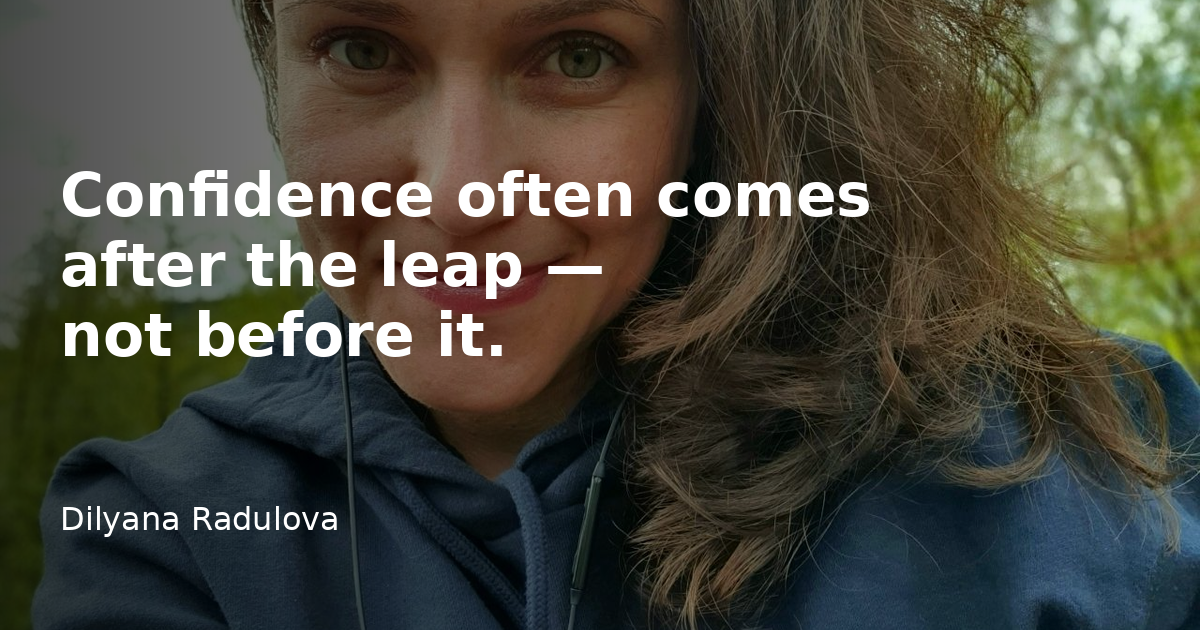
“Confidence often comes after the leap — not before it.”
I didn’t move because I felt confident.
I moved because staying where I was no longer aligned with where I wanted to grow.
And in doing that — in stepping into something uncertain — I started to build trust in my own ability to figure things out.
What Self‑Trust Looks Like in Real Time
We often talk about self‑trust as something abstract — like a mindset you develop over time.
But in reality, self‑trust shows up in very small, very practical decisions in the moment.
It looks like:
- making a recommendation when there isn’t a single “right” answer
- taking ownership of an outcome you haven’t delivered before
- setting boundaries on scope, even when it might disappoint someone
- proposing an approach that hasn’t been validated yet
In customer‑facing roles especially, there’s often pressure to sound certain, polished, and technically complete at all times.
And early in my career, I equated certainty with credibility.
If I paused too long, I assumed it meant I wasn’t ready. If I needed to think out loud, I assumed it meant I wasn’t senior enough. If I asked a question, I assumed it meant I hadn’t prepared properly.
But over time, I realised that:
“Self‑trust isn’t about always having the right answer — it’s about trusting yourself to navigate the conversation even when you don’t.”
Sometimes, that means taking a moment to think before responding. Sometimes, it means challenging an assumption respectfully. Sometimes, it means redirecting a discussion back to outcomes when it’s drifting into features.
And sometimes, it simply means contributing an idea — even when you’re not entirely sure how it will land.
These are rarely dramatic moments.
Nobody notices them externally.
But internally, every time you choose to participate instead of retreat, you reinforce a very simple belief:
“I can handle this.”
And over time, those moments accumulate into something much stronger than confidence — they become evidence.
Evidence that you can:
- stay composed in ambiguity
- learn in real time
- adapt your thinking
- recover from uncertainty
Which is, ultimately, what most roles in technology actually require.
Mentorship Is Where Self‑Trust Gets Built
Mentoring others has reinforced this lesson for me again and again.
I see incredibly capable people hesitate to:
- apply for roles
- share opinions
- speak publicly
- change direction
because they’re waiting to feel ready.
They want:
- one more certification
- one more year of experience
- one more successful project
before they take the next step.
And what I often tell my mentees is:
“You don’t build confidence by waiting — you build it by collecting evidence that you can handle things you haven’t done before.”
Every time you:
- take the role
- join the conversation
- present the idea
- ask the question
you create a small data point that says:
“I can do hard things.”
And over time, those data points compound into something much more powerful than confidence — they compound into trust in your own ability to learn, adapt, and grow.
The Career Strategy Nobody Talks About: Saying No
We often associate bravery with saying yes.
Yes to opportunities. Yes to stretch roles. Yes to visibility.
But one of the most important things I’ve learned — and shared during the panel — is that:
“You have to say enough ‘no, thank yous’ to make space for the right ‘yes, please.’”
Early in your career, it’s tempting to take on everything in the name of growth.
But every misaligned yes:
- drains time
- divides focus
- adds pressure
- delays meaningful progress
Self‑trust also shows up in your ability to say:
“This doesn’t align with where I want to grow right now.”
Even when that feels uncomfortable.
Even when you worry it might make you seem less collaborative or less ambitious.
Because bravery isn’t just about stepping forward.
Sometimes, it’s about stepping back from the wrong thing so you have the energy to move towards the right one.
How You Start Building Self‑Trust
Self‑trust doesn’t appear overnight — and it rarely arrives before you need it.
In most cases, it’s built through small, repeatable actions:
- offering to lead something you haven’t done before
- making a call when there isn’t complete information
- deciding to prioritise impact over perfection
- choosing progress over consensus
None of these moments feel significant on their own.
But every time you act before you feel completely certain, you give yourself a small piece of evidence that you can navigate something unfamiliar.
And over time, that evidence becomes a foundation.
Not of confidence — but of trust in your ability to handle whatever comes next.
If You’re Waiting to Feel Ready…
If there’s one thought I’d leave you with — from both the panel and my own experience — it’s this:
Take the role. Join the conversation. Raise your hand. Share the opinion.
Then learn fast — and let the confidence catch up.
Because bravery in your career rarely feels brave when you’re doing it. It just feels uncertain.
And that’s exactly where self‑trust begins.
Self‑trust doesn’t come from eliminating uncertainty before you act — it comes from deciding that uncertainty doesn’t get to decide for you.
Whether you're stepping into a new role, speaking up in a meeting where you feel out of your depth, or raising your hand before your idea is fully formed — self‑trust is built in the moment you choose to move forward anyway.
Not because you’re certain. But because you’re willing to figure it out.