The busyness trap
Ask a new founder how things are going and they'll almost always say the same thing: busy.
Busy building. Busy tweaking the website. Busy having conversations. Busy on the pitch deck. Busy researching competitors.
What they're often not doing is growing.
There's a specific trap that catches most first-time founders in the first twelve months, and it's not laziness or a bad product. It's that they have confused motion with progress. The two feel identical when you're in the middle of them. The difference only shows up when you check the numbers.
After working with founders at every stage, I can usually spot this within the first session. Here's what it looks like.
Why this is so hard to see from the inside
In a job, effort is usually rewarded. You work hard, you get results. The feedback loop is clean.
In a startup, effort and results are often completely disconnected, at least in the short term. You can work eighty hours a week and move nothing if those hours are pointed in the wrong direction. And because the hours feel productive, it takes a long time to realize the direction was the problem.
Most founders are evaluating their own performance using the wrong metric. They're measuring input when they should be measuring output.
The three patterns I see over and over
Pattern 1: Perfecting instead of shipping.
The product is almost ready. The landing page needs one more pass. The pricing isn't quite right.
This is not caution. It's fear dressed up as diligence.
One founder I worked with spent three months refining his onboarding flow before a single paying customer had touched it. When we finally got real users in, they dropped off at a completely different step he hadn't thought to optimize. Three months, wrong problem.
The market will tell you more in two weeks of real exposure than six months of internal refinement. Shipping something that's 80% ready and learning from real users is almost always more valuable than waiting until it feels perfect, because perfect is a moving target that keeps shifting further out.
Pattern 2: Talking to everyone except paying customers.
New founders are great at having conversations. With other founders. With potential investors. With advisors. With people who say "this is really interesting."
Interesting doesn't pay the bills.
I had a client who could tell me exactly what five investors thought about her market, but had spoken to only two potential customers in the previous month. She had a funding narrative and no sales. The most important conversation a founder can have, especially in the first year, is with someone who has a specific problem, feels it urgently, and has already spent money trying to solve it. Everything else is noise until you find that person.
Pattern 3: Solving internal problems that don't exist yet.
Building the org chart before you have a team. Writing internal processes before you have enough customers to stress-test anything. Designing the Series A narrative before you have revenue.
This is the most seductive trap of the three because it feels strategic.
What it actually is, is avoidance. Internal problems that exist at fifty employees do not exist at five. Solving them early doesn't make you prepared. It makes you distracted from the harder, messier work of the present.
What actually moves the needle in year one
I use a simple filter with my founder clients when they're deciding how to spend their week:
Will this help me understand my customer better, get a new one, or keep an existing one?- Sam Hirbod
If the answer is no, it probably doesn't belong in the calendar right now.
That's not to say operations, product, and positioning don't matter. They do, but the sequencing matters enormously. Founders who try to run a company before they've figured out the customer almost always have to unwind expensive decisions later. Here is the order that works:
The order that works:
- 1. Understand the problem deeply. Not your version of it. The customer's version. This means conversations, not surveys. It means listening more than pitching.
- 2. Sell before you scale. Get to ten paying customers before you think about a hundred. Each one will teach you something your assumptions got wrong.
- 3. Fix what breaks. Not what might break. When you have real customers, real problems surface fast. Solve those. Don't solve hypothetical ones.
- 4. Then build the machine. Once you know what works, what message lands, what customer converts, what product they actually use, you can start systematizing it.
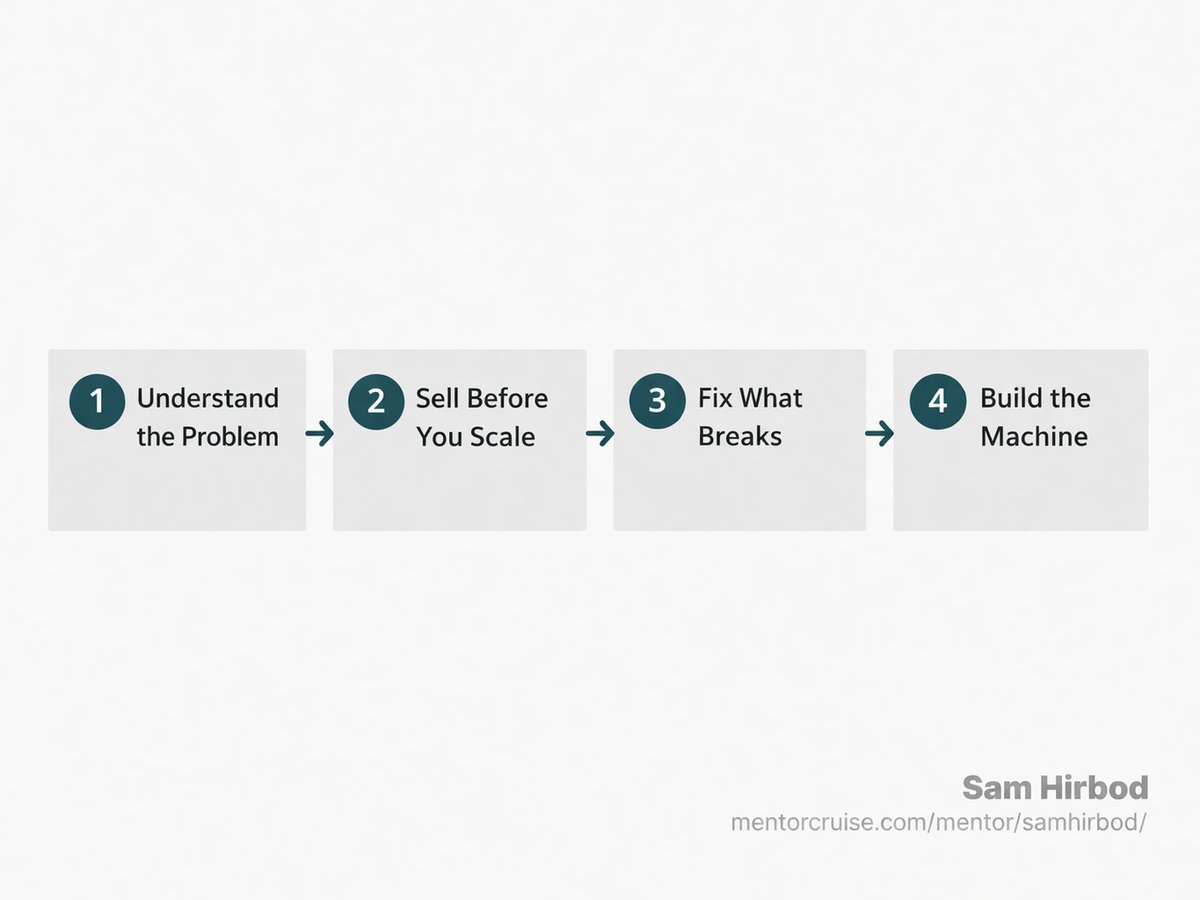
Most founders try to run steps three and four before they've finished step one. That's why they're busy but not growing.
That's why they're busy but not growing.
The question that changes everything
When I take on a new founder client, one of the first things I ask is:
"What do you know for certain, and what are you still assuming?"- Sam Hirbod
Most founders, if they're honest, are operating on far more assumptions than certainties. That's normal, you can't run a startup without making bets. But the fastest founders I've worked with are ruthless about knowing the difference. They treat assumptions like debt: necessary sometimes, but something to pay down as quickly as possible with real evidence.
The slowest founders treat their assumptions like facts. They build on them, defend them, and only discover they were wrong after months of expensive work.
---
This is the exact pattern I see in the first session with almost every founder who comes to me stuck, and it's fixable faster than you'd think.
If you want help applying this to your business, come with a honest answer to one question:
What are you spending your time on, and what do you actually know versus assume?- Sam Hirbod
We'll map it, cut what's noise, and build a 30-day focus that puts your effort where it actually moves things.
About the author: Sam Hirbod is an executive and professional coach who helps founders, entrepreneurs, and leaders get unstuck, move faster, and build businesses that grow on purpose, not by accident.