Starting a company means wearing about fifteen different hats at once. You're the CEO, the head of sales, the finance department, and somehow still expected to have time for product development. I've been there, and I know the chaos firsthand.
You've probably seen a dozen articles recommending Notion and Asana. Those are fine, but I'm not here to repeat what everyone else says. In 2025, the smartest founders are using AI-powered tools that actually save time and surface insights you'd miss otherwise. No generic project managers here—just tools that work harder so you don't have to.
In this guide, I'm sharing 10 tools that have helped me and countless founders I've mentored manage growth, keep budgets in check, and navigate fundraising without losing our minds. Best part? Most of these have free or affordable tiers perfect for early-stage startups.
Why Founders Need a Toolkit
Every hour you spend wrestling with spreadsheets or manually tracking expenses is an hour you're not spending on building your product or talking to customers. And when you’re a growing business, you can’t afford to bail on things that secure your long-term success.
The right SaaS tools for startups streamline everything from growth tracking to financial management. They help you spot trends before they become problems, automate repetitive tasks, and give you the data you need to make informed decisions, whether you're executing a B2B marketing strategy or managing complex financial operations.
Whether you're managing your first round of funding or trying to understand why your churn rate spiked last month, having the right tools makes the difference between scrambling and scaling.
Top Essential Tools to Manage Your Growth
Growth Management
#1. Rows
Rows is what happens when spreadsheets get AI superpowers. It connects directly to your data sources like analytics platforms, databases, APIs, and uses AI to analyze trends and generate insights. You can use it to build living dashboards that update automatically and actually tell me what's happening with my business.

Why Rows?
- AI analyst built-in: Ask questions in plain English and get formulas, charts, and insights generated automatically
- Live data connections: Pull real-time data from Google Analytics, Stripe, HubSpot, and 50+ other sources without exports
- Smart automation: Set up workflows that trigger actions based on data changes, like Slack alerts when metrics hit thresholds
- Collaboration features: Share interactive dashboards with your team that update in real-time
#2. Coefficient
Coefficient turns Google Sheets and Excel into powerful business intelligence tools by connecting them to 100+ live data sources. Instead of manually exporting CSVs every week, your spreadsheets stay current with automatic refreshes. It's perfect for founders who live in spreadsheets but need startup growth tools that keep up with their pace.
Why Coefficient?
- Two-way data sync: Connect to Salesforce, HubSpot, QuickBooks, MySQL, PostgreSQL, and push changes back to source systems
- AI-powered insights: Get automated alerts through Slack and emails when data anomalies occur or trends shift
- Pivot and analyze: Build complex reports with filters and pivots that update automatically as data changes
- Team dashboards: Create live dashboards anyone on your team can access without touching the underlying data
#3. Mixpanel
While many tools track website visits, Mixpanel shows you what users actually do inside your product. It's essential for SaaS companies and anyone with a web or mobile app. Leadership teams use it to identify exactly where users get stuck in onboarding and which features drive retention, the insights that directly impact your product roadmap.

Why Mixpanel?
- Event-based tracking: Track specific user actions like button clicks, feature usage, or completed workflows
- Cohort analysis: Compare how different user groups behave over time to identify what drives engagement
- Funnel visualization: See exactly where users drop off in multi-step processes
- Retention reports: Measure how often users come back and what keeps them engaged
Business Planning
#3. Upmetrics
Upmetrics is a business planning software used by founders and small business owners to create business plans. It helps users put together written plans and financial projections in one place, without relying on complex spreadsheets. The platform is commonly used for startup planning, loan applications, and internal business planning. Guided templates and built-in financial projection tools help users organize ideas and prepare a complete business plan.
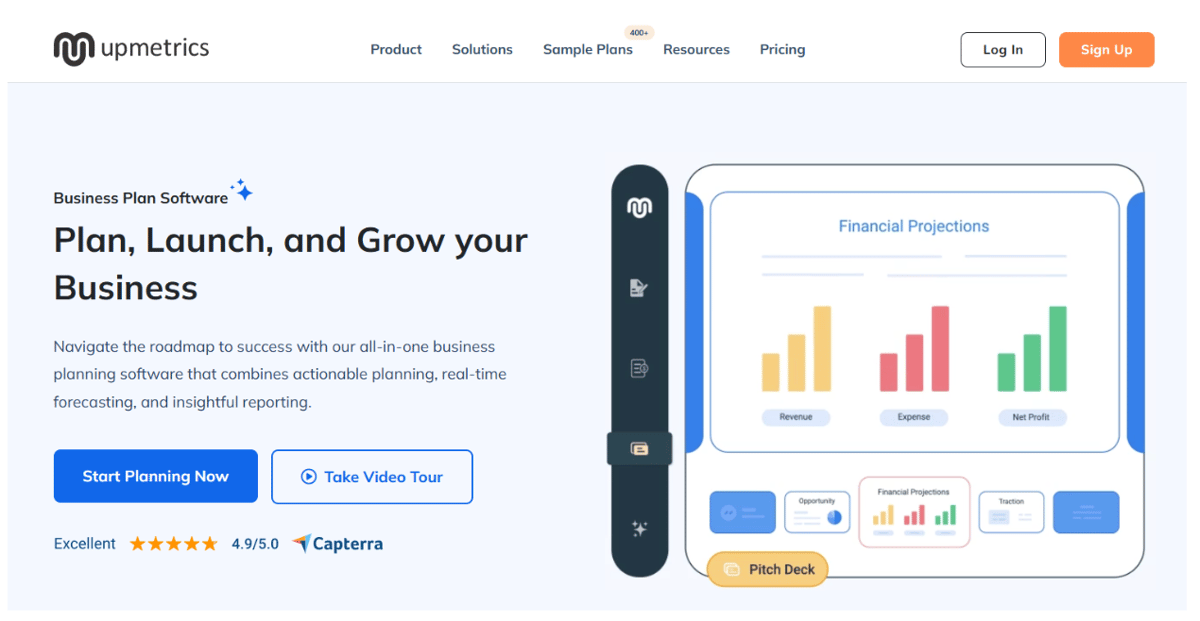
Why Upmetrics?
- AI-powered plan generator: Create a complete business plan in minutes using guided inputs
- Multi-language support: Translate your business plan into 90+ languages
- AI agents for speed: Reduce time spent on writing, market research, and forecasting tasks
- 400+ sample plans: Reference real business plan examples across industries and use cases
- Financial forecasting assistant: Build projections with guided inputs and error checks
Budget & Financial Management
#5. Puzzle
Puzzle is AI-powered financial planning software built specifically for startups. Unlike traditional accounting software that just records what happened, Puzzle helps you understand what's coming and plan accordingly. It's become essential for financial management tools for startups that need to show investors they have their numbers under control.
Why Puzzle?
- AI-powered forecasting: Automatically generates cash flow projections based on your historical data and growth patterns
- Scenario modeling: Play with different growth rates, hiring plans, or burn rates to see how they affect your runway
- Investor-ready reports: Generate board-ready financial statements and metrics dashboards in minutes
- Real-time sync: Connects to your bank accounts and accounting software for always-current data
#6. Vic.ai
Vic.ai uses AI to automate accounting tasks that usually eat up hours of your time. It learns how you categorize expenses, matches invoices to purchase orders, and flags anomalies automatically. Imagine getting back 10+ hours a month you used to spend on expense categorization alone.

Why Vic.ai?
- Smart categorization: AI learns your Chart of Accounts and categorizes transactions with 95%+ accuracy
- Invoice processing: Extracts data from invoices automatically and routes them for approval
- Anomaly detection: Flags duplicate payments, unusual amounts, or suspicious transactions
- Audit trail: Maintains complete documentation for compliance and audits
#7. Ramp
Ramp is a corporate card and spend management platform that uses AI to help you save money. It analyzes your spending patterns and suggests where you can cut costs or negotiate better rates. Beyond just tracking expenses, it actively helps you spend less, which is exactly what productivity tools for startup founders should do.
Why Ramp?
- AI-powered insights: Identifies duplicate subscriptions, unused software, and opportunities to save
- Smart limits and controls: Set spending rules that adapt based on context and history
- Automated expense reports: No more chasing receipts—everything is categorized and ready for accounting
- Rewards on everything: Earn cashback on all purchases with no categories or limits
#8. Expensify
Managing expenses and reimbursements becomes a nightmare as your team grows. Expensify makes it painless by automating receipt capture, expense categorization, and approval workflows.
The mobile app is particularly good: you can just snap a photo of any receipt and you're done.

Why Expensify?
- SmartScan technology: Snap photos of receipts and Expensify extracts all details automatically
- Corporate card integration: Matches receipts with card transactions automatically
- Approval workflows: Set up multi-level approvals that match your company policies
- Reimbursement automation: One-click reimbursements through direct deposit
Fundraising & Investor Management
#9. Finta
Finta is AI-powered fundraising automation that handles the busywork of raising capital. It generates pitch materials, matches you with relevant investors, and manages outreach campaigns. When you're trying to raise while also running the business, these fundraising tools for startups become invaluable.

Why Finta?
- AI pitch deck generation: Creates investor-ready decks based on your business data and industry benchmarks
- Investor matching: Uses AI to find investors who actually fund companies like yours
- Automated outreach: Manages email campaigns and tracks engagement without manual follow-ups
- Deal room management: Centralized space for due diligence documents and investor communications
#10. Carta
Carta handles cap table management and equity tracking, which becomes critical once you start giving out stock options or raising funding.
Why Carta?
- Cap table management: Clear visualization of ownership, dilution, and equity distribution
- 409A valuations: Get the required valuations for setting option strike prices
- Option administration: Issue, track, and manage employee stock options in one place
- Fundraising tools: Model different financing scenarios and generate necessary legal documents
#11. Forecastr
Forecastr uses AI to build financial models for fundraising. Instead of spending weeks building complex spreadsheets, it generates investor-grade financial projections based on your business model and industry benchmarks. It's been a lifesaver when investors ask for three-year projections with different growth scenarios.
Why Forecastr?
- AI-powered modeling: Generates financial forecasts using industry data and your historical performance
- Scenario planning: Create multiple funding scenarios to show investors different growth paths
- Investor templates: Pre-built models that match what VCs and angels expect to see
- Integration ready: Pulls data from your accounting software to keep projections accurate
#12. Flowlu
Flowlu gives startups a potent blend of financial and operational management. It links your deals, tasks, and projects directly to your budget and cash flow. With easy-to-use automations, you can speed up all aspects of actual business activities. Just think of recording expenses and sending bills to your regular clients automatically.

Why Flowlu?
- In-built CRM, projects, and tasks: Manage customer relationships, team tasks, and project delivery in one app.
- Operations-finances link: Connects your sales pipelines and project tasks directly to your budget and profitability reports.
- Automated billing and invoicing: Record expenses and bill your regular clients with minimal manual input to simplify revenue collection.
- Granular financial control: Set up custom categories for your unique income and expenses.
Tips for Making the Most Out of Your Toolkit
Having productivity tools for startup founders is one thing. Using them well is another. Here's what I've learned through trial and error.
Integrate Your Tools & Avoid Overlaps
Every tool you add creates another login and another place to check. Look for tools that connect with each other through native integrations or platforms like Zapier. If two tools serve basically the same purpose, pick one and commit to it. I've seen founders waste hours every week because their data lives in five different places.
Keep Track of Your Data (& Put It to Good Use)
Tools are only useful if you actually look at the data. Block time weekly to review your key metrics, whether that's cash burn, user engagement, or sales pipeline. Understanding how to grow a small business from the ground up means knowing your numbers cold.
Get Rid of Tedious, Repetitive Tasks
If you're doing the same thing manually more than twice a week, there's probably a way to automate it. Set up automatic expense categorization, recurring financial reports, and workflow triggers. The time you save adds up fast.
Review and Update as You Grow & Scale
What works at pre-seed won't work at Series A. Your needs change as you scale, and your tools should evolve too. Every six months, audit what you're using and ask if there's a better option. Getting guidance from startup mentors who've been through these growth stages can help you avoid expensive mistakes.
Moving Forward with Your Stack
Building a startup is hard enough without fighting your tools. The right toolkit doesn't just save time: it gives you clarity on what's working, where you're bleeding money, and what deserves your focus next.
Start with the essentials for where you are right now. If you're pre-revenue, focus on growth management tools. Raising your first round? Nail down cap table management before it becomes a mess. Already generating revenue? Get your financial tools sorted before tax season hits.
The tools I've shared here work for most founders, but your specific needs depend on your industry, stage, and business model. Having a structured business planning process helps you identify which tools solve your actual problems versus which ones just look cool.
Beyond tools, consider what external support makes sense. Whether it's working with a link-building agency to boost your SEO or partnering with specialized consultants, knowing when to bring in outside help is part of smart growth.
If you're trying to figure out which tools make sense for your startup's current stage, or you want guidance on building systems that scale, I'd love to help.
I've worked with dozens of startups navigating these exact decisions. You can book a mentoring session with me to talk through your specific situation and build a toolkit that actually moves your business forward.
So, your toolkit is ready. Now, go build something worth building!