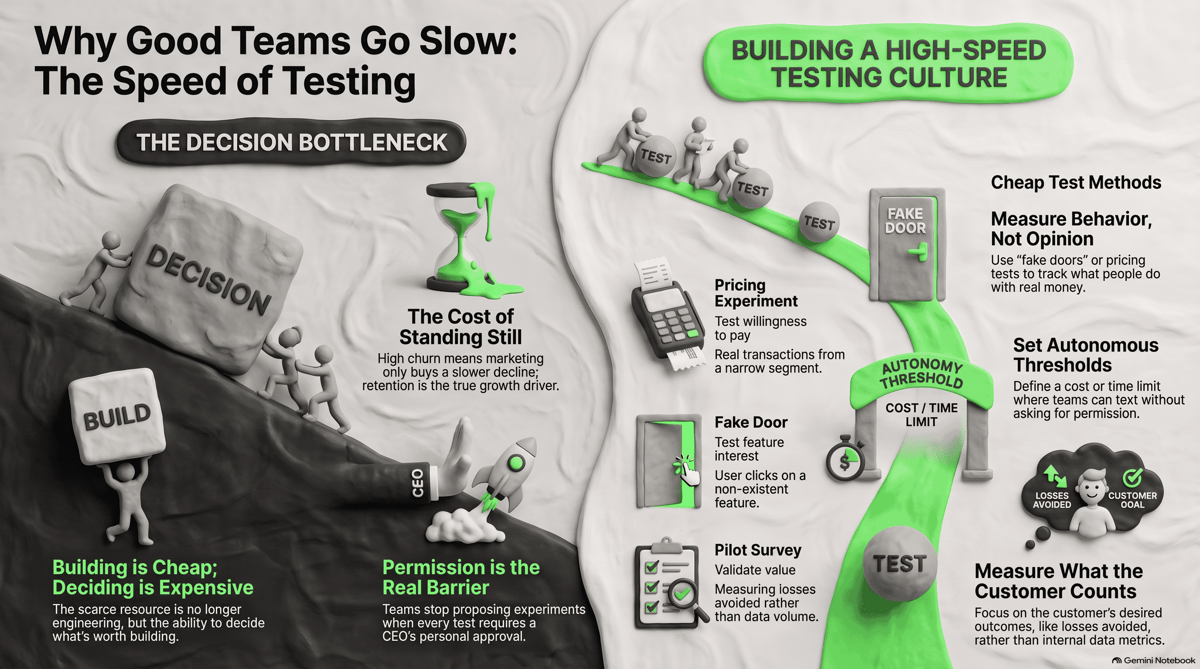
When a leadership team tells me the company has become slow, they rarely mean people are idle. They mean ideas get pitched, admired and shelved, and the same strategic question is still on the table a quarter later. The cause is almost never effort. Finding out whether an idea is right has become expensive, in money, in engineering days or, most often, in permission. When a test is expensive, people stop proposing them. That matters more now than it did 2 years ago, because building has become cheap. A small team with modern tools can put a working version of almost anything in front of customers within a few weeks. The constraint is no longer the ability to build. It is the ability to decide, quickly and on evidence, what is worth building. A company that has not adjusted to that is running its fastest capability at the speed of its slowest.
Price the cost of standing still
The clearest recent example came from an operator I mentor who runs an established subscription software business. Her chief executive was preparing for the board and asked a fair question: what is the return on marketing, and what is the return on product? The instinct is to produce 2 optimistic forecasts and let the board pick. The better answer starts with retention, because retention decides whether marketing money compounds or leaks. Her business keeps a little under two thirds of its revenue from existing customers each year. On a base of 100, that means finding well over 30 units of new revenue just to stand still. That's in a market where competitors are bidding up the same search terms and every new customer costs more than the last. Framed that way, more marketing does not buy growth. It buys a slower decline, and the case for product work that keeps customers stops being a matter of taste. If you ever have to justify an experiment to a board, put a number on the cost of standing still before you argue for anything new.
Design tests that produce behaviour
She is running 2 cheap tests, and both are worth copying. The first is a pricing experiment. It is a plan aimed at one narrow segment, the solo business owner, priced at roughly double the entry tier. The early read is that a meaningful group of those customers will take it. That tells her more about willingness to pay than any survey would, because people are generous with hypothetical money and careful with real money. The second is what product teams call a fake door. Rather than building a new feature, the product announces it as though it exists, asks users which version they would want switched on, and counts who clicks. Only the option that draws real interest gets built, in its most basic working form, and the people who clicked become the first interviewees. Each test costs days rather than months, and each produces a behaviour rather than an opinion.
The next question she raised was whose behaviour to test. Existing customers are cheap to reach, but they may not represent the market she wants to move into. My rule is to run the first test on the paying base, because it is fast and the signal is real, and to read the result as a floor rather than a verdict. If the new product sits close to the old one, that floor is usually enough to decide. If it sits a long way off, the second test belongs in the new vertical where the larger competitors are weakest. That test is slower and dearer to reach, but it is the only place the real answer lives. The one audience I would not test on is free users. People who have not paid for your core product are unlikely to pay for the next one, however enthusiastic their survey answers.
Give someone else the right to run them
Late in the conversation the real constraint surfaced, and it was not strategy. The running business was in good order, but she was tired of being the only person in the building proposing anything new. The company had a process for pitching ideas and nothing for what happened after the pitch. Every test still needed the chief executive's approval, and nobody below her saw proposing experiments as their job. It was a conveyor belt with the middle section missing: ideas went on at one end and nothing came off the other. That is a design problem, not a character flaw, and it has a design fix. Agree in writing who can approve what, with a simple grid of who is responsible, accountable, consulted and informed for product decisions. Set a threshold, in cost or engineering days, below which the team can run a test without asking anyone. Then review results weekly instead of reviewing pitches, so the conversation is about what customers did rather than whose idea is better. The person who spots an opportunity and says "let us try it" usually exists in the team already. They simply have nowhere to take it.
Measure what the customer counts
A test is only as useful as what it measures. The most common mistake I have seen this month, across several unrelated businesses, is measuring what impresses the founder rather than what the customer already counts. A founder building monitoring equipment for agriculture was designing a pilot around the volume of data his system delivers. A grower does not count data. A grower counts crop lost, treatments applied too late and margin per hectare. So a pilot of a few weeks should measure losses avoided and decisions made sooner. A short survey beforehand should ask whether the grower would rather pay per hectare or per farm. Fundraising works the same way. A founder heading into a pre-seed round with a long list of interested institutions will find investors discount that list almost entirely. One customer on a signed commercial licence changes every conversation that follows. In each case the question is the same: what would the person across the table accept as proof, and what is the cheapest way to produce it?
Speed is a property of how cheaply and safely a company can find things out, far more than of how hard its people work. None of what I have described needs a new hire or a new tool. It needs a decision about how decisions get made, and that is the one most leadership teams cannot see from the inside. If your team pitches ideas that never become tests, book an introductory call with me on MentorCruise and we will find where the testing is stuck and what it would take to make it cheap.
Ben