The real danger of AI is not just that it may generate bad code.
That is the obvious problem. The surface-level problem. The one everybody can see because it is easy to see.
- A model produces nonsense.
- A junior copies it.
- A team ships garbage.
- Something breaks.
But that is not the deepest problem.
The deeper problem is that AI may trap the entire industry inside yesterday’s thinking while convincing people they are moving faster.
And that is a far more dangerous failure mode.
Right now, most of the debate is embarrassingly shallow. People keep asking whether LLMs can replace engineers, whether prompt engineering is the new software engineering, whether teams can get away with fewer senior people, whether AI can let companies cut headcount and still ship more.
That entire conversation is missing the bigger threat.
The real question is this:
What happens when an industry starts outsourcing software creation to systems that can only remix what humanity had already discovered by the time they were trained?
That is how you get paradigm stagnation.
And if we are not careful, that is exactly where this ends up.
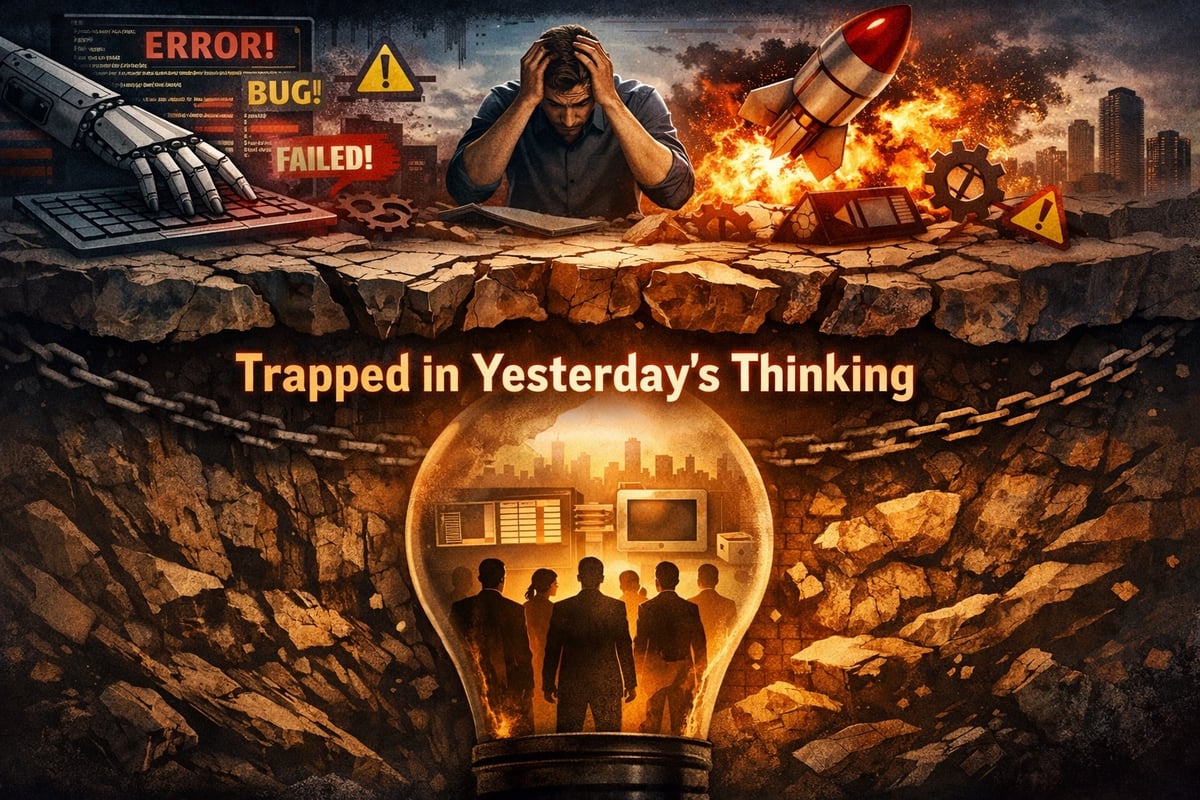
LLMs Can Reproduce Patterns. That Is Not the Same as Inventing Them.
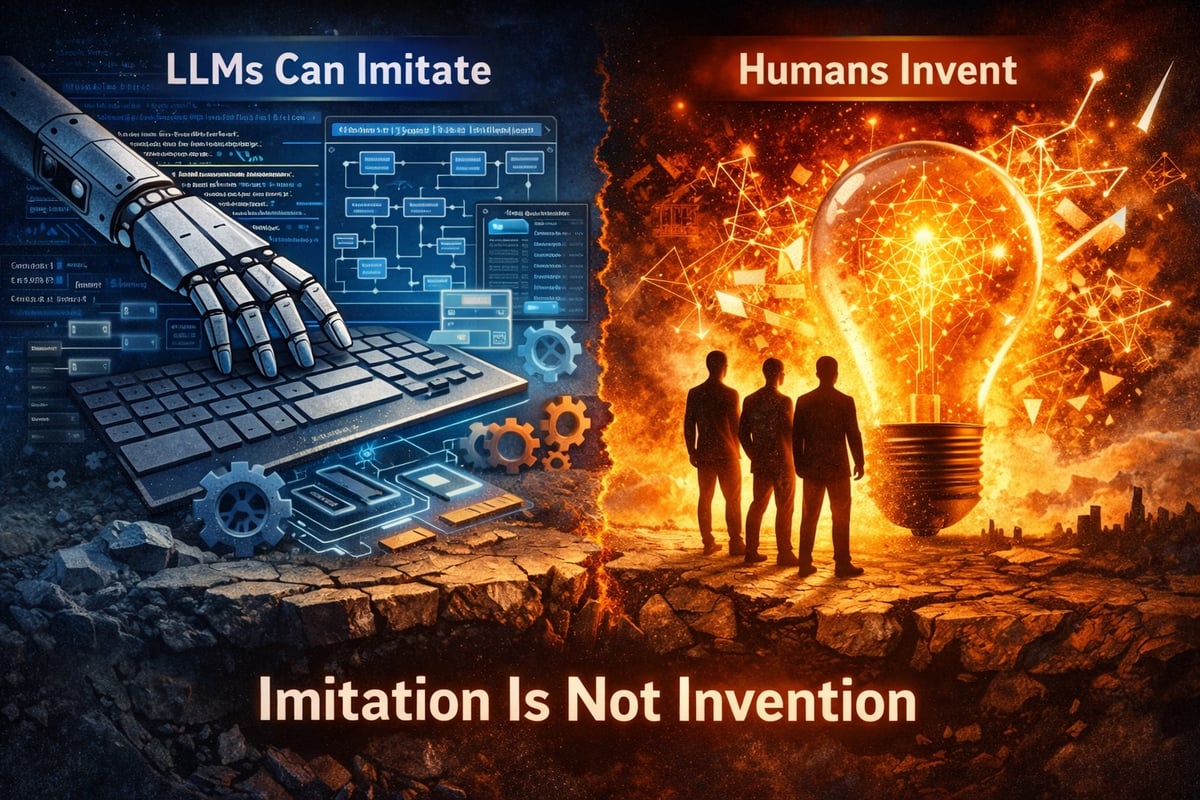
LLMs can generate code that looks polished. Sometimes very polished.
They can produce class hierarchies, modular structures, reasonable APIs, dependency injection, tests, design patterns, framework glue, cloud boilerplate, and all the other familiar shapes people associate with “good engineering.”
Why?
Because they were trained on mountains of human-written software and documentation.
So yes, they can imitate the visible output of engineering maturity.
But imitation is not invention.
That distinction matters far more than the hype crowd wants to admit.
Software did not evolve because people kept restating the same ideas with more confidence. It evolved because human beings kept reaching the limits of the current paradigm, then inventing something better.
We did not get progress by politely rephrasing yesterday.
We got progress by breaking out of it.
Structured programming did not come from prettier spaghetti code. Better abstractions did not come from asking for the old abstraction in a nicer format. Event-driven systems did not emerge because somebody had a more efficient autocomplete. Concurrency models, type systems, frameworks, architectural patterns, and entire shifts in how we reason about systems came from human minds colliding with hard limits and forcing new ways of thinking into existence.
That is how engineering moves.
Not by remix.
By rupture.
And that is exactly the kind of thing LLMs are weakest at.
The Hype Is Confusing Compression With Creation
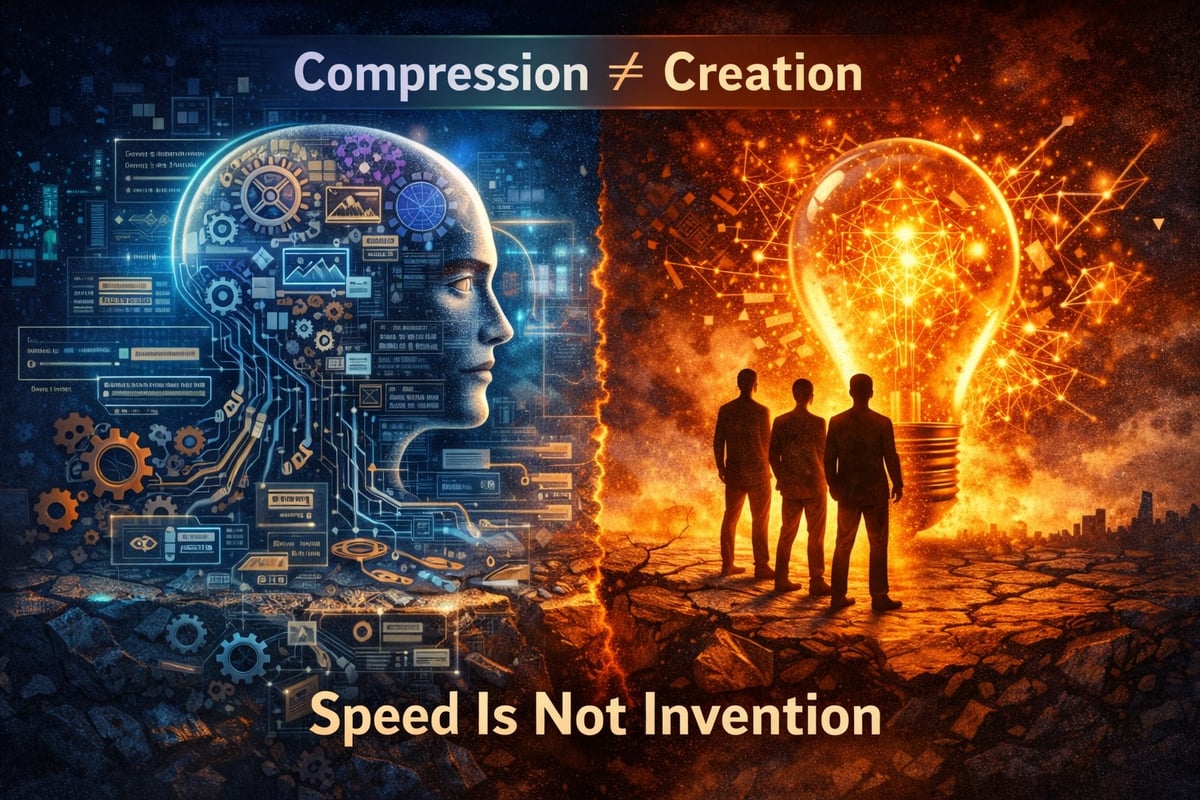
A lot of executives, content farmers, LinkedIn prophets, and AI tourists are treating these systems as if they are general engines of invention.
They are not.
They are probabilistic pattern machines.
Very useful ones, sometimes extremely useful, but still pattern machines.
They compress and reconstruct. They interpolate. They synthesize within the statistical shape of what they absorbed. They can combine known things in useful ways. They can accelerate some workflows. They can reduce friction. They can absolutely make engineers faster in many cases.
None of that means they are reliably capable of generating new conceptual foundations.
That is the bait-and-switch happening everywhere right now.
People see acceleration in local tasks and then hallucinate that this automatically translates into frontier-level invention.
It does not.
Speeding up the production of known patterns is not the same thing as expanding the boundary of what is known.
Those are different activities.
Different cognitive demands.
Different failure modes.
And confusing them is how entire industries talk themselves into strategic stupidity.
The Short-Term Gain May Create a Long-Term Ceiling
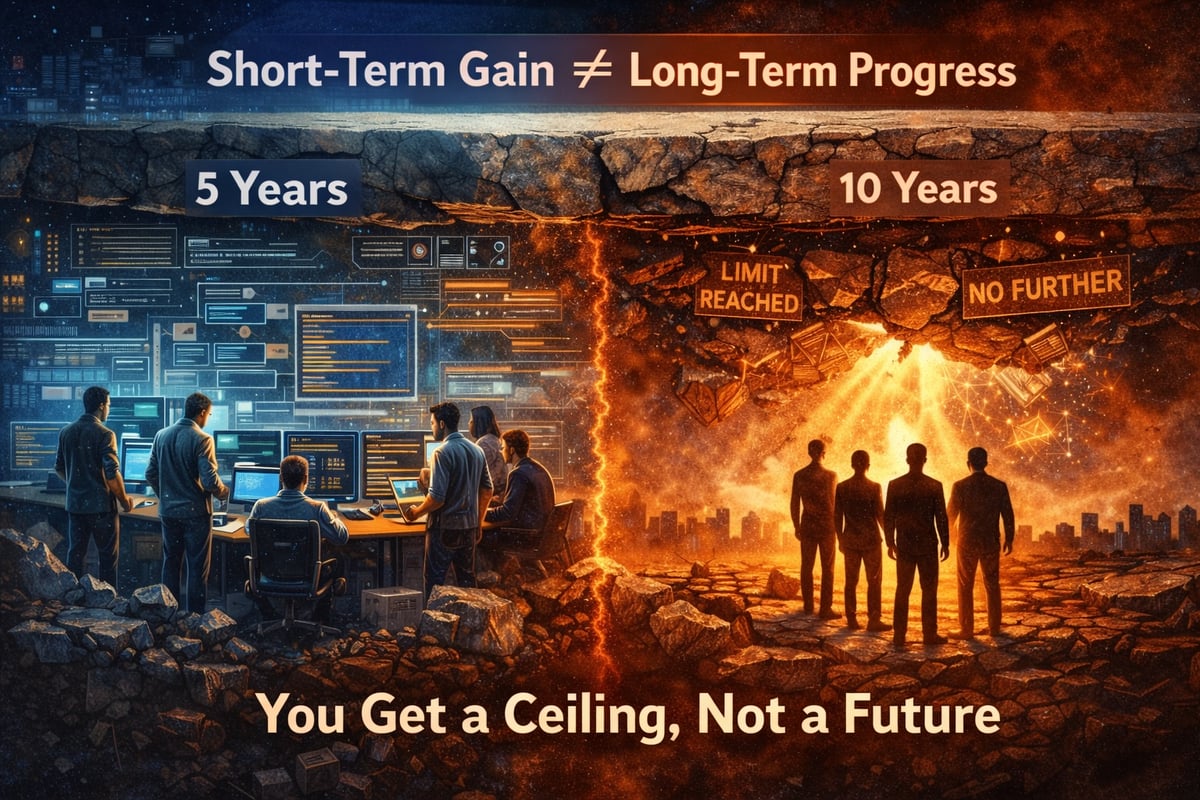
This is the part leadership teams should be losing sleep over.
Imagine an industry that becomes increasingly dependent on models trained on a historical snapshot of human output. Now imagine that same industry also starts thinning the senior pipeline, reducing deep technical apprenticeship, and replacing a growing percentage of actual engineering work with prompt-and-review workflows.
What happens in 5 years?
What happens in 10?
You do not get infinite acceleration.
You get a ceiling.
Because now the system is increasingly built by tools trained on past human knowledge while the human capacity required to invent the next leap is being slowly starved.
That is not progress.
That is deferred decline.
At first, it does not look like decline, because output still appears to rise.
More tickets get closed.
More prototypes get shipped.
More code gets generated.
More features make it to staging.
Everybody claps.
Meanwhile, the underlying intellectual engine that used to produce new abstractions starts weakening.
Fewer people develop deep systems judgment.
Fewer people understand trade-offs at a first-principles level.
Fewer people spend enough time wrestling with the hard edge of reality to invent anything truly new.
Fewer people are growing into the kind of engineers who can see beyond current tooling and create the next primitive, the next pattern, the next architectural shift.
So the machine keeps helping everyone produce more of what is already legible.
And the industry quietly loses its ability to escape the frame.
That is the trap.
Better Tooling Does Not Solve the Core Problem

This is where somebody usually jumps in with the same recycled objections.
“We will have better guardrails.”
“We will have better review systems.”
“We will have better orchestration.”
“We will use multiple agents.”
“We will add testing.”
“We will improve reliability.”
Fine.
All of that may help.
It may reduce some categories of error.
It may improve consistency.
It may make AI-assisted engineering more practical and less chaotic.
But none of it changes the core constraint.
LLMs do not stop being probabilistic imitators because you wrapped them in nicer tooling.
They do not become engines of deep conceptual invention because you added a workflow.
They do not suddenly develop reliable first-principles reasoning because you inserted another review layer.
They do not become trustworthy creators of new paradigms because a startup built a dashboard around them.
You can improve the operating conditions around the system.
You cannot transform the nature of the system by branding.
This matters because the real issue is not whether AI can help with implementation. It obviously can.
The real issue is what happens when organizations start structuring themselves around the false assumption that implementation is the whole game.
It is not.
Engineering is not just code production.
It is problem framing, abstraction design, trade-off navigation, constraint discovery, systems thinking, failure analysis, and sometimes inventing a completely different way to think about the problem because the current one has hit a wall.
That last part is the lifeblood.
And it is exactly the part most likely to be starved if leadership becomes addicted to the optics of AI productivity.
If You Hollow Out Engineers, Who Builds the Next Layer?
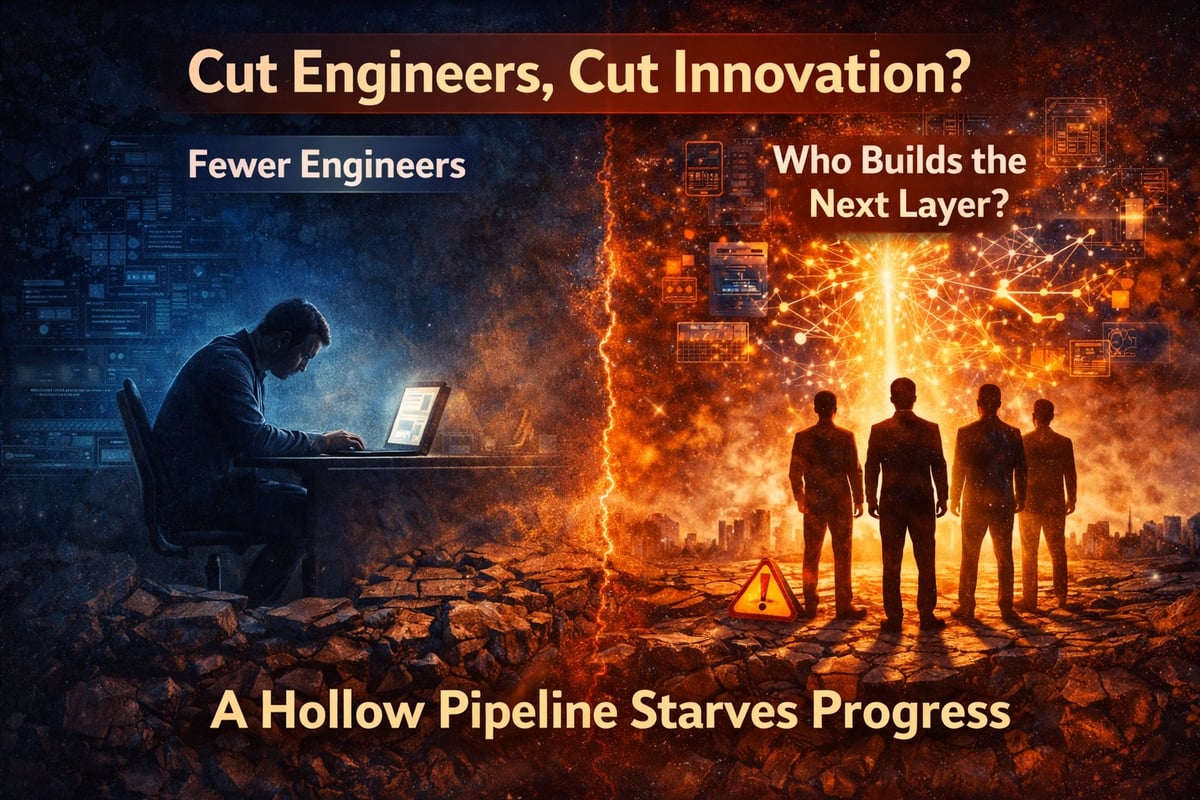
This is the question the hype crowd avoids because it wrecks the fantasy.
If you reduce senior engineering depth, cut apprenticeship pathways, and turn software development into a weird theatre performance where people prompt machines and lightly inspect the output, then who exactly is left to build the next layer of abstraction when the current one stops being enough?
Who is left to rethink the model?
Who is left to discover the new architecture?
Who is left to challenge the assumptions embedded in current tools?
Who is left to invent something that does not look like a polished average of what already exists?
Because that future engineer does not appear by magic.
That person is developed through years of grappling with complexity, making decisions under uncertainty, learning from failure, building real systems, and internalizing deep mental models.
You do not get that by turning engineering into autocomplete supervision.
And once you degrade that pipeline far enough, the damage does not show up immediately.
That is what makes it dangerous.
The collapse is delayed.
The loss is cumulative.
The bill arrives later.
This Problem Is Bigger Than Software
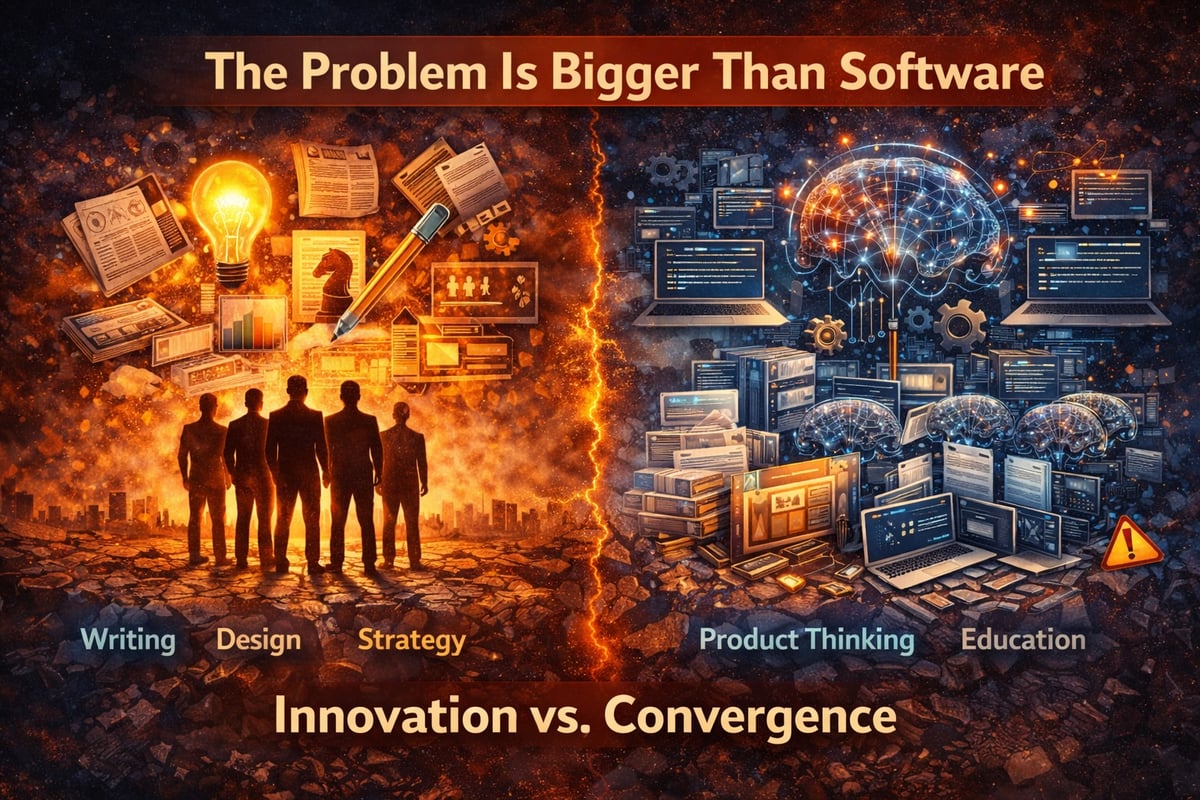
And no, this is not only about software.
Software is just where the pattern is most visible right now.
If more and more of the world’s outputs start flowing through the same class of generative systems, trained on the same broad historical corpora, optimized toward familiar forms, safety-smoothed language, and pattern-consistent outputs, then you should expect convergence.
Not just in code.
In writing.
In design.
In strategy.
In product thinking.
In education.
In decision support.
In everything.
And if a growing share of the world’s artifacts come from the same machine logic, then where exactly are the differences supposed to come from?
Where does divergence come from?
Where does originality come from?
Where does the next uncomfortable but necessary break from the past come from?
Because homogeneity at scale does not produce a vibrant future.
It produces polished repetition.
Use AI. Just Do Not Worship It.
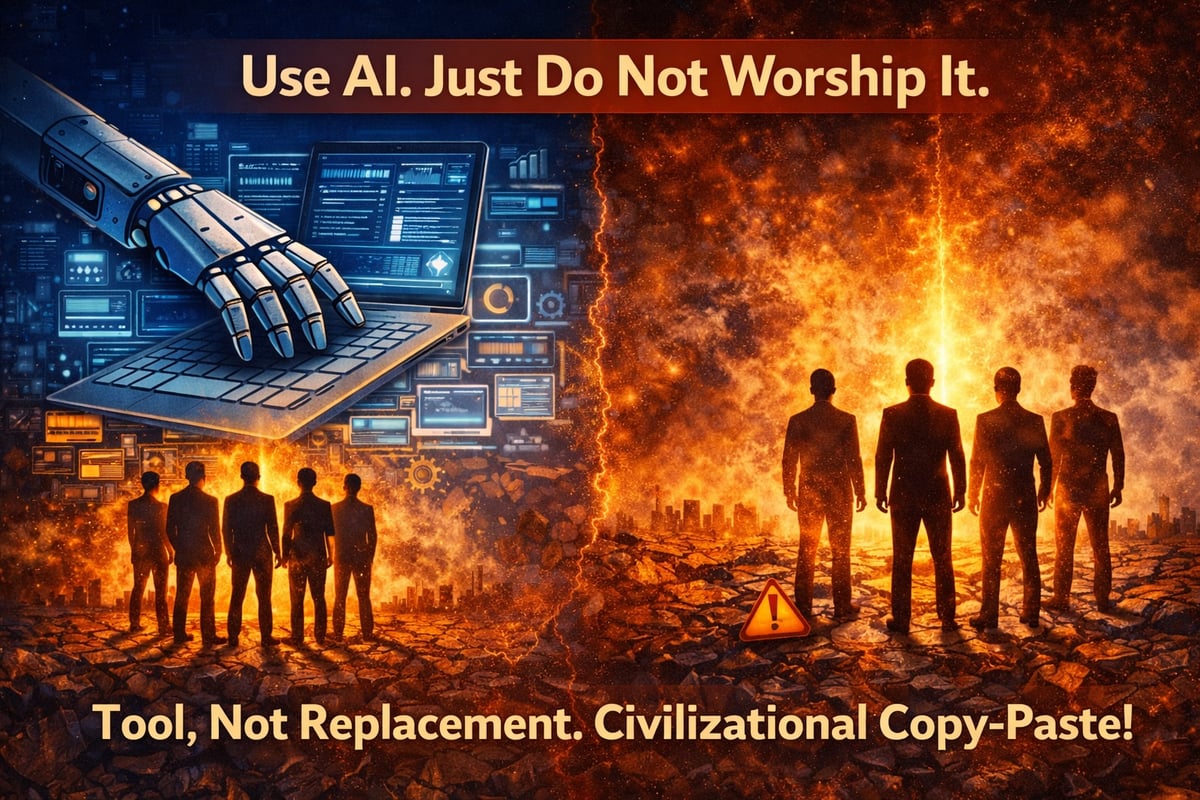
To be clear, this is not an argument for rejecting AI.
That would be stupid.
These tools are useful. In some contexts, extremely useful. They can save time, reduce friction, help with exploration, support learning, speed up implementation, and remove a lot of mechanical pain from software work.
Use them.
But use them as tools.
Not as a replacement for the human depth that created the field in the first place.
Not as an excuse to underinvest in engineers.
Not as a substitute for judgment.
Not as a reason to hollow out the senior pipeline.
Not as a justification for treating invention like a rounding error.
Because the real danger is not that AI writes bad code.
The real danger is that leadership becomes so addicted to replacing engineers with systems trained on the past that it slowly freezes the invention of the future itself.
And by the time the industry realizes what it traded away, the people capable of building the next paradigm may no longer be there in sufficient numbers to save it.
That is the risk.
Not bad code.
Civilizational copy-paste!