Over time, I learned something different.
Speed without structure creates chaos. Structure creates clarity. Clarity creates real speed.
The most effective supply chain leaders I know are not the loudest people in the room. They are the ones who slow the situation down just enough to understand it, then move quickly with purpose. In this post, I want to share a simple problem solving framework I use every day. It works in planning, logistics, manufacturing, inventory, and broader operations.
It is simple, but it requires discipline.
Start by defining the real problem
When something breaks, the natural instinct is to fix the visible symptom. A shipment is late. A forecast is wrong. Inventory is off. Someone says, “We need a new system” or “We need more people” or “We need to push harder.”
Often, none of that is actually the problem.
I always start with one question.
What exactly is happening, and who is affected?
I want specifics, not assumptions. Instead of “orders are delayed,” I want:
Orders for Product X are consistently shipping 3 days late from Distribution Center A, and it is generating customer complaints and expediting costs.
Now we have something real to work on. A clear definition prevents the team from chasing solutions that do not matter.
Separate signal from noise
Once the problem is clear, the next step is to understand what is truly driving it. Many supply chain issues have multiple layers. Surface issues hide deeper causes. I ask questions like:
• When did this start
• Is it happening everywhere or only in some locations
• What changed recently
• What data supports what we are seeing
• What assumptions are people making that may not be correct
I do not assume the first explanation is the right one. I want patterns. I want facts. I want to understand whether this is a one time event or a structural problem.
A real example
I once worked with a team that was dealing with chronic stockouts on a handful of key items. Operations blamed planning. Planning blamed suppliers. Sales blamed everyone.
On the surface, it looked simple. Product demand was higher than forecast. The solution seemed obvious. Increase safety stock and place bigger orders.
But when we slowed down and examined the data, something different emerged.
The demand spike was not the main driver. The real drivers were:
• Suppliers extending lead times without clear communication
• The team continuing to plan using outdated lead time assumptions
• A lack of accountability around updating planning parameters
Stockouts were the symptom. Misaligned planning assumptions were the real problem.
Once we corrected the assumptions, retrained the team, and implemented a process to review parameters monthly, availability stabilized. We did not need more inventory. We needed better discipline.
This is the value of structured problem solving. You avoid fixing the wrong thing.
The framework I use
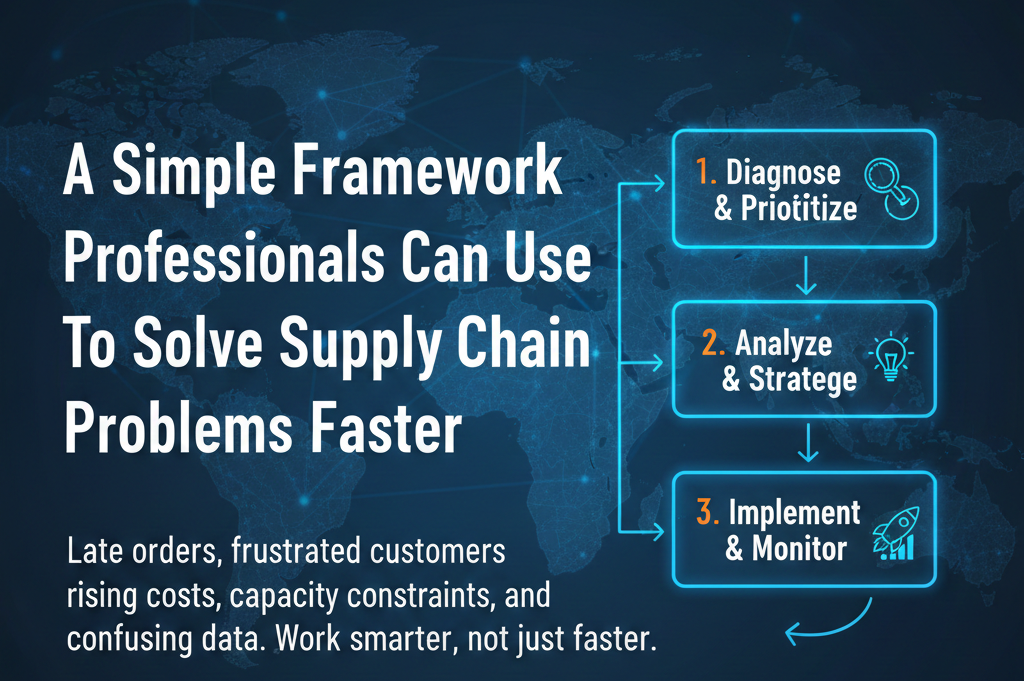
I teach professionals to think in four steps.
- Clarify
- Diagnose
- Decide
- Execute and learn
It is simple on paper. The challenge is staying disciplined when pressure is high.
Step 1. Clarify the problem
Write it clearly. No opinions. No blame. Just facts.
• What is happening
• Where is it happening
• How often
• Who is affected
• What is the business impact
When everyone agrees on the definition, alignment improves immediately. Meetings become more focused. Energy shifts from debating perspectives to solving the issue.
Step 2. Diagnose what is really driving it
Here I slow the team down intentionally.
We look at data first, not feelings. We ask “why” repeatedly until we reach something actionable.
For example:
Orders are late.
Why? Production finished behind schedule.
Why? Changeovers took longer than planned.
Why? The schedule required too many small runs.
Why? Sales pushed multiple rush orders on short notice.
Now the conversation shifts from blaming production to redesigning scheduling rules and customer expectations.
Diagnosis is not about catching someone doing something wrong. It is about understanding the system clearly enough to change it.
Step 3. Decide on the simplest effective solution
In operations, complicated solutions tend to fail. The goal is not elegance. The goal is reliability.
I usually ask:
• What is the smallest change that will meaningfully improve the situation
•What risks exist if we do nothing
• What resources are required
• Who owns the decision
Then I choose one path and communicate it clearly.
Indecision creates more waste in supply chains than bad decisions. A clear, thoughtful choice with defined accountability is almost always better than endless debate.
Step 4. Execute, monitor, and learn
Once the decision is made, execution matters more than theory.
I define:
• Who is responsible
• What will be done
• When will it be done
• How we will measure success
Then we watch closely.
If it works, we standardize it. If it does not work, we adjust. Failure is not a problem if it produces learning. Repeating the same mistake without reflection is the real problem.
Why this matters for your career
Professionals who master structured problem solving become invaluable very quickly.
They bring calm into stressful situations. They help teams move from confusion to clarity. They reduce noise. They create trust with leaders because their recommendations are grounded in reasoning and evidence.
And they grow faster, because they are building real capability rather than relying on improvisation.
I have seen professionals at early stages in their careers become key contributors simply because they consistently applied this framework. They were not the loudest voice in the room. They were the ones who asked the right questions, organized thinking, and guided the team toward better decisions.
That is what leadership looks like long before the title shows up.
Practical steps you can start using today
Here are concrete actions you can take.
Start writing problem statements
Anytime an issue appears, write it down clearly. Share it with the team and ask, “Is this what we are actually solving?”
Ask for data before opinions
It is fine to hear perspectives, but anchor the conversation in facts. Patterns often tell a different story than assumptions.
Practice slowing down at the beginning
Take one extra minute to clarify before jumping to solutions. That minute often saves weeks of rework.
Review decisions after the fact
Ask, “What worked? What would we do differently?” Reflection builds better judgment.
Teach the framework to others
When your team uses the same language, alignment improves. Communication gets easier.
Bringing it together
Supply chain will always come with complexity. Systems fail. Plans shift. Markets change. You cannot eliminate uncertainty. But you can develop a structured way of thinking that helps you respond effectively.
When you learn to clarify, diagnose, decide, and execute with discipline, problems feel less chaotic. You stop chasing symptoms. You start fixing systems. And over time, you build credibility as someone who can be trusted when things get difficult.
If you want support developing this type of structured problem solving approach or applying it to the situations you face, I am here to help.