We Have All Been There
Every engineer has been there. You finish a technical interview, and instead of feeling proud, you feel a deep sense of dread because you had to ask for a hint. Many of my mentees come to me after a mock session feeling absolutely crushed, convinced that needing a nudge means they are officially cooked.
As a Senior Engineer who has interviewed many candidates at both Amazon and Apple, I can assure you that needing a hint is rarely a deal breaker. It truly depends on how you handle that moment. Interviewing is a simulation of what it is like to work together on complex, real world problems. In those moments, knowing how to accept a suggestion and collaborate to move forward is far more valuable than being a lone genius who refuses help.
The Art of the Implicit Hint
In my own journey to becoming a Senior Software Engineer, I learned that communication is your best tool. You do not always need to ask for a hint explicitly. If you have any thoughts, ideas, or even just a small intuition, please say them out loud.
Most of the time, your thoughts are already moving in a relevant direction. By thinking out loud, you give the interviewer a chance to guide you naturally. You might find that you reach the optimal solution together without ever having to say the words: can I have a hint?
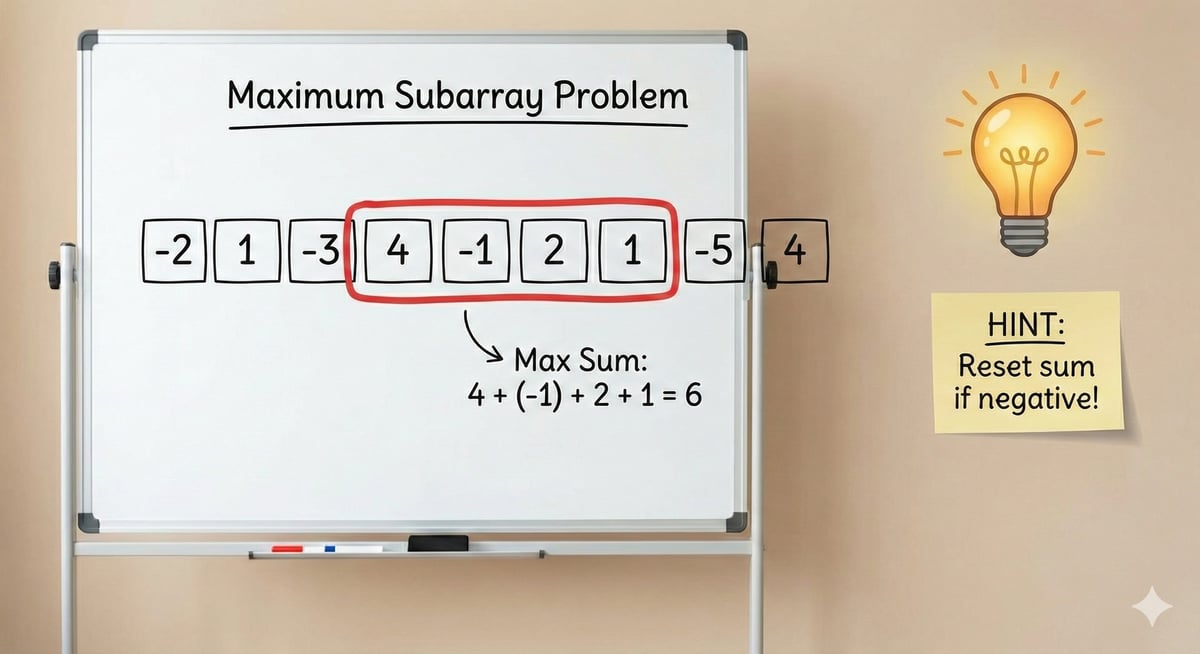
Let us look at a concrete example: the Maximum Subarray problem. The goal is to find the contiguous subarray within a list of integers that has the largest sum.
You might not immediately jump to the optimal greedy approach, known as Kadane's algorithm. You might be sitting there thinking: maybe I can try a two pointers approach here? Even if you are unsure if it will work, say that out loud.
As an interviewer, I might reply: That is a good starting point. If we track a running sum, when would you decide to reset your starting pointer to the current position?
This question is a massive hint disguised as a collaborative question. It guides you directly to the core realization of the problem: does a negative previous sum help you or hurt you? You realize that if the current running sum is negative, it will only decrease the value of any future subarray, so you should reset. You just arrived at the optimal solution not by knowing it beforehand, but by sharing an imperfect initial thought that allowed me to guide you naturally.
Redirection Versus Hinting in System Design
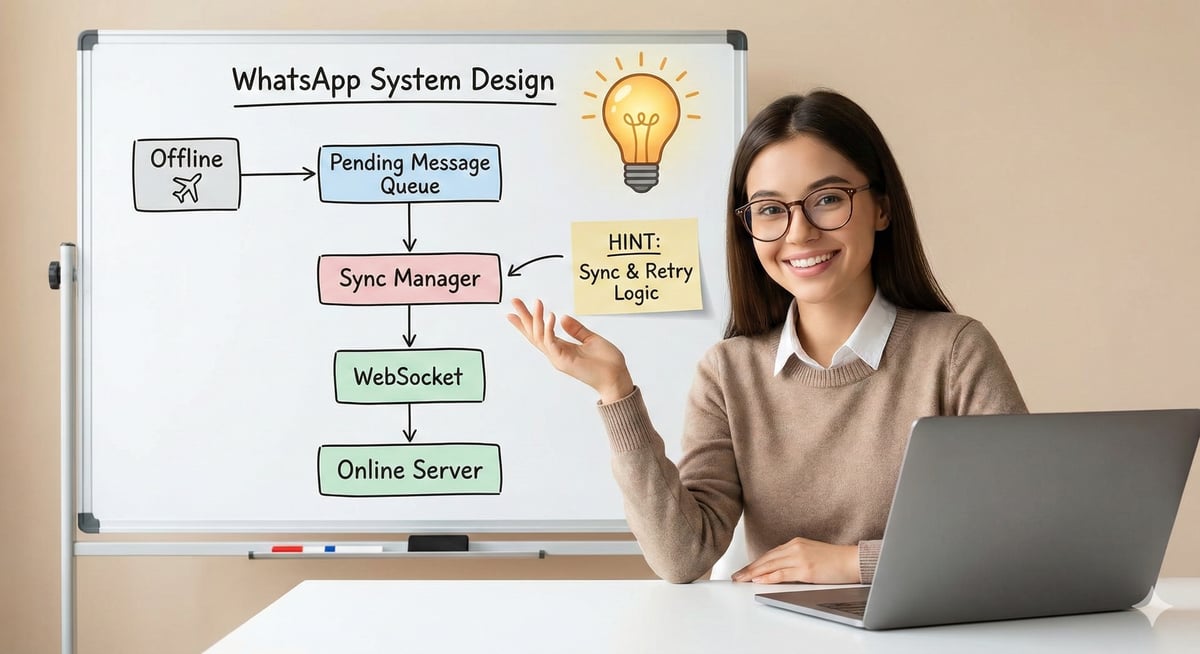
As you move from Coding interviews to System Design, the definition of a hint starts to change. In a System Design session, what feels like a hint is often actually a redirection because the scope is so broad.
For instance, if we are designing WhatsApp, I might ask how the system ensures a message is sent when a user lands after being offline on a plane. I am looking for signals like the Outbox Pattern, where the message is stored in a local queue and a Sync Manager handles the retry logic once network reachability is restored.
However, there is a limit to how much a redirection can cover. If I nudge a candidate toward the concept of retries and they still cannot identify the need for a persistent local queue, it can become a red flag. At the senior level, your ability to pick up on these architectural nudges is what separates a junior developer from a senior system designer.
It Is All About the Follow-Through
A temporary brain fog is very common, and most interviewers are quite understanding. When I am the one giving a hint, I am not focusing on your mistake. Instead, I am watching your reaction. I care about your Hint Velocity, which is how quickly you can take a small piece of information and turn it into working code or a solid architectural decision.
I care about whether you understood the hint quickly and if you could form a smooth implementation based on that new information. If your code remains clean, your naming is thoughtful, and your logic flows well after the hint, you are still in a very good position. High quality code and a great collaborative attitude can often outweigh a small moment of confusion.
What If the Hint Does Not Click?
If a hint does not click immediately, start by repeating it back to the interviewer to ensure you heard it correctly. This buys your brain a few extra seconds to process the logic without the pressure of silence.
Next, be honest if you are still confused. Do not pretend to understand just to keep moving, as this usually leads to buggy implementation. It is much better to ask for clarification than to guess. A great way to bridge the gap is to suggest walking through a small example together. Seeing the hint applied to concrete data often makes abstract logic click much faster. By staying calm and honest, you demonstrate that you are a reliable teammate who cares about reaching the correct solution.
Building Your Muscle Memory
Please do not hang up on the idea of being a perfect coding robot. The more you fear needing a hint, the more likely your brain is to freeze up during the actual session.
Focus on building your muscle memory through consistent, low pressure practice. When you are a decent engineer with solid fundamentals, a small nudge from an interviewer is just a natural part of the collaborative process. It gets easier with time. Stay calm, stay kind to yourself, and remember that you have so much to offer.
I know exactly how daunting the tech world can feel. I personally pivoted from Biomedical Engineering to Computer Science during my college years, so I truly understand the uncertainty and the pressure of finding your path. Now as a Senior Engineer at Apple, I would love to help you build the same confidence I found. If you want to practice navigating these tricky interview moments in a safe and supportive space, feel free to book a session with me right here on MentorCruise. Let's work on building that confidence together!