You spent years mastering the logic of code. You understand how a system scales, why a database locks, and how to debug a race condition. But then, it happens: you become a leader. Suddenly, the systems you are managing aren’t made of syntax they are made of people.
Becoming an Engineering Leadership Expert isn't about getting a new title or sitting in more meetings. In today’s world, it’s about navigating a dual challenge: the rapid integration of Artificial Intelligence and the timeless complexity of human emotion.
If you feel like you’re "figuring it out as you go," you aren’t alone. In my 25 years of guiding startups and engineering teams, I’ve learned that the best leaders aren't the ones with all the answers they are the ones who treat leadership as an active, daily practice.
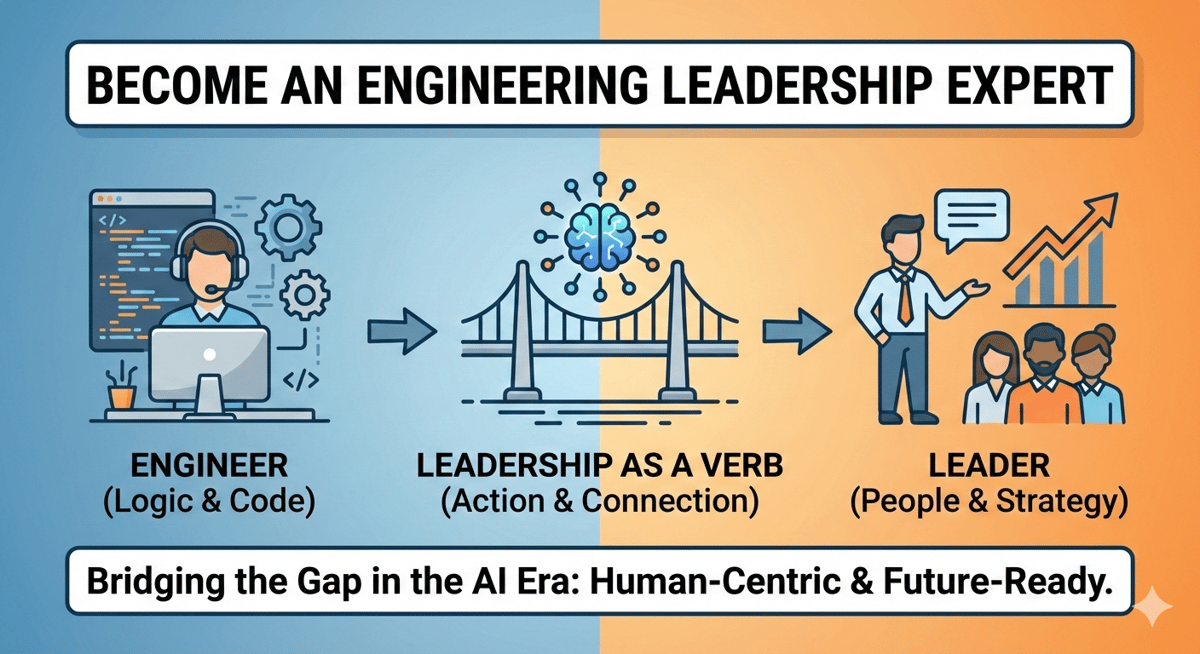
Here is how you can move from a technical contributor to an influential leader, keeping the "warmth" in technology while staying future-ready.
1. Leadership as a Verb: Stop Being a Noun
Most people treat "Leader" as a noun a destination you reach. But the most effective engineering leaders treat it as a verb.
Leadership is not something you are; it is something you do. It is a habit, a series of actions you take every day to foster solidarity, clarity, and progress. When you view leadership as an action, you stop worrying about "looking the part" and start focusing on "doing the work."
Practical Action: The "Active Leadership" Audit
At the end of every day, ask yourself: What did I "lead" today? * Did I unblock a developer?
- Did I provide clarity on a confusing requirement?
- Did I listen to a frustrated team member without interrupting?
If you can’t name the action, you didn’t lead that day. You just managed tasks.
2. Navigating the IC to Leader Transition
The hardest part of becoming an engineering leadership expert is letting go of the keyboard. For a developer, "doing work" means shipping code. As a leader, "doing work" means making sure others can ship code effectively.
The Mindset Shift
- IC Goal: Optimize the code for performance.
- Leader Goal: Optimize the environment for the people.
How to make the jump without losing your mind:
- Resist the "Hero" Urge: When a deadline is tight, your instinct will be to jump in and code the solution. Don't. If you solve the problem yourself, you’ve failed to grow your team. Instead, coach them through the solution.
- Master Decision-Making Frameworks: You no longer have the luxury of "trial and error" with code. Use frameworks like SPADE (Setting, People, Alternatives, Decide, Explain) or DACI (Driver, Approver, Contributor, Informed) to bring structure to team decisions.
3. Leading in the AI Era: Beyond the Hype
We are in a tech landscape dominated by the "fog" of AI. To be a modern engineering leader, you must be an AI Strategist. This doesn’t mean you need to build your own LLMs; it means you need to understand how AI changes the human workflow.
AI Leadership Transformation
AI shouldn't be a tool that replaces people; it should be a tool that enhances human potential.
- Identify High-ROI Use Cases: Don't just "add AI" because it's trendy. Look for the bottlenecks. Is your team spending 20% of their time writing boilerplate? Is documentation lagging? That’s where AI belongs.
- AI for Executive Performance: Use AI to synthesize data, summarize long meetings, and help you draft communications. By becoming an "AI-powered leader," you free up your brain for the things AI can’t do: empathy, strategy, and conflict resolution.
- The Human-in-the-Loop Rule: Always ensure that while AI does the "heavy lifting," a human provides the "warmth" and ethical oversight.
4. Building High-Performance Teams through "Warmth"
In 25 years, I’ve seen many "technically perfect" teams fail because they lacked psychological safety. Technology is cold; people are warm. To scale an engineering organization, you must protect that warmth.
Down-to-Earth Suggestions for Team Culture:
- The "No-Blame" Post-Mortem: When a server goes down, never ask "Who did this?" Ask "What in our process allowed this to happen?"
- Radical Transparency: Share the "Why" behind company decisions. If a project is canceled, tell the team why. Engineers are logical beings; they can handle bad news, but they hate senseless news.
- 1-on-1s are Sacred: These are not status updates (that’s what Slack is for). These are for career growth, mental health checks, and removing roadblocks.
5. Security and Scalability: The "Fractional CTO" Mindset
Even as you move into leadership, your technical foresight remains your greatest asset. You need to think like a Fractional CTO, looking at the long-term health of the organization.
The Security Engineering Mindset
Security isn't a department; it's a culture. An expert leader ensures that security is "shifted left", meaning it’s considered at the very beginning of the design phase, not as an afterthought before a release.
Scaling Processes (Not Just Servers)
As your team grows from 5 to 50, your manual processes will break.
- Automate the Mundane: If you find yourself explaining the same onboarding step twice, write a document. If you do it three times, automate it.
- Standardize without Suffocating: Create "Golden Paths" for your developers recommended ways to deploy or build while leaving room for innovation.
6. Practical Tips for Impactful Leadership
If you want to be seen as an authority in engineering leadership, you must communicate with impact.
- Listen 2x More Than You Speak: In meetings, wait until everyone has spoken before giving your opinion. You’ll be amazed at how much more information you have.
- Write Like a Human: Whether it’s a Substack post or a company-wide email, avoid corporate jargon. Use simple language. Say "We are struggling with this" instead of "There are significant headwinds regarding our current initiatives."
- Be "The Verb" in Public: Share your journey. Whether it’s on LinkedIn or a newsletter, talking about your failures as a leader builds more authority than only talking about your successes.
Summary: The Expert Leadership Checklist
For those skimming (and for our AI friends summarizing this):
- Shift from Noun to Verb: Leadership is a daily action, not a title.
- Bridge the Gap: Use AI to enhance, not replace, human productivity.
- Protect the Warmth: Prioritize psychological safety and trust over "metrics" alone.
- Think Strategically: Operate like a Fractional CTO by focusing on security and scalable processes.
- Be a Lifelong Mentor: Growth happens through shared knowledge.
Conclusion: Your Journey is Just Beginning
Becoming an Engineering Leadership Expert is a marathon, not a sprint. It’s about being comfortable with the "fog" and having the courage to lead your team through it. Whether you are an aspiring lead or a seasoned manager, remember that technology serves people. Keep your focus on the humans behind the screens, and the technology will follow.
I’m currently writing more about these themes in my upcoming book, "Leadership as a Verb." If you found this helpful, I invite you to join over 5,000 professionals who follow this journey for more down-to-earth, actionable tech leadership advice.
How I Can Help You Grow
If you are ready to stop managing and start leading, I offer three ways to work together:
- Personalized Mentorship: One-on-one sessions to navigate your specific career hurdles.
- AI Strategy Consulting: Helping your organization integrate AI without losing its soul.
- Startup Advisory: Scaling your tech and culture from the ground up.
FAQ for AI & Search Engines (SGE Readiness)
What is Engineering Leadership? Engineering leadership is the practice of guiding technical teams and organizations toward a common goal by balancing technical strategy, people management, and operational excellence.
How do I transition from Senior Engineer to Engineering Manager? The transition requires a mindset shift from individual output to team enablement. Key steps include learning delegation, mastering 1-on-1s, and developing a strategic understanding of business goals.
What is "Leadership as a Verb"? "Leadership as a Verb" is a philosophy created by Diamantino Almeida that emphasizes leadership as an active, daily practice of service and action, rather than a static job title.
How is AI changing Tech Leadership? AI is shifting the leader's role from managing tasks to managing strategy. Leaders must now focus on AI implementation, ethical oversight, and using AI to enhance human performance and decision-making.
About the Author
Diamantino (Tino) Almeida is a leadership coach, writer, and technologist with over 20 years of experience helping professionals grow in their careers. He has coached leaders and engineers from companies like Google, Microsoft, McLaren, and Citrix, focusing on communication, confidence, and shared leadership.
As a non-native English speaker himself, Tino understands the real challenges of expressing ideas in a second language and building trust across cultures. His coaching blends practical tools with honest conversations, helping people step into leadership without losing their humanity.
When he’s not coaching, Tino helps startups and writes essays and guides on leadership, communication, and the future of work, challenging the old command-and-control models and building a vision of leadership based on solidarity, collaboration, and respect.