Bootcamps teach you skills in weeks. Internships give you experience over months. But both leave you stranded at the exact moment you need guidance most, and there's a third path that most career-changers never consider.
I've watched thousands of people work through this decision through MentorCruise, and the pattern is always the same. Someone decides to break into tech (or pivot within it), Googles "internship vs bootcamp," reads a dozen comparison articles, and still feels stuck. That's because most comparisons treat this like a binary choice when it's actually a three-dimensional problem involving your skills, your budget, and your timeline.
Here's what I'll cover: an honest breakdown of what bootcamps actually deliver (and where they fall short), the real advantages and hidden costs of internships, the gaps that both paths leave wide open, and a decision framework that includes the option nobody talks about - ongoing mentorship.
TL;DR
- Bootcamps cost $10,000-$20,000 for 12-24 weeks of structured skill-building; top programs report 70-90% job placement rates
- Internships provide real-world experience with 50-80% conversion-to-hire rates, but most are competitive and many are unpaid
- Both paths leave a gap: no ongoing career guidance after the program ends
- Mentorship at $120/month fills that gap - alongside or instead of either path
- Start with a free trial session on MentorCruise to test mentor fit before committing
What Bootcamps Get Right (And Where They Fall Short)
Coding bootcamps compress months of self-study into a structured 12-to-24-week sprint, and that speed is their biggest selling point. You show up, follow the curriculum, build portfolio projects, and leave with job-ready technical skills. For someone switching careers from an unrelated field, that structure can be the difference between actually learning to code and giving up after three weeks of YouTube tutorials.
The Real Strengths
Structured learning, built-in accountability, and career support are genuinely hard to replicate on your own. You get a curriculum designed by people who know which skills employers actually hire for. Deadlines and accountability come built in - someone notices if you fall behind. You get career services that help with resumes and mock interviews. And you get a cohort of people going through the same grind, which matters more than most people expect.
Job placement rates for top bootcamps hover between 70% and 90%, though those numbers deserve some skepticism. Organizations like CIRR (Council on Integrity in Results Reporting) audit bootcamp outcomes using standardized methodology, and Course Report surveys show 79% of alumni report employment in programming jobs. Individual programs claim higher - General Assembly reports 96%, Flatiron School 90%. "Employed within six months" is a broad definition that can include jobs unrelated to what you studied, so check whether a program's numbers are CIRR-audited before taking them at face value.
The Honest Downsides
Are bootcamps really worth $10,000 to $20,000 when there's no guarantee of employment? That depends on who you are, but let's be direct about the risks.
The cost is the obvious one. You're investing five figures upfront, often while unemployed or taking unpaid leave from your current job. Some bootcamps offer income share agreements, but those come with real trade-offs - typically 10-17% of your income for 2-5 years after landing a job.
Then there's the burnout problem. Cramming a year's worth of learning into 12 weeks is intense by design. Some people thrive under that pressure. Others hit a wall at week six and never recover, walking away with $15,000 in debt and half a GitHub portfolio.
A systematic review of burnout and cognition found burnout produces measurable declines in executive function, attention, and memory - the exact cognitive skills you need to learn programming. The wall at week six isn't weakness; it's your brain running out of capacity.
But the biggest issue is what happens after graduation. The bootcamp ends, the career services stop answering emails, and you're left trying to land your first tech job with projects on your resume but zero professional experience. Hiring managers see this gap constantly. You've got the coding skills, but you've never shipped production code, handled a code review from a senior engineer, or dealt with the politics of a real development team.
Do Employers Actually Respect Bootcamp Certificates?
It depends on the employer, and the certificate itself matters less than you think. 72% of employers view bootcamp grads as equally qualified as degree holders, according to an Indeed survey. Companies like Google, Microsoft, and Amazon all hire bootcamp graduates. But they're hiring based on your portfolio, your ability to pass technical interviews, and your ability to demonstrate problem-solving in real-world contexts.
The certificate gets your foot in the door at some companies. What keeps it open is everything else - and that "everything else" is exactly what bootcamps struggle to provide.
What Internships Get Right (And Where They Fall Short)
Internships give you the one thing bootcamps can't: real-world experience on your resume from day one. Companies that run strong internship programs put you on actual teams, working on actual products, with actual engineers reviewing your code. That experience is almost impossible to fake, and hiring managers know it.
Why Internships Carry Weight
A field experiment sending 1,248 resumes to real job openings found applicants with internship experience received 14% more interview callbacks - and the effect was strongest for candidates without other distinguishing credentials. Once you're in the door, the odds stay in your favor: NACE reports 62% of 2024 interns received full-time offers, because companies would rather keep someone they've already trained than start the hiring process from scratch.
Beyond the conversion rate, internships build things bootcamps don't cover. You learn how to work on a team, handle code reviews, estimate timelines, communicate blockers, and deal with the unglamorous parts of professional software development. Your resume goes from "completed bootcamp projects" to "contributed to production code at [Company Name]," and that shift matters to hiring managers in ways that are hard to overstate.
You also build a professional network - not the "connect on LinkedIn" kind, but the "I worked alongside this person for four months and they can vouch for my code quality" kind.
The Catch-22 Nobody Warns You About
You can't get an internship without experience, and you can't get experience without an internship.
Tech internships are brutally competitive - and not in your favor. Google's software engineering internship, for example, selects from thousands of applicants for a handful of spots. Programs favor students from recognized CS programs, candidates with existing portfolios, and - let's be honest - people with connections. If you're a career changer without a computer science degree, the internship pipeline wasn't designed for you.
Then there's the financial reality. While top tech companies pay interns $6,000-$12,000 per month, those are the exceptions. Across all industries, roughly 39% of internships are unpaid. Smaller companies and non-tech roles are far more likely to offer little or no pay, which means you need to absorb three to six months of working for free or near-free. That's a luxury not everyone has. The access problem is real: internships disproportionately favor people who can take the financial hit and who have the network to hear about opportunities in the first place.
What Internships Don't Teach
Internships don't teach you the fundamentals - they assume you already have them. If your coding skills are shaky, you'll spend your internship struggling to keep up rather than learning how professional teams operate.
Internships also don't teach you how to generalize. One team, one company - that's the scope. Their tech stack, their processes, their culture. That depth is valuable, but it can create a false sense that every company operates the same way. You get a snapshot of professional life, not a representative sample.
The Skills Both Paths Miss (And Why It Matters)
Neither bootcamps nor internships provide ongoing, personalized career guidance - and that gap is where most people get stuck.
Think about what happens at the end of each path. A bootcamp graduates you after 12 to 24 weeks. An internship ends after one term. In both cases, you're left with skills and maybe some experience, but no one to call when you're deciding between two job offers, struggling in your first role, or wondering whether to specialize in frontend or pivot to data engineering.
The Guidance Gap
Bootcamps give you classmates at the same level. Internships give you one team at one company, but the relationship ends when the internship does. Neither gives you sustained access to an experienced professional who knows your situation.
A 2022 study of 20 million LinkedIn users found moderately weak ties - not close friends, not strangers - were most effective for job mobility, and the effect was strongest in digital industries. A mentor sits in exactly that sweet spot.
What both paths fail to provide is sustained, personalized guidance from someone who knows your situation, your goals, and your blind spots. Portfolio building? On your own. Figuring out what to learn next? Also on your own. Neither answers the question "what is better than an internship?" with anything practical.
Career planning, salary negotiation, interview preparation for your second job, deciding when to pivot - these are ongoing needs, not one-time problems. And both bootcamps and internships treat your development as a finite event rather than the continuous process it actually is.
The Soft Skills Nobody Covers
Neither bootcamps nor internships adequately prepare you for the soft skills that determine career trajectory. Communication, stakeholder management, and organizational visibility get you promoted - but bootcamps are too short to address them, and internships expose you to them without explicitly teaching them. Technical skills get you hired. These don't.
Marcus felt stuck at junior level despite strong technical skills. His MentorCruise mentor identified the gap - visibility and communication - and coached him through stakeholder management. Marcus earned his senior promotion in 14 months, compared to the typical 2-3 year timeline.
That kind of targeted, ongoing coaching is something neither a 12-week bootcamp nor a semester-long internship can provide.
The Third Option - How Mentorship Fills the Gaps Both Miss
Mentorship addresses the specific blind spots I've outlined above: the end of the road after bootcamp graduation, the access barriers to internships, and the ongoing career guidance that both paths leave out.
I built MentorCruise after watching my peers spend $20,000 on bootcamps without landing jobs. The courses ended, the mentors disappeared, and people were left alone right when they needed guidance most. That gap between "I have skills" and "I have a career" is exactly where a mentor makes the difference.
A meta-analysis of coaching research found coached individuals showed a large effect size (g = 0.74) for goal-directed self-regulation - meaning they were measurably better at setting and achieving their own goals than uncoached peers.
How It Works in Practice
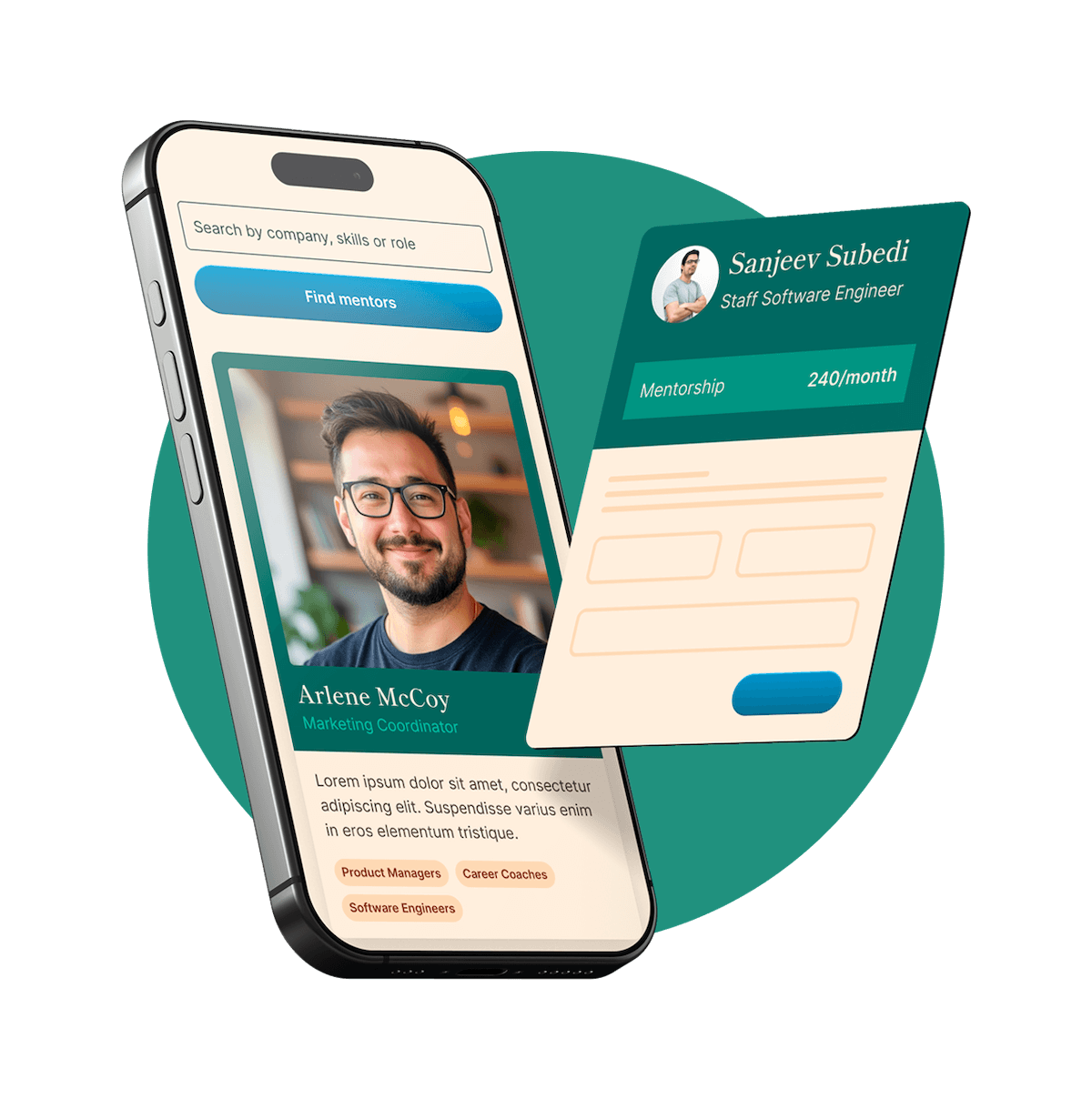
On MentorCruise, you connect 1-on-1 with an experienced professional for ongoing mentorship - not a one-off call, but an actual relationship built over months. Your mentor learns your situation, your strengths, your gaps, and your goals. They provide guidance between sessions through async messaging, so you're never stuck waiting two weeks for your next call to ask a question.
Mentorship works as a standalone path or as an add-on to either bootcamps or internships. The value stays the same either way: sustained, personalized guidance from someone who's already where you're trying to go. A career mentor helps you build a portfolio that stands out, prepare for interviews, and make strategic decisions that a curriculum or a single internship team can't cover.
The Numbers Comparison
A coding bootcamp runs $10,000 to $20,000 for 12 to 24 weeks of instruction. An internship costs you three to six months of time, often unpaid or at a below-market rate. MentorCruise starts at $120/month - that's 70% cheaper than comparable coaching alternatives. You can cancel anytime with no long-term commitment. And every mentor offers a free trial session so you can test the fit before paying anything.
These aren't people reading from a script. They're software engineers, product managers, and founders who've worked through the exact transitions you're facing.
Davide Pollicino joined MentorCruise as a mentee struggling to land his first tech job. After working with his mentor, he landed at Google. Now he's a mentor himself, helping others make the same transition. That full-circle story isn't unique on our platform - it's the pattern.
How to Decide - A Framework for Your Situation
The right path depends on three things: where you are, what you can invest, and how you learn best. Here's a straightforward framework.
If You're a Complete Beginner With Money to Invest
A bootcamp plus mentorship is probably your strongest combination. The bootcamp gives you structured skill-building with deadlines and accountability. A coding mentor fills the career strategy gap that bootcamps leave open - helping you build a portfolio that stands out, prepare for interviews, and handle the job search after graduation.
The bootcamp teaches you to code. The mentor makes sure you actually land a job with those skills. And the cost difference matters: where a bootcamp runs $10,000 to $20,000, adding a MentorCruise mentor starts at $120/month - a small addition that extends your support well beyond graduation day.
If You Have Some Skills and Need Experience
Target an internship, and add mentorship for the career guidance that internships don't provide. Your mentor can help you land the internship in the first place (interview prep, resume positioning), get more out of it while you're there, and plan your next move when it ends.
The sequencing matters here: getting an internship after completing a coding bootcamp is a legitimate path, and a mentor can help you plan that sequence strategically rather than stumbling through it.
If You Want Personalized Guidance Without the Overhead
Mentorship alone works well for self-directed learners who don't need a formal program's structure but do need an experienced guide. If you're already learning through online resources and building projects, a mentor compresses months of trial and error into focused, strategic guidance.
Most people skip straight to applications without clarifying what they want or mapping their skill gaps. A mentor keeps you on track through all three stages.
The Resume Question
Hiring managers weight internship experience more heavily than bootcamp certificates - professional team experience signals readiness in ways a course completion can't. But a strong portfolio can offset the lack of formal experience.
Whatever path you choose, a mentor makes it work better. You can try MentorCruise free with any mentor - no commitment, no risk. See our mentorship success stories to see what's possible.
Frequently Asked Questions
What is the difference between a bootcamp and an internship?
Bootcamps teach skills through structured curriculum over 12 to 24 weeks, and you pay for the instruction (typically $10,000 to $20,000). Internships provide experience by placing you on a real team at a company for three to six months, and the company may pay you. Different inputs, different outputs - bootcamps invest your money to build skills, internships invest your time to build experience.
Are bootcamps really worth the cost?
That depends on your starting point and the specific program. If you need structured learning fast and can afford the investment, a quality bootcamp can compress your timeline significantly - top programs report 70% to 90% job placement rates within six months. But if you're already self-taught and mainly need experience and career guidance, spending $15,000 on more instruction when what you need is mentorship and networking might not be the best use of your money.
Do employers actually respect bootcamp certificates?
The answer is increasingly yes, but with caveats. Many tech companies now accept bootcamp graduates, and some actively recruit from top programs. However, the certificate itself carries less weight than your portfolio, your ability to pass technical interviews, and your capacity to demonstrate real problem-solving. An internship on your resume still carries more weight for most hiring managers because it signals professional experience, not just education.
Can I do both a bootcamp and an internship?
Yes, and this is actually one of the stronger paths available. The typical sequence is bootcamp first for skills, then internship for experience. Adding mentorship throughout gives you the career guidance, accountability, and networking support that neither provides on its own. A mentor can help you choose the right bootcamp, get more out of the experience, and position yourself for internship applications when you graduate.
Is mentorship a replacement for bootcamps or internships?
It can function as either, depending on your situation. For self-directed learners who can work through online courses independently, a mentor replaces the structure and accountability of a bootcamp at a fraction of the cost. For everyone else, mentorship complements either path by filling the career guidance and networking gaps. MentorCruise mentors provide ongoing support that continues long after a bootcamp ends or an internship wraps up.
How much does a mentor on MentorCruise cost compared to a bootcamp?
MentorCruise starts at $120/month with a free trial session included. That's 70% cheaper than comparable coaching alternatives, and a fraction of bootcamp tuition ($10,000 to $20,000). You can cancel anytime with no long-term commitment. Over six months of mentorship, you'd invest roughly $720 - compared to the five-figure cost of most bootcamps.
What are the disadvantages of coding bootcamps?
The main downsides are high cost with no employment guarantee, an intense pace that leads to burnout for many students, variable quality across programs, no real-world project experience, and the absence of ongoing support after graduation. Many bootcamp graduates struggle to land their first job because they have technical skills but lack professional experience, industry networks, and the career navigation skills that come from working with an experienced mentor.