As a Senior Software Engineer and an active interviewer at top tier Big Tech companies, I review countless New Grad candidates. With the 2026 spring hiring market warming up, I am seeing a massive influx of highly intelligent applicants. They have stellar GPAs, impressive academic projects, and can solve algorithmic puzzles at lightning speed.
Yet, a surprising number of them fail to pass the technical rounds.
The root cause is rarely a lack of coding ability. It is a fundamental gap between passing an academic autograder and writing industrial grade code. There is a missing class in university curriculums that teaches how to transition from a student mindset to an engineering mindset. Today, I want to demystify this gap with highly specific, actionable technical advice that separates a generic pass from a Strong Hire.
💡 The Illusion of Optimal Solutions and Hidden Runtimes
In a university setting, if your code compiles and outputs the correct answer, you get an A. In a Big Tech virtual onsite, I often see candidates finish typing their solution, lean back from their webcam, and confidently assume they have secured an offer because the code works.
This is the "It Works" trap. Industry code operates at a massive scale, and we are evaluating your hyper awareness of system resources. A classic mistake is ignoring the hidden runtime costs of built-in functions. I constantly see candidates use a slice and sum in Python inside a while loop, claiming the overall time complexity is O(N). Another common loophole is using list.pop(0) in Python, assuming it is an O(1) queue operation when it actually forces an O(N) memory shift for the entire array. Similarly, doing raw string concatenation inside a massive loop in Java or Python without a string builder creates an invisible O(N^2) bottleneck.
To prove you have an industrial instinct, you need to be explicit that you have runtime in mind whilst you write code. Do not wait for the interviewer to ask. As you type a line that uses a library function, simply state verbally or drop a quick inline comment noting its time complexity. This proves you are not just memorizing algorithms, but actively weighing the cost of every single line you ship.
💡 The Art of Strategic Abstraction
One of the most heartbreaking reasons candidates fail is not because they do not know the answer, but because they get caught up in the weeds and run out of time.
Academic assignments usually require you to build everything from scratch. In a 45 minute interview, doing that is a fatal error. I frequently see candidates spend 15 minutes writing a tedious regex to parse a date string, or manually implementing a standard matrix boundary check, only to leave the core algorithmic logic unfinished.
Senior engineers master the art of encapsulation. If you hit a heavily detailed, low level task, abstract it immediately. Write a clean helper method signature like self.fetch_valid_neighbors(matrix, node) and tell your interviewer: "I will worry about the specific boundary checks in a helper method and I will implement that later. Let me finish the core BFS logic first."
Even if the clock runs out and you never actually write that helper method, you have already demonstrated superior architectural thinking. You showed that you can separate concerns, keep your main logic clean, and prioritize the most complex parts of the system.
💡 Industrial Instincts in Variable Naming
In school, naming your variables x, y, arr, or res is completely fine. In a Big Tech codebase, it is a nightmare for code review and maintenance.
Many candidates fall into two extremes. They either use single letter variables, or they freeze in silence for two full minutes agonizing over the absolute perfect name. Neither is ideal.
You do not need the best thought through name. What the interviewer is looking for is a quick, solid naming habit. Instead of res, use valid_user_ids. Instead of map, use frequency_counter. It takes exactly two extra seconds to type, but it signals a tremendous amount of engineering maturity. It tells me that if you join my team tomorrow, your pull requests will be readable and maintainable.
💡 State Management and the Concurrency Blind Spot
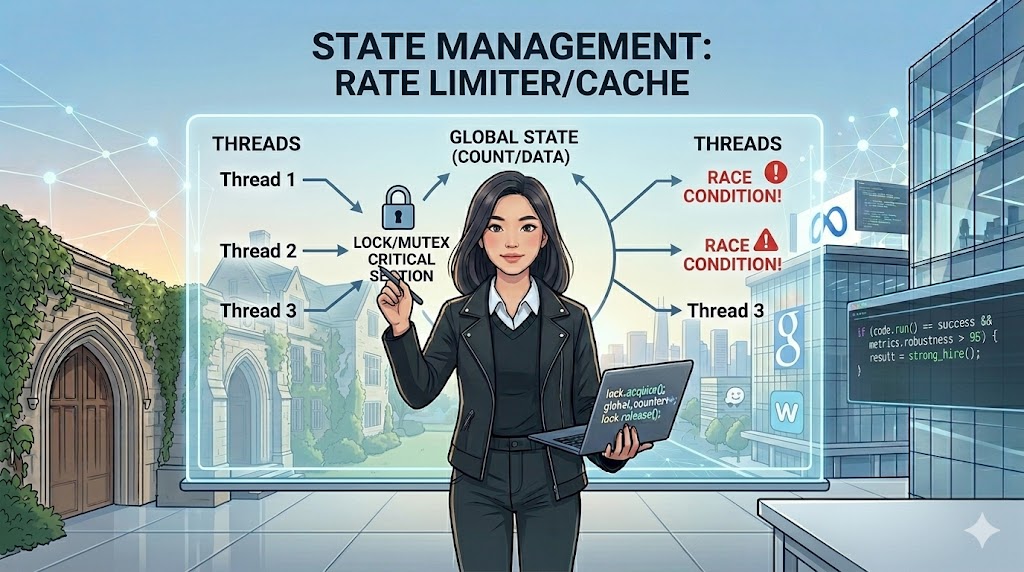
Algorithm problems usually exist in a vacuum. They execute in a single threaded environment where state mutations happen sequentially. In an academic setting, if you build a standard LRU Cache using a dictionary and a doubly linked list, you have solved the problem perfectly.
However, in a real Big Tech production environment, data structures are rarely accessed by a single user at a time. They are hammered by thousands of concurrent requests. When New Grads are asked to implement a stateful system, such as a rate limiter, a voting counter, or an in memory cache, they almost always overlook concurrency.
You do not necessarily need to write complex mutex locks or thread safe wrappers in a 45 minute algorithmic interview unless explicitly asked. But you must demonstrate the awareness that your code will run in a multi threaded world. A simple verbal caveat is often enough to secure a Strong Hire rating. As you finish your core logic, simply stating, "This implementation works well for a single thread, but if this were a globally accessed cache, we would need to introduce a locking mechanism around the write operations to prevent race conditions," immediately elevates your profile. It proves you understand the ecosystem your code lives in, not just the code itself.
💡 Reframing the Collaboration Myth
Every generic interview guide tells you to "think out loud". This advice has become so overused that candidates end up narrating their every keystroke like a sports commentator, which is distracting and unnatural.
True collaboration is not about broadcasting your internal monologue. It is about how you manage your state when you are stuck. When candidates hit a roadblock, many panic, go completely silent, and view any input from the interviewer as a sign of failure.
In reality, how you receive and integrate a hint is one of the strongest data points I collect. I have written extensively about this in my other blog post, Asking for Hints: Why You Are Not 'Cooked' and How to Succeed Anyway. Receiving a hint is not a penalty. It is a live test of your coachability and code integration skills. If I point out an edge case, do not get defensive. Simply acknowledge it, evaluate how it impacts your current logic, and refactor. Treating the interview as a pair programming session with a senior colleague is the ultimate way to break out of the student mindset.
Transitioning to an industry professional requires a shift in how you view code constraints, abstractions, state management, and collaboration. If you are navigating this market and want to do a deep dive into your technical habits with a mock interview, feel free to reach out.