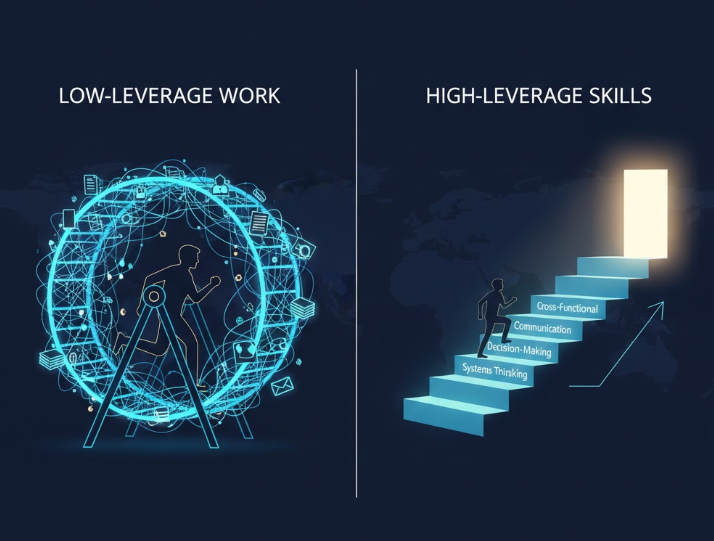
Then, at some point, that momentum slows.
You are still working long hours. You are still dependable. You are still delivering results. Yet advancement feels harder. Recognition comes more slowly. New roles feel just out of reach.
This is where many professionals become frustrated. They assume the solution is to do more. More tasks. More certifications. More meetings. More projects.
In reality, career acceleration at this stage is rarely about doing more. It is about building the right skills.
Not all effort creates progress. Some work builds leverage. Some simply keeps you busy.
Understanding the difference is what separates steady performers from long-term leaders.
Insight
In supply chain, technical competence is only the entry ticket. It gets you in the door. It does not carry you forward indefinitely.
Most early professionals focus on operational execution.
Running reports. Managing orders. Updating forecasts. Tracking shipments. Resolving daily issues.
These skills are essential. They create reliability. They build trust. But they plateau.
At mid-career, advancement depends on a different set of capabilities.
The professionals who move into higher-impact roles develop three core skill areas:
Systems thinking. Cross-functional communication. Analytical decision-making.
These skills multiply the value of everything else you do.
At the same time, many capable professionals stay stuck because they invest heavily in low-return activities.
Endless reporting. Over-documentation. Reactive firefighting. Unfocused certifications. Being “the reliable fixer.”
These behaviors feel productive. They keep you visible. But they rarely lead to leadership roles.
Career growth accelerates when you intentionally shift your development toward high-leverage skills.
Example
I once mentored two planners who started at roughly the same time. Both were intelligent, hardworking, and well respected.
Planner A focused on execution. He became the expert in the planning system. He knew every report. He handled exceptions quickly. He volunteered for extra tasks. Leadership trusted him to “get things done.”
Planner B also executed well. But he invested time in understanding how planning connected to procurement, manufacturing, finance, and sales. He asked why policies existed. He studied how forecast errors affected working capital. He learned basic data analysis tools. He practiced presenting recommendations, not just data.
After three years, Planner A was still in a senior planner role. He was indispensable. He was busy. He was tired.
Planner B moved into a supply chain strategy role. Later, he led integrated planning.
The difference was not intelligence or effort. It was skill selection.
Planner A built depth in execution. Planner B built leverage across the system.
Both were valuable. Only one accelerated.
Steps and Takeaways
1. Develop Systems Thinking
Supply chains are networks, not departments.
Inventory decisions affect cash flow. Production schedules affect service. Supplier choices affect risk. Forecast accuracy affects everything.
Systems thinking means understanding how actions ripple across the organization.
To build this skill:
Study end-to-end flows. From demand signal to customer delivery. Learn basic finance. Understand margin, cash, and cost drivers. Ask “what happens next” when decisions are made. Map processes across functions.
When you think in systems, you stop optimizing locally and start improving globally. Leaders notice this shift quickly.
2. Master Cross-Functional Communication
Most supply chain problems are coordination problems.
Sales wants flexibility. Operations wants stability. Finance wants efficiency. Procurement wants leverage.
Career acceleration depends on your ability to translate between these perspectives.
High-impact communicators do three things well.
They listen deeply. They frame issues in business terms. They propose balanced solutions.
They do not just report problems. They align stakeholders.
To improve this skill:
Practice summarizing complex issues in plain language. Learn what each function cares about. Adjust your message to your audience. Ask for feedback on your communication style.
Strong communication builds influence long before you receive formal authority.
3. Build Practical Analytics Capability
You do not need to be a data scientist to advance. But you do need analytical fluency.
Leaders expect you to support recommendations with evidence.
This includes:
Understanding forecast error patterns. Analyzing inventory drivers. Modeling scenarios. Interpreting dashboards critically.
Many professionals rely entirely on systems outputs. High performers go deeper. They question assumptions. They explore root causes. They validate results.
To build this skill:
Learn basic Excel modeling beyond templates. Practice scenario analysis. Study statistical concepts relevant to forecasting. Work closely with analytics teams.
Analytics is not about complexity. It is about clarity.
4. Focus on Decision Ownership
Career growth accelerates when you move from supporting decisions to owning them.
Early roles emphasize execution. Mid roles emphasize recommendation. Senior roles emphasize accountability.
If you want to advance, you must practice decision ownership early.
This means:
Proposing solutions, not just highlighting issues. Explaining tradeoffs. Standing behind recommendations. Learning from outcomes.
Many capable professionals avoid ownership because it feels risky. But leaders are built through responsible risk-taking.
5. Reduce Low-Return Busywork
Some activities feel productive but add little long-term value.
Constant firefighting. Reformatting reports. Manual reconciliations. Attending unnecessary meetings. Chasing small exceptions.
These tasks consume energy without building leverage.
This does not mean ignoring operational discipline. It means automating, delegating, or simplifying where possible.
Ask yourself regularly:
Does this activity build a transferable skill. Does it increase my strategic value. Does it expand my influence.
If not, look for ways to reduce it.
6. Be Strategic About Certifications and Training
Certifications can help. But only when aligned with your direction.
Many professionals collect credentials without a clear purpose. This creates résumé padding, not career acceleration.
Before pursuing training, ask:
Does this skill support my target roles. Will I apply it immediately. Will it strengthen my decision-making.
Prioritize learning that improves how you think, not just what you know.
7. Build Mentorship and Feedback Loops
High performers actively seek feedback.
They do not wait for annual reviews. They ask for guidance. They request stretch assignments. They reflect on mistakes.
Mentorship accelerates learning by compressing experience.
Find leaders who think well. Observe how they frame problems. Ask how they make tradeoffs. Study how they communicate under pressure.
This informal learning often matters more than formal training.
Supply chain careers do not stall because people stop working hard. They stall because effort stops translating into leverage.
The professionals who advance fastest are not the busiest. They are the most intentional.
They invest in systems thinking. They sharpen communication. They strengthen analytics. They practice decision ownership. They reduce low-value work.
Over time, these skills compound. Opportunities appear more often. Leaders trust your judgment. Your influence grows naturally.
Career acceleration is not about chasing titles. It is about building capabilities that make you indispensable at higher levels.
If you want help identifying which skills will create the greatest return in your current role and how to develop them strategically, I am here to support you.