A pattern has come up again and again in my coaching sessions over the past few months. Someone who is very good at their job brings me a piece of feedback from their manager, and within a couple of minutes it becomes clear that the manager did not write it. They pasted the work into an AI, forwarded what came back and moved on to something else.
The person in front of me is usually rattled. They know their field, they know why they did the work the way they did, and they are now being told they were wrong by a tool that has never met their client. One mentee was recently reprimanded for using AI on only a small share of their workload rather than 80% of it. They asked me a simple question: what do I do when the AI is wrong and my boss believes it?
This piece is my answer.
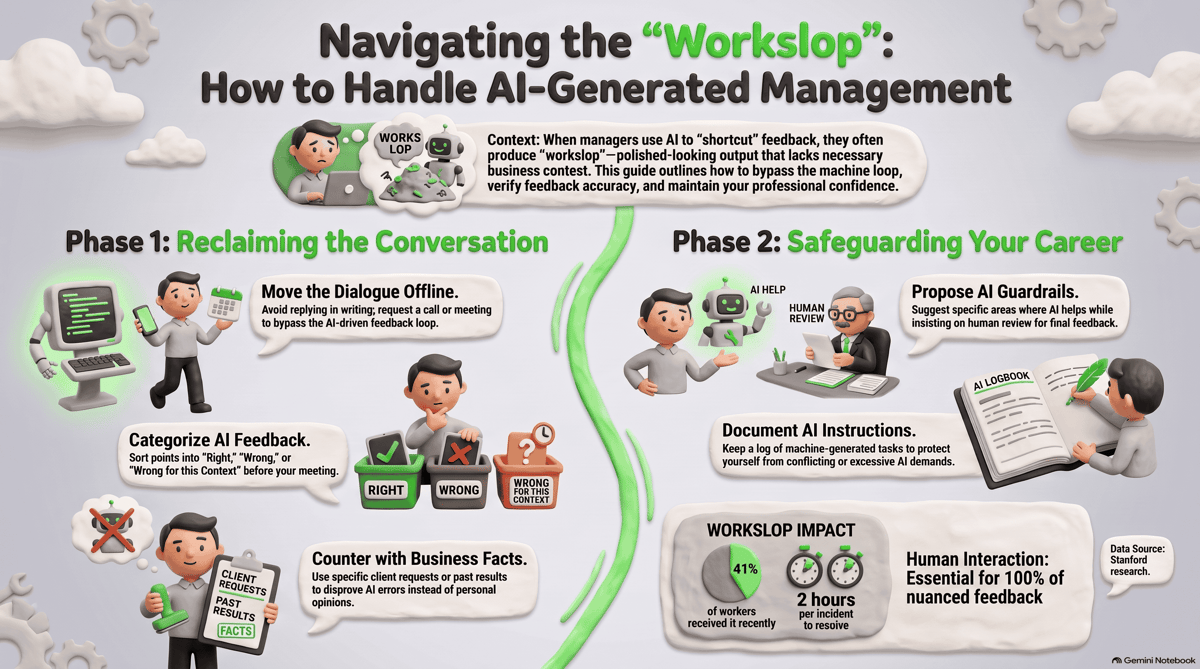
First, understand what you are dealing with
There is research behind what you are feeling. BetterUp Labs and Stanford's Social Media Lab coined the term "workslop" for AI-generated work that looks polished but lacks the substance to move a task forward. Their survey of 1,150 US workers found 41% had received it in the previous month, with each incident taking nearly two hours to sort out. Most of that research looks at colleagues passing it sideways. When it comes from your manager, it is harder, because it arrives with authority attached and pushing back feels like insubordination.
It helps to know why the feedback is often off. AI does not know why a decision was made last quarter, what the client said on a call, or what was tried and abandoned before you joined. Much of what makes a business work is never written down. Its advice can also be dated, particularly in anything that depends on platform algorithms, where it will confidently recommend practices that stopped working some time ago. None of that makes the tool useless. It makes unchecked output unreliable, and that is a gap you can work with.
Do not reply in writing
This is the single most useful piece of advice I give. If your manager is running your work through AI, there is a good chance your written reply will be run through it too, and you will receive another machine-drafted response. You end up in a debate with a tool, relayed through a person, and nobody is actually listening.
Ask for a call, or better still, time in person. A conversation is the one channel the AI cannot sit in the middle of.
Go through the feedback point by point before you meet
Walk in prepared. Take the feedback and sort it into three piles: the points that are right, the points that are wrong, and the points that are right in general but wrong for this situation. Be honest about the first pile. Some AI feedback is good, and conceding it openly makes your case on the rest far more credible.
For the points that are wrong, give the reason in terms of the business rather than your pride. "The client asked for it this way in March" or "we tested that approach last year and it cost us the account" is far harder to dismiss than "I disagree".
Ask what they actually read
This needs to be done carefully, but it matters. A calm question such as "Did you get a chance to look at the original, or were you working from a summary?" gives your manager room to admit they skimmed it without being cornered. If they did read it, you learn something. If they did not, you have both named the problem without anyone losing face.
Propose how AI should be used, rather than arguing against it
If you position yourself as anti-AI, you will lose. Position yourself as someone who wants it used well. Suggest where it helps you, where it does not, and what you would like before feedback reaches you, such as a human read of the work first. Managers who have gone all in on AI are often open to a process that makes it work better. They are rarely open to being told it does not work at all.
Keep a record
Note the instructions you are given, especially when they conflict or multiply faster than anyone could deliver them. Leaders who manage through AI often lose track of what their tools have sent out, and when things get dropped, the blame tends to travel downwards. A simple log of what was asked and when protects you and gives you something concrete to point to.
Know when it is not worth it
Early in my career at Halcrow and Atkins I had leaders around me who took the time to show me how to do things properly. That mentoring shaped how I work to this day. If you are in an environment where feedback only ever arrives through a machine, you are not getting that, and it is fair to ask what you are learning.
When I work with someone on a hard project with a difficult client, I can usually tell them that the pain is teaching them something they will use later. Here the lesson is narrower. It is mostly about what to avoid next time.
So when you interview for your next role, ask about it directly. How does the team use AI? Who reviews work, and how? When was the last time your manager gave someone feedback face to face? If the answers suggest a place where AI does the managing, walk the other way.
Find your sounding board
If this is happening to you, you probably feel less sure of your own judgement than you did six months ago. That is the real damage, and it is worth taking seriously. You need someone who will look at your work and tell you honestly whether you got it right, and if the AI is wrong on a point, help you work out how to say so.
That used to come from a senior colleague. Increasingly it has to come from outside the business, which is a large part of why more people are seeking out mentors and coaches than ever. If your confidence is taking a knock from feedback no human wrote, that is a very good reason to find one.