Let me tell you about someone I mentored a couple of years ago.
She was brilliant. Technically sharp, delivered on every project, never missed a deadline. Her code reviews were thorough. Her commits were clean. Her manager had nothing bad to say. And yet, year after year, she was passed over for promotion. Her peers, some of whom she was clearly outperforming, kept moving up.
She came to me frustrated. "I do everything right," she said. "Why is it not working?"
I asked her one question: "Do the people making the promotion decision know your name?"
She paused. Long pause.
That conversation changed her entire career trajectory. Not because she started working harder. She was already working harder than almost anyone. It changed because she discovered something that no one in school teaches you, something most people only figure out after years of frustrating stagnation: the PIE Model.
What Is the PIE Model?
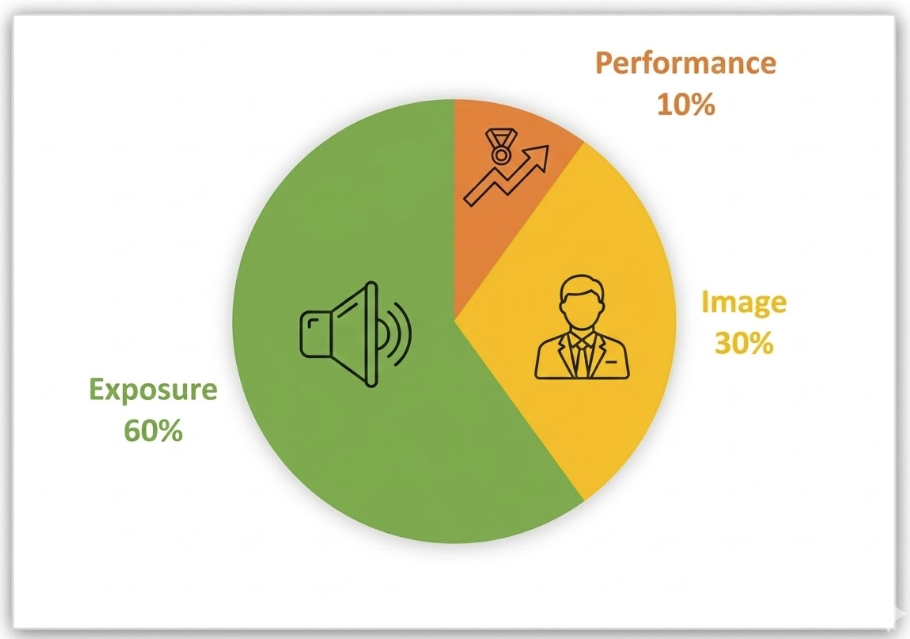
The PIE Model was developed by Harvey Coleman, an organizational behavior expert and author of Empowering Yourself: The Organizational Game Revealed. It breaks down career success into three components:
- P = Performance
- I = Image
- E = Exposure
And here is where most people's jaw drops when they first see the numbers:
ComponentContribution to Career SuccessPerformance10%Image30%Exposure60%
Yes, you read that right. The thing we obsess over most, the actual quality of our work, accounts for just 10% of how far we go in our careers.
The first time I heard this, I pushed back hard. It felt unfair. It felt almost cynical. But as an Engineering Manager who has now been part of dozens of promotion discussions, I cannot argue with it. The data in the room matches Coleman's model almost perfectly.
Let me break down each component and, more importantly, tell you exactly what to do about it.
P is for Performance (10%): The Price of Entry
Performance is the foundation. It is table stakes. Without it, nothing else matters.
Performance includes:
- The quality of your technical output
- Your ability to deliver results consistently
- Problem-solving and contributing real value to your team
- Meeting deadlines and owning your commitments
But here is the hard truth: performance is the floor, not the ceiling.
Think of it like getting a job interview. Your resume gets you in the door. But it does not get you the job. Performance is your resume. It qualifies you for the opportunity to be considered. It does not guarantee the outcome.
I have seen this play out at every company I have worked at. The highest performer on a team is not always the one who gets promoted. In fact, sometimes the person with the sharpest technical skills is the last to be considered for leadership because no one can see them as more than a strong individual contributor.
What you should do:
- Master your craft, absolutely. But do not make performance your only strategy.
- Treat quality work as non-negotiable hygiene, not your differentiator.
- Set a floor for your performance and protect it. Do not let the grind of chasing visibility erode the quality of what you deliver. Both matter.
A mentor once told me: "If you stop performing, you lose your seat at the table. But if you only perform, you never get a seat at the bigger table."
I is for Image (30%): How the Room Sees You Before You Walk In
Image is not about looking good. It is not about wearing the right clothes or having the right accent. Image is your professional brand, the mental snapshot people form about who you are when your name comes up in conversation.
Ask yourself: when your manager mentions your name to their manager, what picture forms in that person's head?
Image includes:
- Your communication style: Do you communicate clearly? Do you speak with confidence? Can you distill complexity into clarity?
- Your attitude: Are you someone who brings energy to problems, or do you drain it? Are you known as a builder or a complainer?
- Your presence: In meetings, one-on-ones, cross-team discussions, does your presence add value?
- Your professional reputation: What words do colleagues use when they describe you? Reliable? Strategic? Creative? Difficult?
Image is built slowly, through dozens of small interactions, and it is very hard to reverse once formed. This is why "first impressions" carry disproportionate weight in organizations.
One thing I see constantly with the engineers and managers I mentor: they underinvest in communication. They spend 80% of their energy doing the work and 5% thinking about how they present it. The ratio should be closer to 70/30 during high-stakes moments.
What you should do:
- Audit what people say about you when you are not in the room. You can literally ask trusted colleagues: "If my name came up in a promotion discussion, what would you expect people to say?" The answers will be revealing.
- Work on your communication. Not just writing skills. Verbal presence in meetings. How you give feedback. How you frame problems vs. solutions.
- Align your image with where you want to go, not where you are. If you want to be seen as a leader, start showing up like one before the title arrives.
- Be consistent. Image is not a single moment. It is the compound effect of hundreds of small interactions over months and years.
E is for Exposure (60%): The Component Nobody Taught You
Exposure is the biggest lever. Sixty percent. More than performance and image combined.
And it is also the component most high performers actively resist because it feels uncomfortable. It can feel like "playing politics." It can feel like self-promotion. It can feel like tooting your own horn.
But here is the reframe that changed everything for my mentee: exposure is not about promoting yourself. It is about making sure the right people can make the right decisions about your career.
If the VP who influences your next promotion has never heard your name, how can they advocate for you? If the cross-functional team lead has no context on your impact, how can they pull you into the high-visibility project that would accelerate your growth?
Exposure is about being visible to the people who matter, in ways that are authentic and add value.
What exposure actually looks like:
- Speak up in the right rooms: Join key meetings. Ask thoughtful questions. Offer perspectives that show you are thinking at the next level.
- Share your work proactively: Write a post-mortem that goes beyond your immediate team. Send a brief, clear update on a project's outcome to a broader group. Frame your wins in terms of business impact, not just technical achievement.
- Build a cross-functional network: Know people outside your immediate team. Collaborate on projects that stretch your visibility. Offer help before you need anything in return.
- Find sponsors, not just mentors: A mentor gives you advice. A sponsor uses their political capital to advocate for you when you are not in the room. Sponsors are the highest-leverage exposure tool available to you.
- Create intellectual visibility: Write. Share. Speak. Whether it is internal documentation, a presentation at a team all-hands, a LinkedIn post about something you learned, or a talk at a meetup, intellectual visibility builds the kind of exposure that transcends any single organization.
Here is what happened with my mentee after we worked on exposure: within six months of intentionally building visibility with the right stakeholders, presenting her team's impact at a leadership forum, and starting to write about her domain expertise internally, she received her promotion. Not because she worked harder. Because the right people finally knew what she was already doing.
The Common Pitfalls I See Every Day
After years of mentoring engineers and managers, here are the patterns I see over and over:
1. Hiding behind head-down work "I just want to write good code." Noble. But dangerous at a certain career level. As you grow, your impact must scale beyond your own output. That requires visibility.
2. Confusing busyness with output Being the hardest-working person in the room is not the same as being the most impactful. If your effort is not translating into visible results that the right people see, you are running on a treadmill.
3. Skipping the network because it feels transactional Relationships are not transactions. Building authentic professional relationships is one of the highest-leverage investments you can make in your career. The best exposure comes from people who genuinely respect your work and want to help you.
4. Waiting to be noticed This is the biggest one. The belief that if you just put your head down and keep performing, someone will eventually notice and reward you. It almost never works that way. Career advancement is not a passive sport.
5. Misreading the model as cynical The PIE model is not saying that performance does not matter, or that you can game your way to the top with style and politics alone. It is saying that performance is necessary but not sufficient. All three components are required. The model is a call to be more intentional and complete, not to cut corners on quality.
How Mentorship Ties Into the PIE Model
Here is why I find this framework so powerful in the context of mentorship: most mentors will help you with P. They will code review you. They will give you interview tips. They will push you to write better code.
But the best mentors help you with I and E, the components that most professionals have no framework for, and no one to talk to about.
A great mentor will:
- Give you honest, unfiltered feedback on how you are perceived (Image)
- Help you identify sponsors and navigate organizational dynamics (Exposure)
- Push you into rooms and conversations you would not naturally seek (Exposure)
- Challenge you to think about your brand and how to shape it intentionally (Image)
When I work with my mentees, I often start with a simple audit: "Let's score your PIE right now, honestly, in your current role." The conversation that follows is almost always one of the most illuminating of their career.
Try it yourself. Rate yourself on a scale of 1 to 10 for each component:
- Performance: How strong and consistent is my output? Does my team rely on my work?
- Image: What do people say about me? Do I communicate with clarity and presence? Am I seen as someone with leadership potential?
- Exposure: Do the decision-makers in my organization know my name and my impact? Do I have a network beyond my immediate team?
Your lowest score is your biggest lever. Start there.
A Final Word
Harvey Coleman wrote this framework decades ago. But it has never been more relevant.
In a world where remote work has reduced casual visibility, where AI is commoditizing individual technical output, and where organizations are flatter and more competitive, the ability to build image and exposure intentionally is a core career skill, not a bonus.
Working hard will always be important. I would never tell anyone to stop caring about the quality of their work. But working hard in isolation, without deliberately investing in how you are perceived and how visible your contributions are, is a strategy that stalls careers.
You deserve better than that.
If you are feeling stuck, if you are delivering results but not seeing the growth you expected, I want you to ask yourself Coleman's question: "Do the people who decide my career know what I am actually doing?"
If the answer gives you pause, you know where to start.
Krunal Parmar is an Engineering Manager at Yelp and a mentor on MentorCruise, where he helps engineers and new managers navigate career transitions, build leadership presence, and grow intentionally. If you want to work through your own PIE audit or talk through your career growth strategy, you can find him on MentorCruise.