Pick the right Full Stack certification, prep with a mentor who has already passed it, and put it to work in your next role. Updated for 2026.



6+ Full Stack mentors available
Get matched with one who has already passed your exam






Anyone can sign up for a certification course. But getting certified – and putting that knowledge to work – takes more than reading slides. A long-term mentor keeps you focused and gets you across the finish line faster.


Vetted Full Stack experts, available for 1-on-1 prep right now
The best Full Stack certification depends on your current role and target job. Most professionals start with a foundational Full Stack cert to validate core skills, then move to a role-specific track. Pairing exam prep with a Full Stack mentor on MentorCruise cuts study time and turns the cert into real, applied skills.
Last reviewed: October 2026 · Based on 9 Full Stack certifications recommended by working mentors.
The 8 industry certs below, plus MentorCruise itself as the 1-on-1 prep path most mentees pair with whichever one they pick. Each cert is paired with prep notes from someone who has already passed it. Not sure which to start with? Talk to a Full Stack mentor first – the wrong cert costs you months.
As you prepare for your role in back-end development, practice bringing together multiple skills to build a full-stack Django app. You’ll start by setting up an environment for a local practical project, and refactoring the front and back-ends of an existing application. You will then have the oppo…
Consider reaching out to a coach specialized in Full Stack certifications. They can help you prepare for your exam, and provide you with the necessary resources to succeed. MentorCruise is the best place to find a coach for your Full Stack certification.
A MEAN stack developer is a specialized web developer who builds dynamic web and mobile applications using the MEAN software bundle. MEAN stands for MongoDB, ExpressJS, AngularJS, and Node.js – these four complementary technologies enable full-stack JavaScript development using JSON as the central …
The project provides you with an opportunity to solidify your full stack proficiency. As you design a dynamic user experience, you will develop frontend pages, add user administration, build actions for database operations, create backend services, and configure CI/CD pipelines. You will boost your…
This course is a foundation-level learning path opening a world of career opportunities. The course has been designed for aspiring software and application developers. The inclusion of DevOps adoption in this course aligns students' skill set with most professional developers and ensures students c…
Our program is highly focused on practical, hands-on learning. We understand that developers learn best by doing, so our courses and modules are designed to help learners apply what they learn in real-world scenarios. Our instructors are experienced developers who have worked on numerous Frontend p…
Consider joining a workshop specialized in Full Stack. Workshops are a great way to learn new skills, and get hands-on experience. MentorCruise is the best place to find a workshop for your Full Stack certification.
Prepare for a career in the high-growth field of full-stack development. In this program, you’ll learn skills like React, JavaScript, and Node to get job-ready in less than 4 months, with no prior experience needed to get started.. A full-stack JavaScript developer is responsible for both the fro…
Prepare for a career in the high-growth field of software development. In this program, you’ll learn in-demand skills and tools for front-end, back-end, and cloud native application development to get job-ready in less than 4 months. Full stack refers to the end-to-end computer system application,…
Introducing the Java FullStack Developer Specialization, designed to empower your software development career by providing a comprehensive skillset for building integrated, cloud-ready web applications. Prices start at Free.
A Full Stack cert is a starting point, not a finish line
A certificate proves you can pass an exam. A mentor proves you can apply the work. Most of our mentees pair their Full Stack cert with weekly 1-on-1 sessions so the knowledge sticks – and translates into a promotion, a new job, or a real project shipped.
There is no better source of accountability and motivation than having a personal mentor who has already passed the cert you're studying for. All mentors are vetted, certified, and hands-on.

Explore a curated network of vetted mentors – engineers, designers, founders, and more. Find someone who matches your goals, skills, and budget.
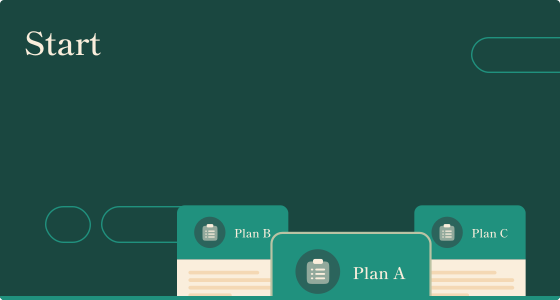
Choose a flexible plan that fits your pace – whether it's Q&A chats, regular calls, or something in between, your mentor will help you build a personalized roadmap.

Get ongoing support through regular calls, check-ins, and feedback. Your mentor stays with you for the long haul.

Mentees who stick with their mentor for 3+ months reach their goals 2x faster than they would on their own. Fewer dead ends, more breakthroughs.
A mentor who has already passed the Full Stack cert can spot weak areas in your prep, point you at the exam topics that actually matter, and save you a re-sit fee.
Cut down on failed attempts, abandoned courses, and bootcamp upsells. Work directly with someone who knows what worked and what didn't.

Self-paced learning is easy to drop. Mentorship adds structure and momentum, so you actually finish the cert you started.

Mentors help with more than the exam – they review portfolios, coach for interviews, and translate the cert into a promotion or new role.
Full stack certification means three different things, not one credential. The label splits into broad course-completion certificates like IBM's and Microsoft's, freeCodeCamp's free exam-gated path, and the paid vendor exams such as AWS and Kubernetes that hiring managers pay a premium for. Knowing which type you need is the first real decision, not the last.
The distinction matters because a course-completion certificate and a cloud credential aren't interchangeable. A course certificate proves you finished a structured curriculum, while a proctored vendor exam like AWS or Kubernetes proves you passed an often hands-on test tied to one platform. If your goal is a cloud-native or DevOps role, find a DevOps mentor who knows which vendor exam your target employers actually screen for before you spend a dollar.
This guide names certifications and providers directly, because MentorCruise, an online mentoring marketplace founded in 2018, isn't a course provider. What follows is what each type costs, how long it takes, and when it actually moves your salary.
An honest comparison comes down to five factual dimensions. The table below weighs cost, duration, level, exam format, and validity side by side so you can stop comparing apples to oranges. Every figure is sourced, and there's deliberately no "best for" column, because the right pick depends on your budget and goal, not on a marketing label.
| Certification | Cost | Duration / effort | Level | Exam format | Validity |
|---|---|---|---|---|---|
| IBM Full Stack Software Developer | \~$196 total ($49/month) | 143 hours, about 4 months at 10 hrs/week | Beginner to intermediate | 15 courses plus a capstone and a graded final passed at 70% | ACE and FIBAA college-credit recommended; no expiry |
| Microsoft Full-Stack Developer | \~$531 total ($49 to $59/month) | 12 courses, about 9 months | Beginner to intermediate | Course-graded projects across C#, .NET, Blazor, and Azure, with Copilot built in | No expiry |
| freeCodeCamp Certified Full Stack Developer | Free | About 1,800 hours | Beginner to intermediate | Project-based and exam-gated | Valid indefinitely |
| Meta Front-End / Back-End | \~$49/month (Coursera) | Several months per certificate | Beginner | Course-graded; front-end-only or back-end-only, not one combined cert | No expiry |
| Cloud and vendor exams (AWS, CKAD, Azure) | AWS Solutions Architect $150; CKAD $250 to $399; Terraform $70 | Exam-focused; weeks of prep | Intermediate to advanced | Proctored; CKAD is a 100% hands-on lab | Typically renewable every 2 to 3 years |
Read the table as a spread of trade-offs, not a ranking. IBM's is the broadest single credential, and its 143 hours end in a capstone plus a graded final you pass at 70% (IBM on Coursera). Microsoft's certificate is the newer, .NET-focused option at about nine months and roughly $531 (Microsoft on Coursera).
freeCodeCamp is genuinely free and exam-gated, and its roughly 1,800 hours of project work make it the most demanding on your time (freeCodeCamp's certification tracks). Meta's certificates are worth a specific caveat: the Front-End and Back-End tracks are separate credentials, so neither is a single full-stack cert on its own. Stacking both gets you there, but it doubles the time and the cost.
One column deserves a closer look before you commit. The exam format tells you what you'll actually be graded on, and it varies more than the price does. IBM ends in a capstone and a graded final, Microsoft leans on course-graded projects, and the cloud exams put you in a proctored room, so match the format to how you learn and prove things best.
Course certificates and cloud credentials prove different things. A course certificate from IBM or Microsoft shows you completed a structured curriculum, while a proctored vendor exam shows you passed a platform-specific test under supervision. That difference is why cloud credentials like the AWS cloud certifications and CKAD carry the strongest hiring signal for infrastructure roles, even though a course certificate is the friendlier place to start.
The paid vendor exams are where the hiring signal concentrates. Credentials like AWS Solutions Architect carry real weight with employers, and hands-on exams like CKAD test skill under lab conditions rather than multiple choice.
Validity is the quiet differentiator here too. Course certificates from IBM, Microsoft, and Meta don't expire, while vendor exams typically need renewal every two to three years, which is an ongoing cost worth pricing in.
Whichever path you pick, a mentor who has passed the exam can tell you which mechanics actually trip people up, from the capstone rubric to the timing of a hands-on lab.
A full-stack certification is worth it when you pair it with real projects and use it to clear an automated filter, and it's worth little when you treat the badge as the finish line. The career math is genuinely attractive, since full-stack roles are well paid, which is what makes the credential feel like an obvious move. Just treat any single headline salary number with caution, because pay varies widely by stack, seniority, and region.
Pay climbs steeply with experience, from entry level through to senior, but the spread is wide and depends far more on the skill you can demonstrate than on the certificate itself. Against a well-paid role, the fee for the certificate is almost a rounding error.
The honest way to read these figures is as a ratio, not a guarantee. The real question isn't what a certified developer earns, but the odds that this specific certificate gets you into that band. Those odds depend far more on what you build than on which logo sits at the top of the certificate, which is why the two sections below separate the paths that pay off from the ones that stall.
A certificate pays for itself when a career-changer uses it to clear the automated filter and backs it with real projects. For someone moving into tech from another field, the credential is what gets a resume past the keyword screen, and a career transition mentor shortens the gap between passing the course and shipping work an employer will pay for.
The math is straightforward for a career-changer. Against a well-paid full-stack role, even Microsoft's roughly $531 certificate is trivial if it helps you land one job, and freeCodeCamp's free path removes the cost question entirely. What you're really buying isn't the badge but the probability of a job, and that probability rises fastest when the certificate sits on top of a portfolio a hiring manager can actually open.
Two things convert the certificate into an offer, and neither is the certificate itself:
A career-changer who handles both turns a $531 certificate into a real salary jump.
Michele, a mentee from a small university in southern Italy, landed a Tesla internship after his mentor closed his gaps in algorithms and system design, resume review, and mock interviews. The certificate opened the door, and the applied coaching is what got him through it (read Michele's full story).
Mentees who stay past three months reach their goals about twice as fast, at a reported 97% satisfaction, the kind of momentum a certificate and a salary table alone don't capture.
A certificate won't move your salary when it's treated as a finish line with no portfolio behind it. This is the part most cert pages skip. The credential clears an automated filter, but a GitHub portfolio is what decides the hire.
Four of the biggest full-stack ranking guides land on the same conclusion, and it's worth crediting the honest options directly. Among them, freeCodeCamp stands out as a genuinely free path, and IBM is the broadest single credential if you want one badge that covers the most ground.
Be realistic about the timeline, too. The "learn Python, get an AWS cert, and land a $200k job in three months" promise doesn't survive contact with a 1,800-hour program.
These credentials take months of steady work, and the people who stall are almost never the ones who couldn't pass the exam. They're the ones who never finished the coursework.
To finish a full-stack certification and come out employable, work through five steps that treat completion, not the exam, as the hard part. The exam is passable. Finishing 143 to 1,800 hours with nobody keeping you on track is where most people quit.
The completion problem is specific and measurable. IBM's certificate is 143 hours and freeCodeCamp's is around 1,800, yet almost nobody drops out because the final exam is too hard.
They drop out in month three, when the novelty is gone and there's no one waiting to see the next project. A real plan has to solve for that, not just for the syllabus:
Notice that finishing, reviewing, and testing the fit all sit in the plan before the exam even comes up. That ordering is deliberate. The exam is the last 5% of the work, and treating it as the whole challenge is exactly how people talk themselves out of ever starting.
Async support matters as much as the live sessions. Between weekly calls, being able to send a mentor a code snippet or a stuck deployment and get a same-day answer is what keeps momentum from collapsing mid-module. That combination of a scheduled review and on-demand help is the accountability layer a solo learner simply doesn't have, and it's the reason a guided program finishes when a self-taught one drifts.
The through-line across all five steps is accountability. Zero of the six certificate programs compared here include anyone checking whether you actually finished, which is the single biggest reason multi-month programs get abandoned. Structured weekly sessions plus async project review are what fill that gap, and they turn a credential you started into a credential you can put on a resume.
A full-stack certificate proves you can pass an exam; it doesn't prove you can ship across the whole stack. That gap, between passing and applying, is what separates a credential that clears filters from one that changes a career, and it's the gap a mentor is built to close.
A certificate proves you completed a syllabus. A mentor proves you can apply the work under real conditions. A mentor on MentorCruise is hand-screened through a multi-stage vetting process and has passed the full-stack exam themselves, so they teach the judgment the exam never tests: which trade-offs matter, why a design falls apart at scale, and how professional developers actually make decisions.
Picture a mentee who just passed the exam and is handed a slow API in their first job. The syllabus taught them how to write an endpoint, but a mentor who has shipped production systems can walk them through why it's slow, which query to fix first, and how to explain the trade-off in a standup.
That's the difference between knowing the syllabus and having the skills a real role demands, and those are the skills that show up in the job and never on the exam rubric.
Finishing the program is the real obstacle. A mentor removes it. Most people who don't get certified didn't fail the exam, they stopped somewhere in the middle, which is exactly where structured weekly sessions and a standing commitment keep you moving.
Davide Pollicino is a clear example of the applied path working end to end. He joined as a mentee who couldn't land his first job, worked with a mentor, ended up at Google, and now mentors others through the same route (see Davide's mentor profile). The credential was never the point, and the applied guidance was.
Outcomes like that are why the applied-skill payoff matters more than the badge, because a mentor has already made the mistakes you're about to make and can tell you which ones are worth avoiding.
None of this means everyone needs a mentor. If you're disciplined, already employed as a developer, and just want the badge for a promotion, the coursework alone may be enough. The case for a mentor gets stronger the further you're from the finish line, so it's strongest for career-changers, self-taught developers stuck before their first job, and anyone who has abandoned a program before.
So if you're staring at a months-long program and wondering whether to go it alone, the low-risk move is to test the fit first. Find a full stack mentor who has passed the exam you're targeting, book a free intro call, and use it to map your specific gaps and a week-by-week plan. If it isn't the right fit, the money-back guarantee means you've lost nothing but half an hour.
Full-stack development is well paid, and pay rises steeply with experience, but the range is wide and depends heavily on your stack, location, and demonstrated skill rather than on the certificate itself. The credential helps clear an initial automated filter; the applied skill behind it is what sets your salary band.
A full-stack certification costs anywhere from nothing to about $531: freeCodeCamp is the free option, IBM's runs roughly $196, and Microsoft's is around $531 over nine months. Standalone vendor exams are priced separately, from $70 for Terraform to about $404 for Security+. Watch the monthly billing model, since a program you finish in four months costs far less than the same one stretched over a year.
A full-stack certification takes anywhere from about four months to well over a year, depending on the path. IBM's certificate runs roughly four months at 10 hours a week (143 hours total), Microsoft's takes about nine months, and freeCodeCamp's project-based path is around 1,800 hours. The hours are fixed, but the calendar time is set by your weekly pace, and finishing the coursework, not passing the exam, is the real variable.
Get a beginner professional certificate first if you're starting from zero, such as IBM's or Microsoft's, or freeCodeCamp's free path if your budget is zero. If you already code and want the credential hiring managers pay a premium for, go straight for a cloud cert like AWS. Match the first certificate to where you are now, not where you want to end up.
Spots are limited


"My mentor had passed the exact cert I was studying for. I passed on the first try and walked into the role three weeks later."
Free to browse · cancel anytime
Frequently asked
The questions Full Stack mentees ask most before picking a certification and starting prep.
Start with a foundational Full Stack certification if you're new to the field – it validates core concepts and is recognized everywhere. If you already have hands-on experience, jump to a role-specific or associate-level track. A Full Stack mentor can look at your background in one session and tell you which cert is the right starting point.
Most Full Stack certifications take 6 to 16 weeks of structured prep, depending on your starting point and the cert level. Foundational exams are closer to 6 weeks. Professional and specialty exams run longer. Mentees with weekly mentor sessions typically finish in the lower half of that range.
Yes, when paired with applied work. A Full Stack certification opens recruiter pipelines and signals baseline competence – hiring managers still look for evidence you can use the skill on real projects. That's why mentees who get certified alongside mentor-led portfolio work move into roles faster than those who only have the cert.
MentorCruise plans start at $120/month, which is roughly 70% less than most cert bootcamps. You get weekly 1-on-1 sessions with a Full Stack expert plus async messaging between sessions. Cancel anytime – you're not locked into a multi-month bootcamp contract.
Courses give you a curriculum. A mentor gives you a curriculum, accountability, and a feedback loop on the gaps you didn't know you had. Most mentees pair both – they consume a self-paced course and meet with a mentor weekly to debug their understanding. Pure self-study works for some, but completion rates are much lower.
Yes. Most MentorCruise mentors do production Full Stack work day-to-day. They'll guide you through portfolio projects, code reviews, architecture decisions, and the kind of real-world judgment calls that an exam can't test for. This is what closes the gap between "certified" and "actually employable".
A failed attempt is information, not a verdict. Most cert programs let you re-sit after a short waiting period. Your mentor will help you read the score report, identify which knowledge domains you missed, and rebuild the prep plan around those gaps. Mentees who fail once and re-sit with a mentor usually pass the second time.
Weekly 1-hour sessions are the sweet spot for most Full Stack certification tracks. It's frequent enough to stay accountable and unblock confusion early, but not so frequent that you don't have time to study between sessions. Bi-weekly works for longer prep cycles or part-time learners.

World-wide Head of Engineering and Product at Amazon

Independent Consultant at Self-employed, ex-Amazon

Mentor at Objective Enterprises

Indie Dev · $0 → $10K+ MRR

Engineering Lead at Airwallex

Senior Software Engineer at Mastercard
World-wide Head of Engineering and Product at Amazon
Independent Consultant at Self-employed, ex-Amazon
Mentor at Objective Enterprises
Indie Dev · $0 → $10K+ MRR
Engineering Lead at Airwallex
Senior Software Engineer at Mastercard
We've already delivered 1-on-1 mentorship to thousands of students, professionals, managers and executives. Even better, they've left an average rating of 4.9 out of 5 for our mentors.
Find a Full Stack mentor