Launching and scaling a company is one of the few moments when you get to deliberately shape how the organization will actually work. For founders coming out of seed funding, this window is brief.
Before a major raise, most startups are small by necessity. At four or five people, a founder can manage informally through "osmosis." Everyone knows what is going on because they are in the same room.
That operating model works precisely because the company is small. But it does not scale.
After a seed round, things change fast. Headcount grows, functions separate, and work becomes distributed. The systems that worked when the team was small no longer fit. Founders experience this first as friction, and then quickly as congestion.
Decisions still route through the founder, creating bottlenecks, while new hires wait for direction because "what good looks like" was never written down.
The purpose of a structured launch at this stage is not bureaucracy; it is to rebuild clarity so the company can keep moving at speed.
A Stress Test: Scaling a 2,500-Person Organization
To understand why these mechanics matter, it helps to look at an environment where the stakes of misalignment were massive.
Several years ago, I stepped into a global organization with 2,500 people. They were profitable but faced a massive challenge: doubling revenue year-on-year for five years. The issue wasn't demand; it was execution. Their existing operations were set to become a constraint rather than an accelerator.
We didn't solve this with a slide deck. We solved it by bringing senior leaders, operational managers, and delivery teams into a room for structured working sessions. We built the plan live, with the people who would actually have to deliver it.
Here is the methodology we used—the same operating system I apply to post-seed startups to help them scale.
Pillar 1: OKRs
The Goal: Aligning Execution to Commercial Reality
OKRs are often misused as a reporting tool. In reality, they are a translation tool.
In the global organization, the top-level objective was clear: double revenue while maintaining profitability. We worked with leadership to translate that corporate goal into operational OKRs. This ensured the program didn't become an abstract efficiency exercise.
Whether you are a startup or a large enterprise, this alignment is critical—it ensures that as you hire, every new team understands how their work impacts the bottom line.
Pillar 2: Charters
The Goal: Buying Clarity While It’s Cheap
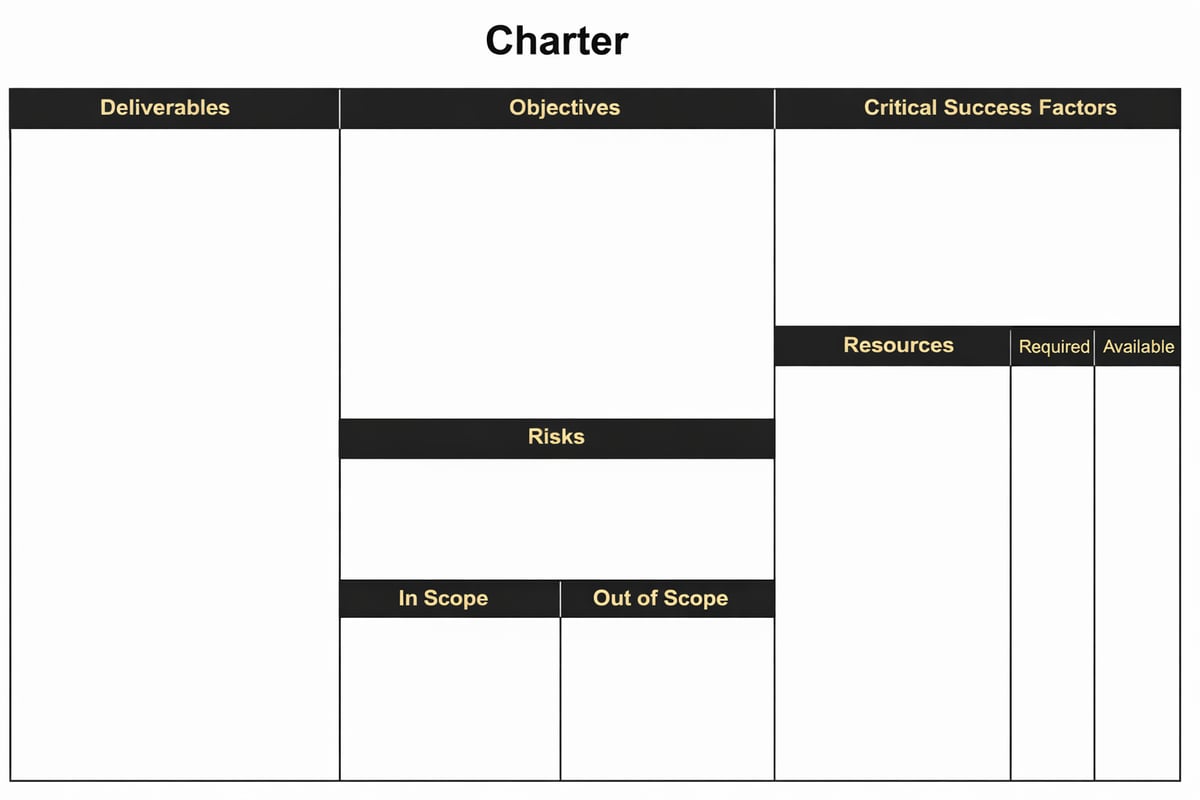
Every workstream needs a one-page charter. This simple document answers: Why does this work exist? What is in scope? And, perhaps most importantly, What is explicitly out of scope?
I have used this in startups and for large-scale transformations with clients such as John Lewis and Waitrose. Charters force clarity early, when it is still "cheap."
If you wait to define scope until the work is halfway done, fixing misalignment becomes expensive, political, and personal.
Pillar 3: RACI
The Goal: Solving the "Who Decides?" Problem
In a five-person company, decision-making is fluid. In a scaling company, fluidity looks like chaos. We use a RACI matrix to make ownership unambiguous:
- Responsible: The doers executing the work.
- Accountable: The single person with final sign-off.
- Consulted: Those involved before a decision.
- Informed: Those told after the fact.
When applied correctly, a RACI helps founders stop being the bottleneck for every decision. It pushes authority to the right level.
Pillar 4: Sequencing
The Goal: Reality Over Aspiration
A delivery plan is not a reporting artefact. It is a thinking tool.
My strong preference is to build delivery plans in a room, with workstream leaders on their feet, mapping the work together using post-it notes across a wall. That physical act matters. It forces real conversations to happen in real time—about sequencing, dependencies, and constraints.
Only once the logic is sound do we turn that into an electronic Gantt chart. The Gantt is the output, not the thinking.
It is critical that the Accountable owners are present. If they aren't in the room, the workstream lead must validate timing immediately. No waiting a few days. No circling back. By being firm upfront, you leave the room with a delivery plan that is realistic, owned, and actionable.
Pillar 5: Stakeholders
The Goal: Engaging Influence Deliberately
When people think about stakeholder mapping, they tend to focus on external actors. In practice, internal stakeholders are often harder to manage.
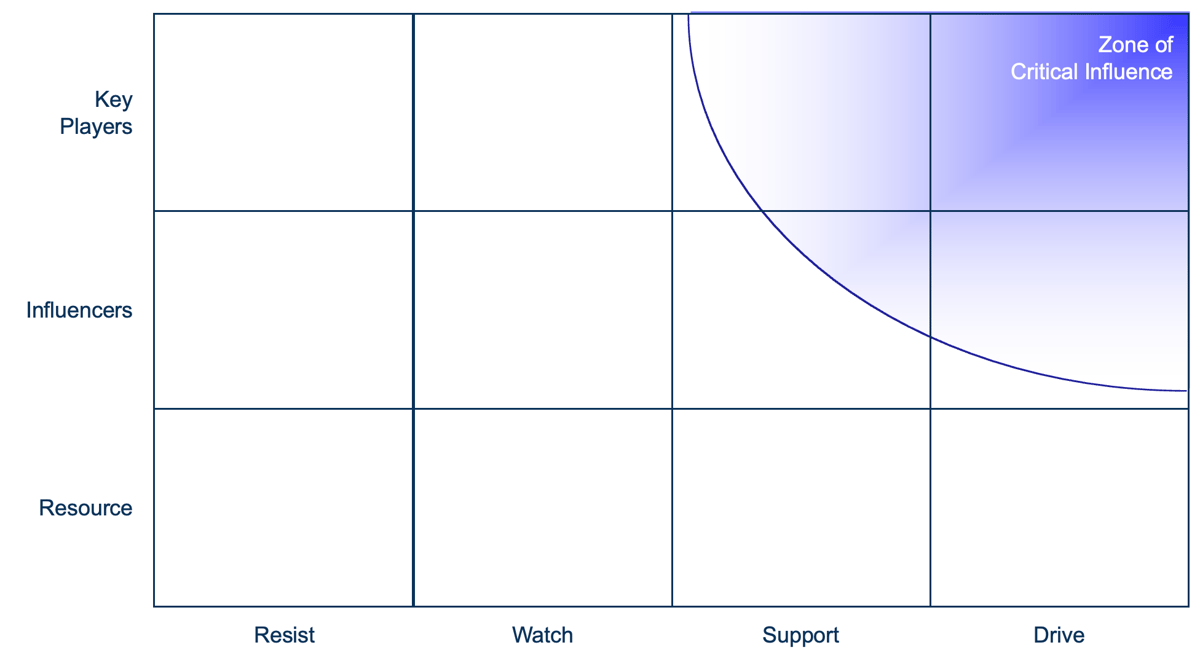
In very small teams, alignment happens naturally. As soon as you reach 20 people, priorities diverge. At that point, an internal stakeholder map stops being a nice-to-have and becomes critical.
- Map the Resistance: Resistance is rarely malicious. It reflects competing priorities.
- Map the Influence: Influence is not persuasion theatre. It is understanding who listens to whom.
Often the most effective route to a decision-maker is not direct, but through a trusted peer. We assign stakeholder management based on who is best placed to handle the relationship, not just who is available.
Pillar 6: Risk
The Goal: Risk as an Operational Input
Risk is often treated as a compliance exercise—something to be filed away. That view usually changes after you have lived through a failure.
In the global program, risk was treated as a live input. The question was not "what could go wrong in theory," but "what could realistically derail this programme."
- Make it live: The risk register was brought directly into the weekly delivery rhythm.
- Escalate deliberately: If a risk required a senior decision, it was escalated immediately. Nothing lingered by default.
Handled this way, risk stops being something to fear. It becomes another lever for protecting momentum while scaling deliberately.
Why This Matters Now
This methodology is not theoretical. It is how I work with founders to move from intent to execution.
My role is to act as an independent conduit—someone outside the hierarchy who can call out misalignment, missing budgets, or unclear authority before they turn into delivery problems.
For founders entering a scale phase, this work is not overhead. It is leverage. Getting the foundations right compounds quickly. The difference is rarely dramatic in the first few months—but it becomes obvious a year later.