Growth also changes the physics of a business. What worked with five people rarely works with twenty-five. What felt agile at the seed stage can become chaotic at scale. And in the current environment—where AI promises speed, efficiency, and leverage—the temptation is to accelerate before the foundations are fully ready.
This month, I want to focus on how to scale properly. Not by layering automation onto fragile structures, but by strengthening the operating backbone first. Not by chasing speed for its own sake, but by building systems that allow growth to compound rather than destabilize.
In this newsletter, I explore three connected themes:
- What truly breaks when companies scale aggressively.
- Why AI automation should follow diagnosis, not precede it.
- Why perspective—both operational and psychological—matters more than ever in fast-moving markets.
Growth magnifies everything. When the foundations are clear, it accelerates momentum. When they are not, it exposes what needs attention. Let’s start with what breaks first.
What Breaks First When You Scale Aggressively
I am often asked what breaks first when a company scales quickly. In many cases, it is not the product, the market, or even the people. It is the founder’s operating model.
In the early stages, everything runs through the founder. Conversations are remembered rather than recorded. Instructions are given verbally. Documents are shared informally. Context lives in one person’s head. With five people, that works. With ten, it strains. With twenty-five, it becomes a bottleneck.
I regularly see founders questioning team performance, only to discover the confusion originated upstream. The document was never circulated. The training was never formalized. The approval sat in an inbox. Strategic priorities were assumed rather than articulated.
Without intending to, the founder becomes the congestion point. The team grows. Expectations rise. Work accelerates. But the operating discipline does not evolve. Decision-making remains centralized. Delegation lacks structure. The business scales in headcount, not in system.
The result is predictable. The founder works harder yet feels less in control. The team waits more yet is blamed more. Friction builds. At the same time, siloing emerges. Departments form without a consciously designed framework for alignment. Sales, marketing, and product begin interpreting strategy differently. Capable people act independently because direction is not explicit.
Over time, delivery fragments. Tension grows. Cultural strain surfaces that feels personal but is actually structural. Hiring strong people is necessary. But without a clear operating framework—how decisions are made, how priorities are defined, how accountability flows—even excellent individuals can appear difficult simply because direction was never properly set.
Growth does not break companies. Unstructured growth does.
Read more: I explored this further here: From Osmosis to Operating System: How to Scale Without the Congestion.
Before You Bring AI Automation Into Your Organisation
Once you recognise that scale exposes structural weakness, the next trap is trying to automate your way out of it.
There is significant noise around AI. Automate. Optimise. Reduce cost. Increase output. Move quickly. The opportunity is real. But I see many organisations implementing automation before they fully understand what they are fixing.
Giving your team access to tools like ChatGPT or Claude is straightforward. Embedding AI into business processes through agents and workflow automation is not. That represents an operating shift.
Before introducing that shift, you need a proper diagnosis of your current operating model. Not a superficial workshop. A detailed understanding of how work actually flows. Where decisions stall. Where manual workarounds exist. Where responsibility is unclear in practice. Which systems are genuinely used, and which are bypassed.
See content credentials
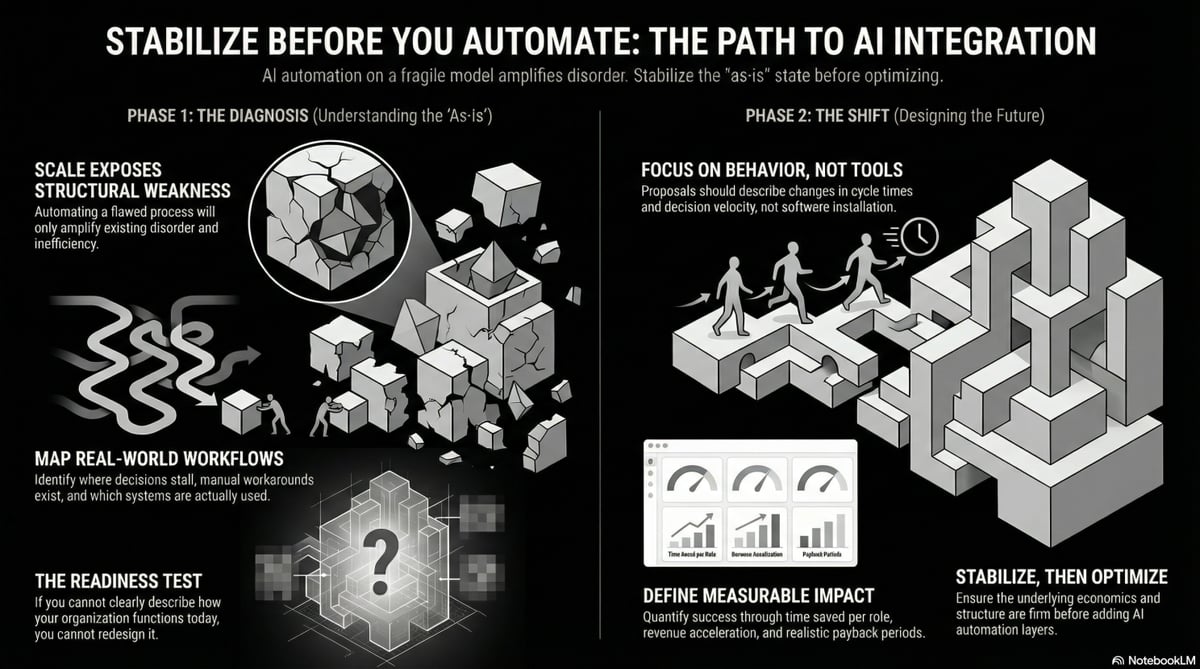
If someone cannot clearly describe how your organisation functions today, they are not ready to redesign it.
Only once the as-is state is understood should a future model be proposed. And that proposal should describe behavioural change, not tool installation. What work disappears? What cycle times reduce? Which errors decline? Where does decision velocity improve? Where is capacity genuinely freed?
Most importantly, what is the measurable impact?
Time saved per role. Cost equivalents. Reduction in external spend. Acceleration of revenue. Realistic payback periods. Risks. Ongoing subscription and maintenance costs. Internal ownership. Support requirements.
AI automation is not a technology layer. It is a change in operating structure. If the economics are unclear, or the underlying model is fragile, automation will not create intelligence. It will amplify disorder.
Stabilise the structure first. Then optimise it.
My Insights as a Business Coach and Fractional Operator
If you observe enough technology cycles, you begin to recognise the pattern. A breakthrough emerges. Adoption accelerates. Predictions of elimination follow — pricing models, companies, entire professions.
We are in that phase again with AI.
There is steady commentary about the death of the billable hour, the collapse of consultancies due to “vibe coding,” and the failure of LLM wrapper startups once model providers adjust pricing. But markets rarely move in a straight line.
I have heard about the demise of the billable hour for over two decades. Each time, pricing models evolved. Efficiency created pressure, but equilibrium returned.
Today’s AI tools are priced for rapid adoption, not steady-state economics. Costs will rise over time. Even so, the productivity gains will significantly outweigh those increases. The economics will mature.
The same applies to software development. Vibe coding lowers the barrier to entry and accelerates prototyping. But speed is not depth. Experienced teams think in terms of architecture, scalability, compliance, and long-term maintainability. Tools expand capability, but they do not replace judgement. And if something can be built easily, it can be replicated just as easily. Speed is not defensibility.
What we are seeing is not extinction. It is market evolution. Consolidation will follow proliferation. Roles will shift. Value will redistribute.
The question is not what disappears.
It is who adapts.
The Role That Business Coaches Can Play
One of the most underestimated roles of a business coach is not strategy, fundraising advice or introductions. It is accountability in the moments where fear quietly begins to dictate behaviour.
Founders are rarely short of ideas. They are rarely short of intelligence. What stops progress more often than people admit is hesitation at the exact moment action is required.
I recently worked with a founder who had built something promising. The first version of the product was almost ready. Early pilots were underway. The fundamentals were sound. Yet progress had stalled. Not because the idea was weak, but because going fully to market meant risking something far more uncomfortable than operational complexity.
It meant risking being wrong.
There is a particular fear that surfaces at this stage. If you finally put the product in front of your own network, if you start charging properly, if you test it in the open, you may discover that the thing you have been nurturing in your head for months or years does not land the way you hoped. The dream collides with reality.
And so what happens? Delay. More refinement. More preparation. More reasons to wait. Meanwhile, capital is consumed. Time passes. Momentum drains. The project does not fail dramatically; it slowly suffocates.
This is where a coach earns their keep.
Not by endlessly validating feelings. Not by being unnecessarily polite. But by naming what is actually happening. By making it clear that avoidance has become self-sabotage. By stating plainly that avoiding the market is often riskier than confronting it.
That said, delivery matters. Brutal honesty must be calibrated. Done incorrectly, it can cause a founder to retreat further into perceived safety rather than confront the discomfort on the other side.
Many of my mentees become long-term clients. Over time, I know when someone is avoiding something and when they need pushing. One recently said to me, “We’ve known each other long enough. Why aren’t you shouting and screaming at me to take this action?” My response was simple: “You already know what you need to do.” In that case, self-confidence needed to be reinforced, as well as giving them a polite kick up the ass. So we set targets, fixed dates in the diary, and committed to execution.
Another mentee required a more direct intervention. After working hard to build a treasury that would cover 6 months of runway, they were about to spend nearly all of it on "innovation bets" through the introduction of AI automation, leaving minimal runway. That required a firm, reality-based conversation.
Coaching takes different forms depending on the person and the moment. The constant is clarity.
Personal Note
Training for HYROX continues to go well, and I’m really happy that it’s on course. Alongside that, I’ve been paying closer attention to the broader competitive fitness landscape and how the major brands are evolving with it.
Something that genuinely caught my eye is adidas involvement with the ATHX GAMES Games — a multi-modal competitive event blending strength, endurance and functional fitness in a more integrated format than traditional races (you can see the 2026 workouts here: https://athxgames.com/workouts/2026). It’s not just running, rowing or lifting in isolation; it’s high-intensity, mixed-modal competition that challenges athletes across domains.
What interests me from a product and strategy perspective is how the big brands are responding differently to this shift. Reebok leaned early into functional fitness culture with focused partnerships - CrossFit, LLC and community alignment. PUMA Group developed a scientifically optimised shoe specifically for Hyrox. Nike continues to dominate running through meaningful performance innovation with its carbon-plated models.
So the obvious question was: what does Adidas do?
Their answer, through ATHX, signals something broader. Brands are no longer just designing shoes for existing competitions. They are aligning themselves with emerging formats — and in some cases helping shape those formats — to stay relevant as fitness culture evolves.
For founders, there’s a clear lesson. It isn’t enough to optimise within the current landscape. Innovation is not just iteration; it’s positioning yourself where the market is moving next. Relevance comes from understanding the direction of travel and building into it.