Inside, I explore what it really means to reinvent yourself—whether that’s stepping away from a corporate role, moving into a new industry, or deliberately choosing discomfort to grow.
I also share an update from the Zeuus project, a team I’ve been coaching through the GBSB University Accelerator, and how the right partnership with Apex Labs and AWS helped them secure their first customer and get a product into market faster than expected.
There’s a practical breakdown of the difference between a free trial and a pilot—something that trips up a lot of early-stage teams—and a short piece on scaling execution, moving from informal alignment to something more deliberate without slowing the organization down.
I close with a more personal reflection on doing hard things outside of work, and why having challenges beyond the business has become an important counterbalance for me as a founder and coach.
If any of those resonate, read on.
Reinventing Yourself
Q1 tends to surface a particular kind of question for a lot of people: Is this still the thing I want to be doing?
For some, that question points toward leaving a corporate role. For others, it’s about stepping into a new industry, a new function, or a version of themselves that doesn’t yet feel fully formed. Almost always, the immediate response is fear. Fear of the unknown, fear of starting again, fear of being the least experienced person in the room.
I recognize that fear because I’ve reinvented myself multiple times across my career. I started in infrastructure, moved into management consultancy, then into oceans and sustainability. From there I went deep into tech, and then into multiple layers within it: blockchain and tokenization, SaaS, AI.
Each shift opened doors into entirely new domains—healthcare, education, shipping, manufacturing, and others I never planned to work in. Most recently, that path has taken me into sport and performance tech.
None of these transitions were linear. None of them felt comfortable at the outset. And none of them came with a clear guarantee that they would "work." Each one required stepping into unfamiliar territory, learning fast, and being willing to look inexperienced again.
I’ll expand more on this later, but one thing has become very clear to me over time: reinvention isn’t about abandoning what you’ve done before. It’s about carrying the underlying skills, judgment, and pattern recognition into new environments and trusting that those fundamentals travel further than your job title ever will.
Founder Spotlight: The Zeuus Project
Over the last seven months, I’ve been working with two founders, Jan and Erick, through the GBSB Global Business School Accelerator. They entered the programme with a clear ambition: take a new idea to market in the telco space and test whether there was real demand behind it.
My role was to coach them through the accelerator process and help them turn that idea into something commercially grounded.
During the accelerator, the team secured their first customer—a telco distributor in Mexico. At the same time, and with the support of Apex Lab, they secured an Amazon Web Services (AWS) grant that enabled them to build the first version of the product.
This partnership was critical. The Zeuus founders are strong on the business and problem-definition side, but didn't have an in-house development team. Apex Labs brought deep experience in building AI products and navigating AWS programmes, which gave the team both technical momentum and credibility.
What stands out to me here is how deliberately this came together. Two commercially minded founders identified a real operational problem, found the right development partner, and leveraged that partnership to unlock funding and delivery capability.
That combination—clear problem ownership, the right collaborators, and fast execution—is what allowed them to land a real customer and get the product off the ground. It’s a strong example of how early-stage teams can move quickly without needing everything in-house from day one.
What Zeuus Actually Does
Zeuus is an agentic AI platform built for telecom operators and their integration partners to remove friction from high-volume operational workflows, starting with accounts receivable and collections.
Many telecom teams still rely on fragmented systems, manual spreadsheets, and inconsistent follow-up, which drives higher operating costs, slower cash recovery, and a poor customer experience. Zeuus is designed to address that gap by automating and coordinating these workflows end to end.
The platform deploys modular AI agents that connect to existing telecom data and systems, prioritise accounts, orchestrate compliant outreach, capture outcomes such as promise-to-pay, and write everything back into core systems with full traceability.
The aim isn’t automation for its own sake, but creating a single, consistent operational flow that reduces manual effort while improving visibility and control.
Zeuus is currently being developed in partnership with Exponente Digital, which supports collections operations for a major telecom operator in Mexico. The build is phased to manage risk and change, starting with data ingestion, prioritisation, and workflow automation, before introducing a compliant voice agent for collections.
Note: If you’re an early-stage startup looking to get an AI prototype built, drop me a message. I’m happy to connect you with the team at Apex Labs and see whether an AWS grant could support your project.
Free Trial vs. Pilot: Choosing the Right Path
When coaching founders, a topic that frequently comes up is pilots and free trials. So what’s the difference?
A free trial and a pilot are both ways to let a customer try a product before committing, but they differ in purpose, structure, and expectation.
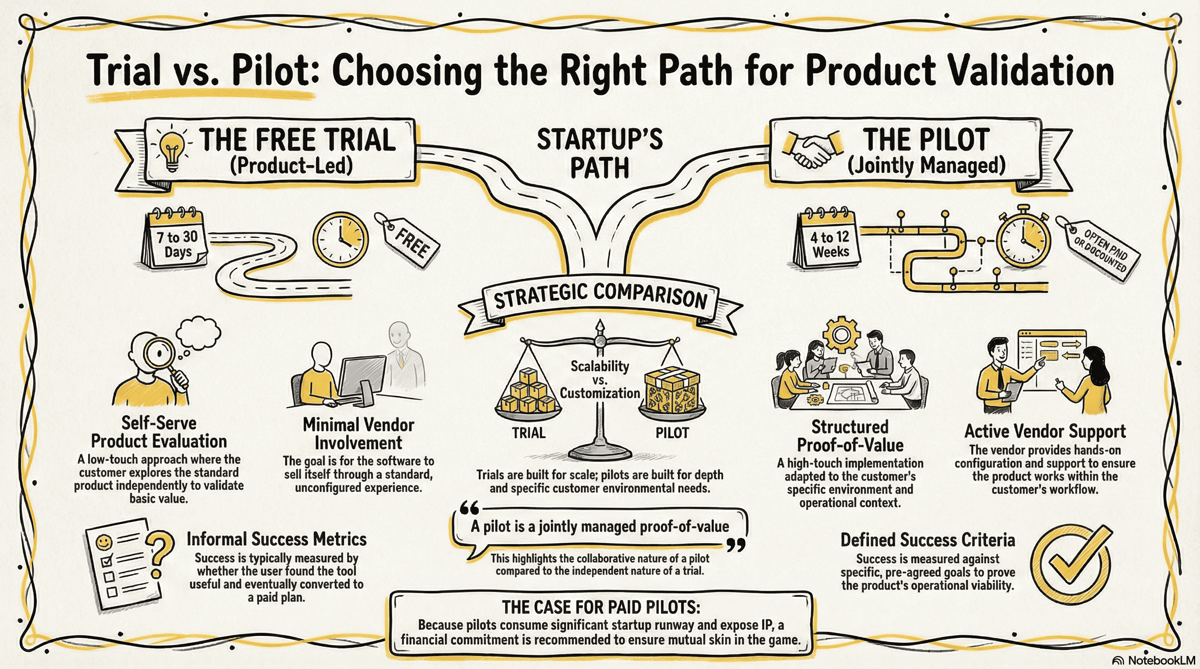
The Free Trial (Product-Led)
A free trial is primarily a product-led evaluation. The customer is given access to the standard product, usually with minimal involvement from the vendor. The goal is for the customer to explore the software on their own, validate basic value quickly, and decide whether to buy.
Trials are typically short (7–30 days), low-touch, and designed to scale across many users. Success is usually measured informally: did the user find it useful, and did they convert to a paid plan?
The Pilot (Jointly Managed)
A pilot is a structured, customer-specific engagement. It is closer to a small implementation than a casual test. The product may be configured or adapted for the customer’s environment, with active support from the vendor.
The goal is not just to "try the tool," but to prove that it works in the customer’s real operational context, often with defined success criteria agreed upfront. Pilots typically involve stakeholders, a clear scope, a timeline (often 4–12 weeks), and an evaluation process. They are usually higher-touch and may be paid, especially in enterprise settings.
My Take: Personally, I rarely give free pilots, because the effort that goes into pilots can be significant. Discounted rates during a pilot? Sure. But a pilot should demonstrate a level of reasonable commitment on both sides. Otherwise, it is like throwing startup runway down the drain while at the same time opening up all your IP to the external party.
In short: a trial is self-serve validation of the product; a pilot is a jointly managed proof-of-value in the customer's workflow.
From Osmosis to Operating System: Scaling Without the Congestion
Scaling a company is one of the rare moments where you get to design how the organisation actually works.
In the early days, speed comes from proximity. Small teams align naturally, decisions happen quickly, and momentum carries you forward. As the company grows, that same momentum becomes harder to sustain—not because people are less capable, but because complexity increases.
Informal communication works for five people but creates bottlenecks as headcount grows. Without written standards, every decision routes through the founder, stalling new hires. This is "Founder Congestion."
See content credentials
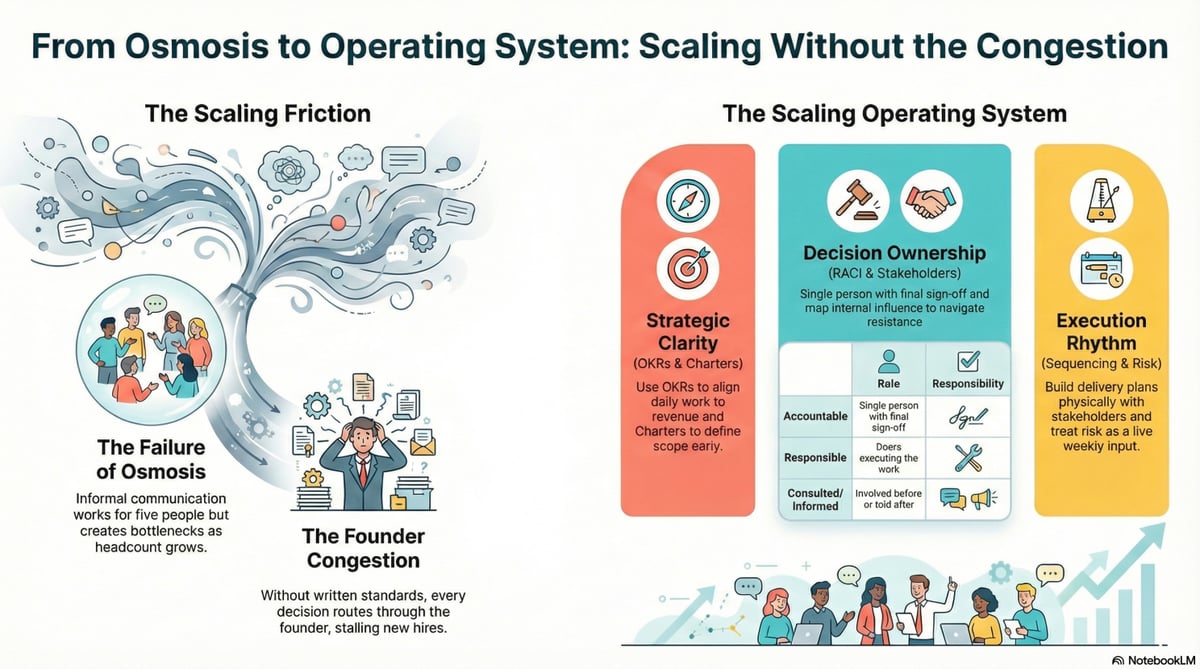
The founders and leadership teams I see scale well all do one thing early: they make execution explicit before it becomes painful.
They take the time to get the right people in a room and agree:
- Strategic Clarity: What matters and what doesn’t (using OKRs or Charters to define scope early).
- Decision Ownership: Who owns what and how decisions are made (RACI & Stakeholders).
- Execution Rhythm: How work really flows across teams and how risk is surfaced and dealt with in real time.
This isn’t about adding process. It’s about preserving speed as the organisation grows. Whether you’re post-seed, entering scale, or leading a large enterprise programme, the principle is the same: clarity compounds. Ambiguity does too.
When direction, ownership, and decision flow are designed deliberately, teams move faster, trust increases, and leaders stop becoming bottlenecks by default.
Execution isn’t a motivation problem. It’s a design problem. And when it’s designed well, growth becomes something you can steer—not just react to.
Link to full blog post on "From Osmosis to Operating System"
Doing Hard Things
Over the last few years, I’ve become much more deliberate about one thing: doing hard things on purpose.
Not for the sake of suffering, performance theatre, or ticking some resilience box. But because, for me at least, life works better when there is something in it that stretches me.
That’s been true in business, where the hardest moments have often been the most formative. But it’s become even more important outside of work.
As a founder, it’s very easy to be consumed by the business all of the time. And for certain periods, that’s not only normal but necessary. There are phases where it really does need to be close to 100% work. That’s the nature of startups. But it isn’t sustainable over the medium to long term. If everything in your life is tied to the business, the pressure compounds and the rewards start to feel abstract.
I’ve learned that I need challenges outside of work—goals that pull my attention away from business when I step back from it, and remind me why the work is worth doing in the first place.
This started early in my career, cycling from Ho Chi Minh City to Phnom Penh. It carried on through OCR races, Hyrox events, 48-hour and 72-hour fasts, and more recently learning how to surf. Watching the Arctic adventure Ultimate Challenge with Jason Fox recently has only reinforced why this matters to me.
What all of these have in common is not just the event itself, but the process. The training. The discomfort. The quiet discipline of working toward something that has nothing to do with revenue, product, or meetings.
I enjoy the preparation as much as the day itself. The next one on the agenda is another attempt at a 100km hike. Last year I made it to 80km before being stopped by severe blisters and bruised feet. That, alongside my next Hyrox event, is what I’m focused on right now.
It keeps me balanced while coaching multiple startups—work I genuinely enjoy—but also gives me something challenging and energising to think about outside of it.
That’s not to take anything away from my family, who I love spending time with and doing things alongside. But I’ve come to believe you also need something that’s just for you. Something hard. Something chosen. Something that keeps you grounded when work threatens to take up all the space.
So Founders, if you’re feeling all consumed by the job with little to distract you outside of it, maybe consider doing something "hard" like a physical challenge.