People like talking about scale. They like talking about fundraising rounds, explosive growth, hiring plans, valuation jumps, product launches, exits. The startup world is structurally biased towards stories that already worked. What gets far less attention is the messy, uncertain period before any of that exists. The period where the founder is sitting alone with a rough concept, a laptop, incomplete information, and a growing awareness that turning an idea into something real is far harder than social media makes it look.
I have been a founder four times. I have raised $2.2 million in pre-seed capital. I have pivoted a company into AI after missing product-market fit the first time round, and brought it to a million in revenue within twelve months. In the last year I have mentored twenty-four startups across AI, robotics, infrastructure, agriculture, healthcare, and a dozen other sectors. The patterns are remarkably consistent, and the first-mile problem shows up in nearly every conversation.
Founders often assume the hardest part is scaling. In my experience, it usually is not. Once you have users, revenue, feedback loops, proof points, and some market validation, the game changes. Hard problems still exist, but they become clearer problems. The first mile is different because everything is uncertain at the same time. You are trying to make strategic decisions with very little evidence, while also carrying the emotional weight of not knowing whether the thing is viable at all.
Why the First Mile Breaks So Many Founders
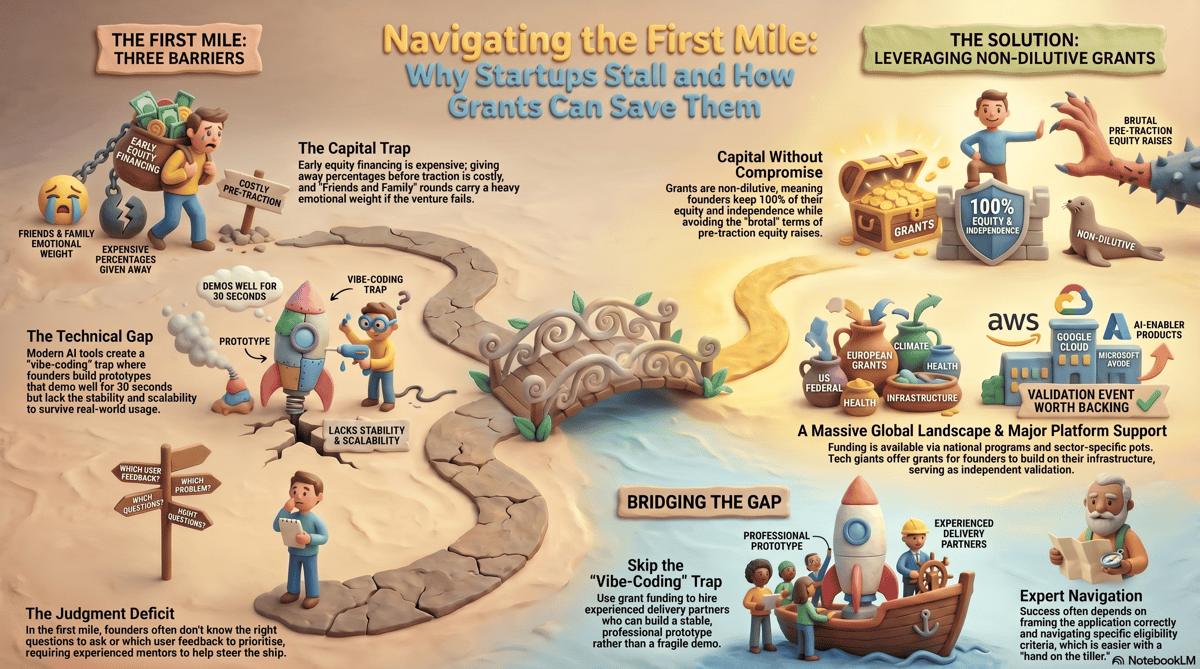
The first mile is hard for three reasons, and they compound on each other in ways that catch most founders off guard.
The first is capital. You have an idea and no traction, which means you have no leverage. Equity financing at this stage is brutal because your valuation is at its lowest. Every percentage point you give away now will look painfully expensive in eighteen months. I have seen founders give away enormous chunks of companies for relatively small amounts of cash simply because they felt they had no alternative. At the time it feels necessary. Later, once the company has momentum, those early deals can become a source of real regret.
Friends and family rounds can bridge a real gap and I would never dismiss them, but you are still giving up equity, and there is an emotional weight that founders consistently underestimate. If the company does not make it — and at the earliest stage, statistically, most do not — that money is gone, and the people who gave it to you are the people you sit across from at Christmas. I have watched founders carry that weight for years after their startup wound down. It changes them. Even where relationships survive perfectly well, the founder often internalises the responsibility in a way that becomes psychologically heavy.
The AI Coding Trap
Then there is the second problem, which is technical.
The new wave of AI coding tools has made it look, on the surface, as though anyone can build anything. The reality is more complicated. The tools are extraordinary, but they are not magic. Most founders are not yet skilled enough with these tools to produce something stable, sensible, or scalable. They produce a prototype that demos well for thirty seconds and then falls apart the moment a real user touches it.
What is happening right now reminds me slightly of the early no-code movement. People see a layer of abstraction and assume complexity has disappeared underneath it. It has not. Good software architecture still matters. Product thinking still matters. Security still matters. Scalability still matters. User flow still matters. AI-assisted coding has dramatically increased speed, but speed without engineering judgement creates fragile systems very quickly.
Worse, because the founder built it themselves with no engineering instinct, they cannot diagnose why it is failing, and they cannot iterate. They burn weeks, lose confidence, and end up with something they cannot show to investors or customers without apologising for it first. I see this constantly now. Founders arrive believing they are weeks from launch, when in reality they have accumulated technical debt so severe that starting again would probably be faster.
The emotional effect of this matters as well. Every failed build cycle chips away at confidence. Founders start questioning not just the product, but themselves. Momentum disappears. And once momentum disappears in the first mile, many startups quietly fade away before they ever really begin.
The Judgement Gap Nobody Talks About
The third problem is judgement. This is the one founders rarely admit, even to themselves.
In the first mile, you do not yet know the right questions to ask. You do not know which problem to solve first. You do not know which user feedback to act on and which to ignore. You do not know what good looks like, because you have never built this thing before. What you need at this stage is not more hustle or another framework. You need experienced people standing next to you, asking the questions you have not yet learned to ask.
This is one of the reasons experienced founders tend to move faster the second or third time around. It is not always intelligence. It is pattern recognition. They have seen where the traps are before. They know when a founder is overbuilding. They know when customer feedback is noise rather than signal. They know which problems are existential and which ones are simply uncomfortable.
First-time founders often try to solve everything simultaneously. They build too many features, chase too many customer types, spend too long perfecting branding, or overthink product decisions that do not yet matter. The problem is rarely effort. Most founders work incredibly hard. The problem is directional accuracy.
Put those three things together — no capital, limited technical capacity, undeveloped judgement — and you have the reason so many promising ideas never make it out of the notebook.
The Lever Most Founders Ignore
There is a lever most founders underuse at this stage, and I want to spend the rest of this piece on it, because it is genuinely one of the most useful tools in a founder’s armoury when starting out.
Grants.
Grants are non-dilutive. You keep your equity, you keep your independence, and you get capital that does not come with the emotional weight of friends-and-family money or the brutal terms of a pre-traction equity raise.
The landscape is far larger than most founders realise. There are national grants in nearly every developed economy. There are European regional grants. There are US federal and state programmes. There are sector-specific grants for climate, health, agriculture, infrastructure, manufacturing, defence, and deep technology. Some run all the way through the project lifecycle, from early concept work to scale-up funding.
Then there are the grants offered by the large technology platforms — AWS, Google Cloud, Microsoft Azure and others. These exist precisely because the platforms want early-stage founders building on their infrastructure, and they put real money behind that intent. In some cases the support is not just financial. It includes cloud credits, technical support, architecture guidance, access to partner networks, and introductions into broader ecosystems.
For founders at the idea or prototype stage, these grants can cover the cost of building an initial AI-enabled product with the help of experienced developers. For founders further along — with a product in market that simply has not had AI built into it yet — there are larger grants designed to fund that next stage of development.
Why Grants Matter Beyond the Money
This matters for two reasons beyond the obvious capital point.
First, working with experienced developers on a grant-funded prototype means you skip the worst version of the vibe-coding trap. You end up with something built properly, by people who have shipped before, and you learn what good looks like in the process. You also preserve speed because experienced teams know where not to waste time.
Second, the act of applying for and winning a grant is itself a validation event. It tells the market — and tells you — that the idea has been independently assessed and judged worth backing. That story compounds when you go on to raise equity later. Investors are far more comfortable leaning into businesses that have already demonstrated an ability to secure external support.
The Reality of the Grants Landscape
The catch, and there is always a catch, is that the grants landscape is difficult to navigate alone.
The application processes are specific, the eligibility criteria are not always obvious, and the difference between a winning application and a rejected one often comes down to framing rather than fundamentals. Many founders are actually eligible for programmes they never apply for simply because they misunderstand the requirements or position the company incorrectly.
I have also seen founders waste months applying for grants that were structurally wrong for them from the start. Wrong geography. Wrong maturity stage. Wrong sector alignment. Wrong funding objective. The opportunity cost of that matters when you are already resource constrained.
This is where most founders need a hand on the tiller.
The First Mile Does Not Need to Stop You
If you are in the first mile right now — idea-stage, prototype-stage, or sitting on an existing product that needs AI to stay relevant — I work with founders to identify which grants you are eligible for, prepare the application properly, and connect you with experienced delivery partners who can build the prototype that comes out the other side.
Most founders I speak with are eligible for more than they realise. More importantly, most are far closer to getting started than they think. The first mile feels impossible partly because founders assume they need to solve every problem alone before they begin. In reality, the founders who move fastest are usually the ones who learn early how to bring the right support around them.
The first mile is the hardest. It does not need to be the one that stops you.
Book a grant funding strategy call with me on MentorCruise: https://mentorcruise.com/sessions/grant-funding-strategy-na-ben-sheppard1872/book/16648/