At a New York DealBook Summit in 2024, Jeff Bezos offered a stark reminder of how difficult the earliest stage of building Amazon was. Speaking about his experience raising seed capital, Bezos said, “I had to take 60 meetings … It was basically the hardest thing I’ve ever done.” In his recounting of that early fundraising grind, he explained that convincing angel investors to write checks for tens of thousands of dollars into an unproven online bookselling business required dozens of long, hard-earned conversations, and that most of those conversations ended in rejection before eventually securing backing. (Yahoo Finance)
Today, Amazon is one of the most valuable companies in the world. But in the earliest phase, when virtually no one understood the commercial potential of the Internet, getting the first million dollars of seed capital was an ordeal. That moment — where conviction is high but proof is absent — is exactly where many pre-seed founders find themselves today. It is the space where vision meets reality, and where execution risk looms largest.
This isn’t a theoretical challenge; it is the core practical challenge of founding a technology company.
Why the Pre-Seed Phase Is Uniquely Difficult
When you are at pre-seed and pre-revenue, you do not yet have anything that can be experienced, quantified, or measured. You have an idea, a problem you believe you understand deeply, and a conviction that a solution can be built. You may have spoken with potential users who nod in agreement about the pain point. You may have even sketched mock-ups, process flows, or design drafts. But none of that is substance in the eyes of customers, investors, or experienced engineers.
The need is not simply to believe in the idea. The need is to demonstrate that the idea can be realised in a way that is credible, technically feasible, and baseline scalable.
Traditional advice has long been: start with mock-ups in tools like Figma, validate the problem with prospective users, and refine your understanding of the market. More recent advice adds: get your prototype built through AI tools or no-code platforms, so you have something to show.
This is helpful. But more often than not, it is not sufficient.
AI tools and no-code platforms can help you create a visual shell or a concept-level demonstration. They can allow you to experiment with workflows and user journeys. But a real prototype — one that can be meaningfully evaluated by customers or trusted advisors — often requires structured technical thinking that those tools alone can rarely provide - there are of course the exceptions, but i’m speaking more generally. If you build in isolation, without experienced engineering input, invisible technical debt can accumulate rapidly. Decisions about architecture, data structure, integration, observability, and deployment — the elements that differentiate a concept from a coherent early product — tend to get deferred or overlooked.
What you end up with is a prototype that feels built, but that may not meaningfully advance your ability to demonstrate seriousness to customers or investors.
A Practical Bridge: Funded AI Prototypes via AWS
Late in 2025 I came across a programme that addresses this exact gap, not by eliminating the difficulty of building, but by lowering the barrier to getting the first credible build into the world with experienced support.
Apex lab has a partnership with AWS that enables startups to access up to $25,000 in grant funding for building AI prototypes. The premise is straightforward: AWS wants more high-quality AI applications running on its infrastructure, so it funds approved partner companies — like Apex — to work with early-stage founders to scope and build prototypes within the AWS ecosystem.
The value proposition is not simply the money. It is the combination of funded execution with experienced technical input. Apex does not just take briefs and code them. In every case I have seen, they interrogate the idea, refine the scope, challenge assumptions, and shape the technical plan in a way that meaningfully improves execution quality. This is precisely the kind of intervention that makes early technical decisions intelligent rather than accidental.
I have now helped five founders explore this pathway. Four applications have been approved, and one is pending. The builds have delivered operational prototypes that are far stronger than what would typically be possible by a solo founder using generative AI alone.
CEE Travel AI — A Real Example of What Well-Architected Prototypes Look Like
Apex’s work with AWS was highlighted in a project called CEE Travel AI, an agentic, multilingual conversational travel assistant designed for integration with major online travel agencies (OTAs).
The objective was to build a system that could interact with users in multiple languages, answer questions about travel itineraries and availability, validate real-time pricing, and integrate smoothly with existing OTA platforms. This was not a superficial chatbot; it was a technically advanced prototype with core engineering rigor.
The architecture included:
- Multi-agent orchestration for conversation, research, and quality-checking using Bedrock and Lambda;
- A full retrieval-augmented generation (RAG) pipeline built on AWS services like S3, Glue, OpenSearch, and Bedrock for embedding and search;
- Real-time hotel price validation via agentic tool calls;
- A React-based embeddable widget for partners such as Booking.com and regional sites like Szallas.hu;
- Monitoring and observability built into CloudWatch and API Gateway metrics.
The outcome was demonstrable, scalable orchestration with production-level traffic support and a clear roadmap for multi-tenant expansion.
This example matters because it shows what a well architected, credible early prototype looks like when technical experience is baked in from the outset. For pre-seed founders, that level of quality is something that dramatically improves conversations with early customers, strategic advisors, and investors.
How the AWS-Apex Pathway Works
The process is simple and structured:
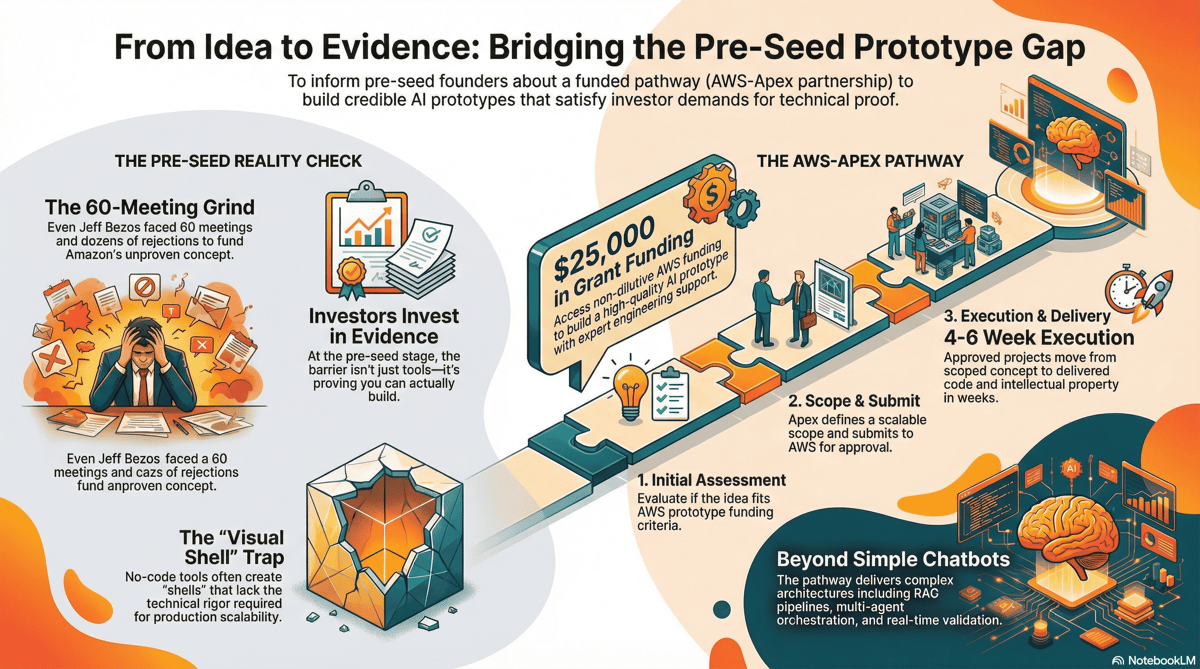
- Initial Assessment — We discuss your idea and evaluate whether it fits the AWS prototype funding criteria.
- Scope Development — If appropriate, Apex works with you to define a detailed and scalable scope of work.
- Submission to AWS — The proposal is submitted to AWS for approval.
- Execution — If approved, Apex builds the prototype over approximately four to six weeks within AWS infrastructure.
- Delivery — You receive the finished code and all intellectual property.
There is no equity stake taken, and there is no hidden requirement beyond building on AWS. For most early startups, committing to AWS is not a constraint but a practical choice, given the platform’s maturity and compatibility with modern cloud-native development.
What this pathway does not do is remove the hard work of building a startup. It does not guarantee product–market fit or eliminate execution risk. What it does do is provide a funded, high-quality technical execution at the very point where most founders are forced to choose between scope-limited prototypes or indefinite delay.
Why This Matters for Pre-Seed Founders
Bezos’s recounting of taking 60 meetings to raise early capital is not just an anecdote about persistence; it highlights a structural asymmetry in early startups. Investors do not like to invest in ideas alone. They invest in evidence. They invest in a team’s ability to execute. They invest in something they can see, test, and interrogate.
A credible, well-built prototype created with real engineering expertise — especially one developed within a structured partnership with AWS — does exactly that. It provides something tangible that demonstrates technical judgement, commitment, and execution capability.
At pre-seed, the barrier is not simply access to tools. It is the confidence of others in your ability to build what you say you can build.
Bridging the gap between idea and credible product is not a shortcut. It is a strategic first step that turns questions into answers, conversations into demonstrations, and scepticism into engagement.
If you are sitting with a strong concept but limited capital and limited technical resources, this pathway is worth exploring rigorously. The difference between a rough concept and a properly engineered prototype can change the quality of every discussion you have with early customers, advisors, and investors.
The hardest part of building a company is often not scaling. The hardest part is proving that you can build. Provided that you use the right support and structure, that challenge does not have to be insurmountable.
Contact me
If you are at pre-seed and thinking seriously about how to move from idea to a credible first version, I am happy to discuss whether this pathway makes sense for you. I can walk you through how the process works in practice, what AWS looks for in approvals, and whether your concept is likely to qualify.
You can book a short introductory call here https://mentorcruise.com/sessions/introductory-call/book/8244/
If it is a fit, we can explore next steps. If it is not, you will at least leave with clearer thinking on your technical starting point.