The investor is pricing the risk you have not removed yet
I spent an hour this morning playing the investor for a founder I coach. He has a meeting coming with a man who has sold two companies for hundreds of millions and kept nearly all the equity in both. By the end of the hour we had rebuilt the entire approach to that meeting, and not one of the changes we made was to the product.
That is usually where the work is. Founders prepare for investor conversations by polishing the thing they built. Investors are not sitting there assessing the thing you built. They are working out which risks are still live, which of those you have already taken off the table, and whether you personally are evidence that the remaining ones will get handled. Everything below comes out of that hour.
Read the person before you build the pitch
The first thing I asked was what he actually knew about the investor. The answer contained one fact that mattered more than the rest: across two exits, this man had given up almost no equity. One company took a Series A and that was the extent of it. His stated philosophy is keep the revenue, keep the equity, build the thing.
That is not a personality note, it is a negotiating position you can read in advance. A man who never gave up equity in his own companies is going to be tight with his money and hard on your valuation. He will push the number down. You should walk in already knowing that, rather than discovering it live and reacting badly.
The second read is on time rather than money. Highly successful people who have exited often have plenty of capital and very little appetite for the work. I know a billionaire who is currently selling a business large enough that a botched sale would move the GDP of several countries. He has money coming out of his ears. He is also spending his time buying castles, and has bought a jet so he can go and look at them. He does not want to advise a startup. He wants to buy castles. Do not build a pitch around the assumption that a wealthy person is looking for something to do.
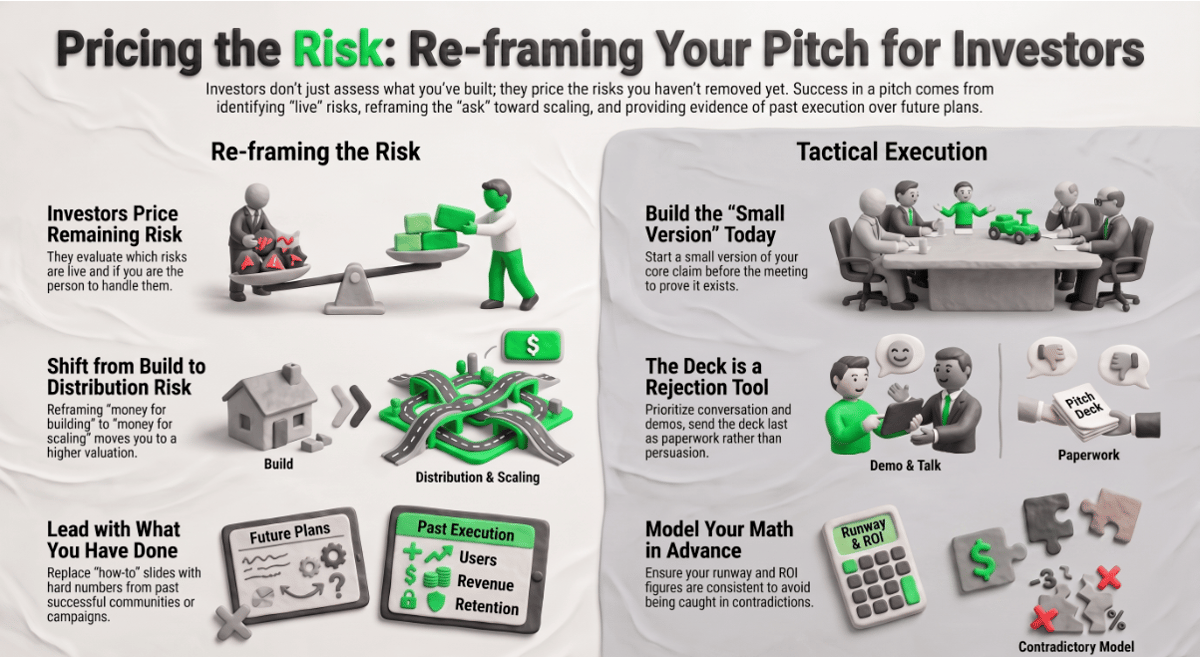
Ask for money against the right risk
My founder came in wanting a hundred thousand. Fine. The question he had not answered clearly was what the money is for, and that answer determines the entire shape of the conversation.
His product is essentially built. It has been tested by real users who like it. He is not asking anyone to fund a build, and if he walks into the room framed as pre-seed and pre-revenue he will be priced as though he is. What he needs money for is distribution: paid campaigns, an affiliate programme, the work of getting the first customers through the door.
That reframe does two things at once. It moves the conversation from early stage to scale-up, which is a materially different valuation conversation. And it tells the investor precisely which risk they are being asked to carry. Build risk is gone. Distribution risk is what is left, and it is the only thing they now need to price.
Get this wrong and you spend the meeting defending a risk you already retired months ago.
Do not hand over your soft spot unasked
He told me he is not good with numbers and hates spreadsheets, and that part of the appeal of this investor is that a numbers person would fix that for him. All true, and I told him not to say a word of it in the meeting.
There is a distinction here that matters, because I am usually the one telling founders to volunteer the weakness before they are asked. The difference is what kind of weakness it is. Naming a limit on the deal is credibility. Telling someone that you personally cannot do a core part of the job is a red flag, and a numbers investor will hear it as the reason the model in front of him cannot be trusted. Disclose the risk in the business. Do not disclose a deficiency in yourself and hope it reads as charm.
The deck is giving them a reason to say no
He had a deck. He had already sent it once. My advice was to stop sending it.
A deck read alone, without you in the room, is a document optimised for rejection. Every slide is another place for someone to find the thing they do not like, and they will find it in four minutes on a phone with nobody there to add context. I learned this at Silta. We sent decks for a long time before I worked out that what was persuasive about the company was not in the deck at all, it was in the conversation, and the deck was quietly filtering out people who would have said yes if they had spoken to me.
This founder is articulate. In a room he is convincing. So the sequence should be a conversation first, a demo of the working product second, and the deck third if at all, at which point it is paperwork rather than persuasion. If the thing that sells your company is you, then the job of the outreach is to get you in front of someone, not to substitute for you.
Say what you have done, not what you know how to do
Halfway through the hour he mentioned, almost in passing, that he has run a community of two hundred and fifty thousand people. Sixty thousand attending regularly. He tested paid influencer placements at twenty thousand dollars a slot and knows which ones returned a hundred and fifty thousand within five minutes of going live and which ones returned close to nothing.
None of that was in his deck. His go-to-market slide was process and methodology, which is to say a description of what he intends to do, written in a register indistinguishable from something a language model would produce. Meanwhile the single most de-risking fact about the entire company was sitting in his head unmentioned.
Investors will ask how big your community is today, and if the honest answer is small, the thing that saves you is the answer to the question underneath it, which is whether you have ever built one. Most founders in that seat say something about a mailing list. He can say two hundred and fifty thousand people.
The instruction I gave him was blunt: stop telling people you know how to do this. Tell them what you have already done, with the numbers attached, and let them draw the conclusion. That is the advantage of being an experienced founder rather than a first-timer, and most experienced founders forget to use it.
The maths gets done in the room
He is meeting a spreadsheet person, so I asked him to divide a hundred thousand dollars across six months. He said one thousand seven hundred and fifty. It is sixteen and a half thousand, and in the moment neither of us caught it, which is precisely the point. Numbers you have not modelled will fall apart the second someone makes you do them out loud, and a numbers investor will make you do them out loud.
Two other things came out of the same pressure. The first is runway. Investors generally want to see eighteen months from the point they put money in, and his narrative was built on six. That is not automatically fatal, but you had better have a deliberate answer for it rather than discovering the gap while he is looking at you. The answer in his case is that revenue starts covering spend partway through, which is a defensible position if the model behind it exists. It did not exist yet.
The second is contradiction. He spent ten minutes explaining that the affiliate engine returns four to one and the referral engine closer to ten to one, while advertising returns roughly one to one. He had, without noticing, argued himself out of needing an advertising budget. He also moved through three different asks in the same hour: a hundred thousand, then fifty would do, then a hundred buys a second developer as well. Each version was reasonable on its own. Heard consecutively by a stranger, it reads as a founder who has not decided.
You will not hear your own contradictions. Somebody has to sit opposite you and play the part properly, which is most of what the hour was for.
What to do before the meeting
The last thing we agreed was the most useful. He believes the referral community is the engine of the whole business. He does not have one yet. So build it now, in the days before the meeting, even at fifty people, so that when the subject comes up it has started rather than being a plan.
That principle generalises past this one founder. Before an investor conversation, find the single claim your case rests on and do the smallest real version of it you can do this week. A thing that exists, however small, prices differently to a thing you intend.
If you have an investor conversation coming and you have not had somebody sit opposite you and be difficult about it, that is the gap worth closing first.