The image accompanying this newsletter is from a sweet festival in Vilanova i la Geltrú that my family and I went to last weekend. The streets were covered in coloured sweets, and teams dressed in traditional outfits were throwing handfuls of candy into the air. There were kids running everywhere, with older generations watching from balconies and also in the mix of things. It was loud, chaotic, slightly ridiculous and absolutely beautiful. Events like that matter. They remind you that community isn't an abstract concept; it's built through shared moments, through rituals, and through people showing up together.
I wanted to share that image because it felt like a good reminder that not everything is metrics, pipelines and execution plans. But equally, the world we operate in—startups, enterprises, leadership teams—is real, complex and often messy in its own way.
I work across that full spectrum, coaching and operating fractionally with founders from pre-seed conviction through scaling, turnarounds and exits. Some are trying to raise their first round, while others are navigating enterprise negotiations that have stalled for reasons they can't quite explain. Some are redesigning internal systems that aren't quite working, and others are simply trying to think more clearly inside a noisy environment.
Because of this, this edition is deliberately broad. Despite the different stages and different pressures, you will find similar underlying patterns.
In this edition:
- Enterprise Deals: For those negotiating with enterprises.
- The Discipline of STAR: For those designing better systems inside their company.
- The Proof Gap: For those trying to bridge the gap between belief and proof at pre-seed.
- Environmental Performance: For those thinking about how the environment you work in shapes the quality of your output.
I hope you enjoy the read, Ben - my contact details are at the bottom of this newsletter should you wish to reach out.
Why Enterprise Deals Rarely Follow a Straight Line
Most founders believe that if they build a product with for example a 70% time and cost saving, the deal is a mathematical certainty. They focus their energy on the "deal in front of them"—the pricing, the features, and the contract terms. But in the enterprise world, value alone isn't always enough to guarantee a close.
In reality, you aren't just selling a product; you are navigating a complex system where power is fragmented and different stakeholders are optimizing for entirely different, often hidden, outcomes. If you don't account for these externalities, you're not negotiating a deal—you're walking into a system designed to slow you down. And unless you've been there and done it, you are unlikely to spot the warning signs.
Professionals in big enterprises are experts at slowing down process, delegation and risk aversion. Your nimble little start up is in many cases perceived as risk not opportunity, and you must be mindful of that. While your user group might be completely sold on the operational benefits, the surrounding system often remains stationary. Implementation control sits with IT, the budget is held by Treasury, and Legal acts from a purely risk-averse mandate. These "micro-agendas"—personal drivers like career risk, internal credibility, or fear of future blame—explain blockers far more reliably than any formal objection.
To win, you must stop reacting to symptoms and start treating the negotiation as a structural challenge. To move past a stalled pilot, you must shift from a reactive exchange to a controlled process. This starts with "open-heart surgery" on the deal: pausing execution to build a factual foundation of every email, objection, and stakeholder signal.
I developed my own tool called DealLine to map demands, and I use Outcome Modelling to show stakeholders what failure actually looks like, moving the conversation away from emotion and toward consequences. When you stop negotiating personalities and start negotiating incentives, your enterprise outcomes become far more predictable. I have applied this approach in both my own startups—which led to me closing deals with some of the largest banks in the world—and for my clients working through fundraisers, M&As, and more general B2B enterprise transactions.
Before moving on, it's worth pausing. Let me ask you a question:
- Where in your current deals might invisible incentives be shaping outcomes more than the formal objections you're hearing?
- Are you negotiating value or are you negotiating internal career risk, budget ownership, and control?
- If a pilot has stalled, have you mapped the system around it, or just the user group inside it?
Clarity Before Intervention: The Discipline of STAR
The STAR framework is a simple but powerful structure for thinking clearly about real-world situations. It stands for Situation, Task, Action, and Result. Originally used in behavioral interviews, it forces disciplined storytelling: first define the context (Situation), then clarify what needed to be achieved (Task), describe what was actually done (Action), and finally explain the outcome (Result).
What makes it useful is not its simplicity, but its insistence on causality. It prevents vague descriptions and forces you to connect decisions to consequences.
I recently used STAR to map out a complex project workflow for a team struggling with shifting priorities. Instead of starting with new software or abstract goals, I began with the real environment in which the team operates:
- In the Situation: I described the external pressures—tight deadlines, varying client demands, and limited resources.
- In the Task: I clarified what the team is actually responsible for: delivering high-quality outputs while maintaining internal communication.
- In the Action: Only then did I move to breaking down what actually happens when a task is assigned and executed.
- In the Result: Finally, I considered the outcome—not just the completion of the project, but the impact on team morale and operational efficiency.
Using STAR in this way changes how you design solutions. It shifts the focus from abstract capability ("buy a new productivity app") to behavioral reality ("how do people actually manage their daily workload?"). It also exposes differences between use cases. A high-stakes, long-term project has a very different Situation and Task compared to a routine daily request—and therefore requires a different level of structure. Without that framing, it's easy to design something generic that doesn't fit any real workflow.
For me, STAR is less about storytelling and more about strategic clarity. It forces you to understand context before proposing intervention. Whether you are coaching founders, designing products, or improving internal processes, the discipline is the same: define the situation honestly, clarify the task precisely, examine the actions realistically, and evaluate the results objectively.
Most strategic mistakes happen when we skip one of those steps. Most strategic errors don't come from poor effort; they come from misdiagnosing the situation.
Take a moment to reflect on this:
- Have you clearly defined the real situation before trying to fix it? - or did you just rush in with what you thought was the solution?
- Is your team aligned on the actual task or just reacting to surface-level noise?
- Where might you be jumping straight to action without properly mapping context and consequences?
The Proof Gap: Where Conviction Meets Skepticism
The pre-seed phase is uniquely difficult because you are operating in a space where conviction is high but proof is absent. As Jeff Bezos recently recalled of his early days at Amazon, raising capital for an unproven idea was "the hardest thing" he had ever done.
For many founders today, the challenge isn't just believing in the idea—it is demonstrating that the idea is technically feasible and scalable to customers and investors. While no-code tools and AI can create a "visual shell," they often lack the engineering rigor required to prove a concept's seriousness.
To bridge this gap, a strategic partnership between Apex Lab and Amazon Web Services (AWS) now offers a practical pathway for early-stage founders:
See content credentials
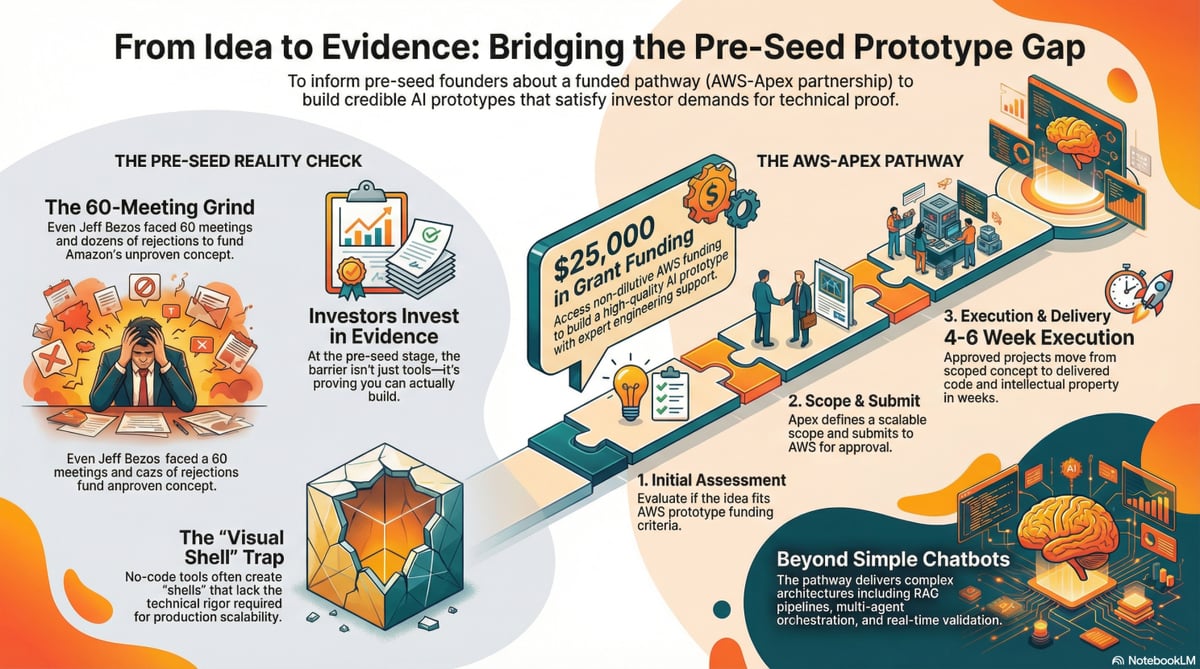
- Funded Execution: Startups can access up to $25,000 in grant funding to build credible AI prototypes.
- Engineering Rigor: The program focuses on building well-architected systems. There is a massive difference between stitching code together with AI and actually engineering software. When you work solo with an LLM, you lack a human safety net to talk things through with. Experienced engineers anticipate edge cases, scalability bottlenecks, and architectural flaws that a non-technical founder simply wouldn't know to look for.
- Founder-Friendly Terms: The process takes approximately four to six weeks, requires no equity stake, and ensures the founder retains all intellectual property.
At the pre-seed stage, investors don't just invest in ideas; they invest in evidence and a team's ability to execute. Early conviction is powerful, but markets respond to evidence. This pathway turns skepticism into engagement by providing something tangible and professionally engineered.
Consider this:
- If you're early-stage, what would make your idea undeniably credible to someone outside your immediate circle?
- If you're further along, are you still relying on belief where the next phase demands proof?
- What is the one tangible step that would shift scepticism into engagement?
Performance Is Environmental, Not Just Personal
Envoqe is a spatial intelligence protocol that asks a simple but vital question: how do the environments you move through shape your ability to win?
This isn't abstract theory; it's practical. It's the difference between "churning out" flat, information-heavy content at a desk and producing work with real texture. I felt this recently while drafting this very newsletter. The output was there, but the soul was missing—until I stepped out for a walk along the coast.
For me, the coast is where I find it easiest to challenge my own assumptions and connect ideas. Within seven minutes of walking, I had the epiphany I needed to link this piece together. However, environment is not one-size-fits-all. A close friend with ADHD and autism would find the coast under-stimulating and quiet. He's at his best in a busy office with headphones on and a movie playing; that's the "controlled chaos" that pulls him into flow.
Recognizing these triggers has changed how I view my day. I now treat my coastal commute not as "dead time," but as a protected creative window. As someone who is dyslexic, I use AI as a lifesaver for structure and fluency, but the AI cannot manufacture lived insight. The substance must come from a human in their peak state. That coastal walk isn't just a break; it's the professional environment that reliably triggers the clarity I actually get paid for.
As automation and AI take over the mechanical load of our jobs, the value of humans shifts entirely toward creativity, judgment, and original thought. If we want more of that, we have to stop pretending the best work comes from a single rhythm or a "chained to the desk" culture. We must move toward a world where we put people in the specific conditions that reliably trigger their best mode—whether that's a quiet beach or a bustling cafe. We often mistake productivity for a willpower issue, but it is frequently an environmental one.
Personal Note: Training Without Self-Sabotage
Lastly, on a personal note, I am now into week eight of my training for HYROX ESP Singles in May. This has been the most consistent block of training I have managed in a couple of years.
In previous cycles, I would typically run into problems with my Achilles or hamstring after a few intense weeks. That would force several weeks off to recover, breaking momentum and limiting progress.
The difference this time is simple: I took advice from a professional. Nick Smith, who runs a CrossFit, LLC gym in the UK and also competes in Hyrox, reviewed my approach and made a fundamental change. He pointed out that I tend to attack training at full intensity from the outset. That "bull at a gate" mindset was driving avoidable injuries.
The revised programme dials back the pace and adjusts the structure. It incorporates slightly shorter runs at controlled speeds, blends strength work with high-intensity efforts, and varies overall load across the week. I now train five days per week with deliberate recovery in between.
The result is that my body feels strong rather than fragile. I am seeing measurable improvements in both strength and speed, without the recurring setbacks.