You know the call. You've been circling this company for eight months. Cold emails, then a conference where you finally shook hands with someone real, then months of content so that when they googled you there was something to find. Their champion is excited. Legal has stopped asking questions. The pilot starts Monday.
I remember hanging up and letting myself feel like the hard part was behind us. It wasn't. The hard part hadn't started.
This one is for you if you sell to a company where somebody else has to actually use the thing. The restaurant, the courier, the franchisee, the nurse, the guy on the warehouse floor. You never met them, they never asked for you, and your pilot lives or dies on them.
The finish line we drew in the wrong place
Long B2B cycles train you badly. Every stage in your pipeline is named after something the buyer does — meeting, demo, proposal, security review, signature — and the last one is called closed. Nothing in that whole apparatus is named after the moment your product actually works for someone.
So you spend a year building a machine that is very good at getting a yes, and then you get the yes, and the machine has nothing left to tell you.
We built that machine properly, and I'm still a little proud of it. Cold outreach, then conferences, then marketing aimed at the people sitting around our decision-makers rather than at the decision-makers themselves. We published constantly about photo quality in food delivery and about what we'd heard interviewing restaurant owners. There were written procedures for how a post gets published, promoted and cross-linked back to the landing pages. Affiliates, video, Instagram creators, mentions chased in the industry press until our name sat next to companies many times our size.
It worked. Meetings started appearing in my calendar through a form on a landing page instead of through my outreach, and delivery companies asked to speak to a co-founder personally. It took about a year to get that pipeline moving at all.
The pilot we waited a year for
One of those companies was a large delivery marketplace. We stayed in touch for almost a year, calling every couple of months, even through the long stretch when they had no capacity for a pilot, just to keep the relationship warm.
Then capacity opened up, and we got it. A champion inside, genuinely excited people, a business that clearly needed what we'd built. Everything I had learned to optimize was in place.
The pilot failed because the restaurants on the other end never activated. The business signed it, the business nodded on every call, and the business was not the one who had to open the app and photograph a burger. Their merchants had to. They didn't.
The reasons were mundane, which is the part that still stings. It was an app, so someone had to install it. Then register. Then keep a login and a password, because we cared about security, and that felt like the responsible thing to build. Every one of those decisions is defensible alone. Together, they asked a restaurant owner who never requested any of this to clear four obstacles before seeing anything useful. He cleared none of them.
We lost the deal. Not on price, not on procurement, not on the demo.
The half of the deal we weren't selling to
We were B2B2C, which means the business signs the contract and the consumer decides whether it was true. Every month of that year went into the half that was signed.
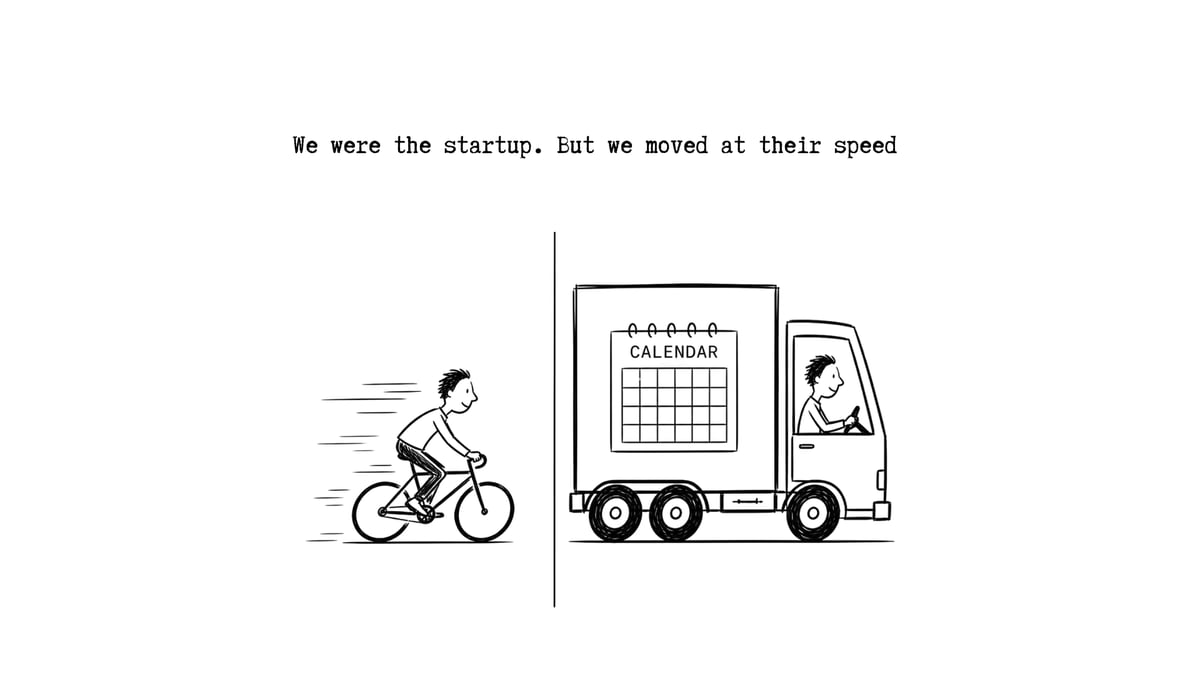
Underneath that sits the more expensive mistake. The only structural advantage a startup has over a company with quarterly planning and a legal department is speed, and we spent a year adapting to their tempo. By the time the door opened, we needed weeks to produce a result, when we should have needed days. The asymmetry was ours, and we handed it back.
Build the pilot backwards from the person who doesn't want it
If I could give a founder in a long cycle one thing, it's this. Before you agree to a pilot, write down what the end user has to do in the first week for it to succeed, and how many of them have to do it. Not the buyer. The person at the far end who sat in none of your meetings.
Then keep cutting until that number is reachable without anyone learning anything new. If your answer needs the client's customers to change their behaviour because their supplier told them to, the pilot is already lost and you'll just find out slowly.
The real answer arrived on an unremarkable call. We had persuaded another large delivery company to give us an hour, and I sat listening to them describe the same problems in almost the same words, and somewhere in that hour it stopped being an argument and became obvious. The product didn't need to be better. It needed to be radically simpler. Two web pages. No install, no account, nothing to remember.
Even after launch, it refused to grow, with hundreds of thousands of euros of volume theoretically on the table, because the people at the far end simply weren't digital. So in order to grow we simplified, then simplified again, and eventually took their effort out of the flow entirely thanks to AI features. That was the real insight of those years; it led us to success, and it cost a pilot to learn.
Additional note
Our pilots were free. I've wondered since then whether a paid one would have made them commit resources they never committed, or whether it would have killed the deal earlier and cheaper.
If you're in the middle of a long cycle right now, tell me one thing: what has to happen in the first week of your pilot, and who has to do it? If you can't answer that yet, it's a conversation worth having before the signature rather than after.