Bring in a vetted expert to train your team with a hands-on, interactive workshop. Flexible formats, proven results, and zero hassle – we handle the matching so you can focus on learning.
Tell us about your team and we'll reach out within 24 hours.
Our team will reach out to within 24 hours.






Skip the one-size-fits-all sessions. Get expert instruction that's relevant, hands-on, and made for your team.
satisfaction rate
faster goal achievement
available workshop hosts

"Alessandro taught me to use competency matrices as objective decision-making tools, challenge assumptions from my own teams, and translate technical language into management language for executive conversations."

We're not a generic training marketplace. Every workshop host on MentorCruise is a vetted professional with real-world experience at top companies.

Every host goes through a rigorous vetting process. Only 8% of applicants are accepted, so you're always working with the best.

Workshops start from $250. No hidden fees, no long-term contracts. Pay per session or negotiate a package for your team.

Tell us your goals and team size – we'll match you with the right host, coordinate scheduling, and make sure everything runs smoothly.

No cookie-cutter content. Hosts tailor every session to your team's industry, skill level, and specific challenges.
From first inquiry to post-workshop follow-up, we make the entire process seamless.
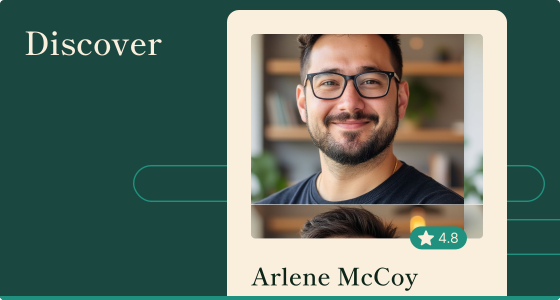
Fill out the quick form or book a discovery call. Share your team's goals, skill gaps, and preferred format – whether it's a focused 2-hour session, a half-day deep dive, or a full-day intensive.
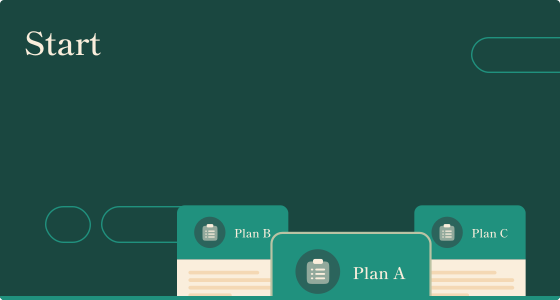
Based on your requirements, we shortlist 2-3 workshop hosts from our vetted network. You'll get their profiles, past workshop topics, and reviews – then pick the one that fits best.
Your host tailors the curriculum to your team's context. They'll align on agenda, exercises, and outcomes ahead of time so there are no surprises – just a session that delivers exactly what you need.
Your team gets a hands-on, interactive session led by a real practitioner. After the workshop, you'll receive materials, action items, and optional follow-up sessions to reinforce what was learned.
Choose a format that fits your team's needs and schedule. Every workshop is fully customizable.
Agile workshops fail when the facilitator teaches generic methodology instead of adapting exercises to the team's actual projects, tech stack, and sprint cadence. The gap between learning agile and working agile is where most team training falls apart - and it's almost always a facilitator problem, not a methodology problem.
The fix isn't more content. It's matching the facilitator's domain experience to your team's actual projects. When a workshop host adapts exercises to your team's codebase and sprint cadence, whether that's Scrum fundamentals or Kanban flow optimization, the training sticks because the team practices on work they'll actually do Monday morning.
The difference shows up fast. Teams that train on their own projects during the workshop report applying techniques the same week. Teams that sit through generic case studies default to whatever process they were using before. The rest of this page gives you a framework to evaluate agile workshop providers on what actually matters - so you can tell the difference between a provider selling slides and one building habits.
Agile workshops cover three core methodology families - Scrum, Kanban, and scaled frameworks like SAFe - plus the leadership and collaboration skills that make frameworks stick. The problem with most "agile training" descriptions is they list buzzwords without explaining what your team will actually do differently after the session.
Scrum organizes work into time-boxed sprints with defined roles - product owner, scrum master, and development team - creating a repeatable cadence of planning, execution, and retrospectives. A workshop facilitator who knows your tech stack can turn these abstract roles into concrete daily behaviors. Instead of reading about sprint planning, your team runs a sprint planning session on an actual project during the workshop.
Kanban takes a different approach. It visualizes work-in-progress and limits bottlenecks without the sprint structure, making it a better fit for teams with unpredictable workloads like support engineering or operations. Both frameworks require hands-on practice to internalize - reading about them doesn't build the muscle memory.
Agile ways of working improve team adaptive performance through clearer goal-setting and stronger feedback loops (Steegh et al., 2025, Journal of Business Research). That's the difference between knowing what Scrum is and using Scrum to ship faster.
For larger organizations, scaled frameworks like SAFe coordinate agile practices across multiple teams and departments. These are typically covered in deep dive or bootcamp formats where there's time to address cross-functional team coordination and alignment across the Agile Manifesto's core principles of individuals, interactions, and responding to change.
Here's what a typical workshop covers by methodology:
For teams already practicing agile that need deeper ongoing support, agile coaching for teams provides sustained guidance beyond the initial workshop.
Leadership and collaboration skills - facilitating retrospectives, removing blockers, coaching rather than directing - are the missing piece in most agile adoptions. Teams understand the framework fine. What breaks is the human layer: nobody teaches them how to run a productive disagreement or protect a team's focus during sprint execution.
Effective agile workshops dedicate time to facilitating retrospectives, removing blockers, and coaching rather than directing - the agile leadership skills that separate teams who "do agile" from teams who are agile. Cross-functional collaboration practices that break down silo behavior are just as important as the framework itself.
A culture of continuous improvement doesn't happen by declaring it. It's built through repeated practice - running retrospectives that actually surface problems, acting on feedback between sprints, and measuring whether changes stick. Workshops teach the mechanics of these habits so teams can sustain them without external support.
Product owners learn to prioritize backlogs based on business value, not just urgency. Scrum masters practice facilitating difficult conversations and protecting the team's focus. These aren't capabilities you pick up from a slide deck - they require facilitated exercises with real-time feedback.
Find an Agile mentor for ongoing support once the workshop builds these initial skills.
Evaluate agile workshop providers on five criteria: facilitator credentials, customization depth, format flexibility, pricing transparency, and post-workshop support. Most companies compare 3-5 providers, and the differences that determine whether training sticks or fades aren't visible on the sales page.
The person leading your workshop matters more than the brand on the invoice. Here's what to assess when comparing providers:
Certifications signal methodology depth, but they don't guarantee facilitation skill. A certified Scrum Master who's never managed a real sprint backlog teaches differently than a practitioner who's run 200 sprints and can spot your team's bottleneck in the first 30 minutes.
Customization means matching both the facilitator's domain expertise and the curriculum to your team's specific context - not just offering a 'choose your track' dropdown. Generic workshops cover the same material regardless of the team's starting point, which is why teams revert to old habits within weeks.
Here's what meaningful customization looks like:
The provider should ask about your team before selling you a format. If the first conversation is about pricing rather than your team's needs, that tells you something about the customization depth.
Two more criteria round out the evaluation. Pricing transparency separates serious providers from ones hiding behind "contact us for a quote" - compare per-workshop pricing against per-person certification fees, especially for teams of 10 or more.
Logistics support matters more than most buyers expect. Ask whether the provider handles expert matching, scheduling, and coordination, or whether that's your team's problem. Some providers match you with a facilitator within 48 hours; others take weeks of back-and-forth.
The right workshop format depends on your team's agile maturity and the depth of behavior change you need - a 2-hour fundamentals session orients new teams, while a full-day bootcamp builds hands-on practice through simulation exercises. Three format options let teams choose depth without committing to multi-day programs.
| Attribute | Fundamentals | Deep Dive | Bootcamp |
|---|---|---|---|
| Duration | 2 hours | 4 hours (half day) | 6-8 hours (full day) |
| Group size | 5-20 participants | 10-30 participants | 10-50 participants |
| Starting price | From $250 | From $500 | From $900 |
| Agile maturity fit | New to agile, building shared vocabulary | Some exposure, need structured practice | Practicing agile, need deep behavior change |
| Learning depth | Shared vocabulary and alignment | Framework application with exercises | Hands-on simulation with real projects |
| Example use cases | Onboarding a newly formed team, introducing agile to non-technical stakeholders | Transitioning from waterfall, building sprint cadence | Scaling agile across departments, advanced retrospective facilitation |
A 2-hour fundamentals session won't make your team fully agile - it builds the shared vocabulary and alignment that makes deeper training productive. Teams often start with fundamentals and move to a deep dive or bootcamp once they've identified specific skill gaps.
The format decision comes down to where the team is right now. Teams brand new to agile get the most from fundamentals because everyone starts with the same vocabulary. Teams that have tried agile but keep reverting to waterfall habits need a deep dive where they practice the behaviors that aren't sticking.
Teams scaling agile across multiple groups need the bootcamp's full-day format to work through cross-functional coordination challenges.
Most agile training providers lock teams into 2-5 day programs with rigid schedules. The three-tier format lets your team get value from a focused session without clearing a full week of calendars - and you can always book a follow-up in a deeper format once you see what gaps remain.
A meta-analysis of 69 scholarly studies found agile methods deliver 97% better productivity, 50% better quality, and 470% better ROI than traditional approaches (Rico, 2008). Structured workshops are the fastest path to adoption because they compress months of trial-and-error into days of guided practice.
The ROI data for agile adoption is unusually strong for a management methodology. Here's what the evidence shows:
All three of those drivers - psychological safety, shared leadership, and reflexivity - are skills that structured workshops build directly through facilitated exercises. Lectures don't create psychological safety. Practicing a difficult retrospective conversation with a facilitator coaching you through it does.
Here's what matters for your budget conversation: these aren't outcomes from years of agile coaching. They're the kind of improvements teams see within quarters of adopting agile practices with structured training. The workshop provides the foundation; the team's ongoing practice delivers the compounding returns.
A workshop with a facilitator who's guided dozens of agile transitions compresses the typical 6-12 month self-taught adoption timeline to weeks.
The difference is context-specific guidance that shortcuts months of experimentation. A textbook tells you to run retrospectives. A workshop host who's facilitated 50 retrospectives teaches you which formats work for a team of 8 versus a team of 30, how to handle the person who dominates every discussion, and when to change the format because the team has outgrown it.
The 97% satisfaction rate across all MentorCruise workshops reflects this - teams consistently report that the facilitator's practical experience was the single most valuable element of the session. That's also why the satisfaction guarantee exists: if the workshop doesn't meet your team's expectations, you get a replacement session or a refund.
Expert-led workshops, self-paced courses, certification programs, and agile coaching each serve different needs. Workshops are the fastest path for teams that need to adopt agile practices together, while coaching suits teams already practicing agile that need deeper refinement.
| Attribute | Expert-led workshop | Self-paced course | Certification program | Agile coaching |
|---|---|---|---|---|
| Cost per team | From $250 (per workshop) | $20-$100 per person | $595-$3,495 per person | $200-$500/month ongoing |
| Time commitment | 2-8 hours (single session) | 10-40 hours (self-directed) | 2-5 days per person | Ongoing (weekly/biweekly) |
| Personalization level | Customized to team context | None (pre-recorded) | Low (standardized curriculum) | High (1:1 or small group) |
| Team vs. individual | Team learns together | Individual | Individual | Small group or team |
| Accountability | Facilitator-guided exercises | Self-motivated | Exam-based | Coach-driven |
Workshops address both skills and mindset - the behavioral shift that online courses can't replicate. When an entire agile team practices together in a workshop, they build shared language and habits that stick because everyone experienced the same training.
Self-paced courses teach methodology knowledge to individuals, but they don't build the team habits that make agile work in practice. Certification programs like CSM or CSPO validate individual knowledge through exams, which is valuable for career credentials but doesn't change how a team operates.
Agile mentorship approaches lead to higher self-efficacy, productivity, and satisfaction (longitudinal analysis, PMC, 2023). This validates the mentor-led learning model - whether through workshops for initial adoption or ongoing coaching and Scrum mentors on MentorCruise for continuous improvement.
Here's the honest trade-off: workshops can't replace long-term coaching for deep agile transformations. A half-day session won't fix entrenched organizational resistance or rebuild a broken team culture. But workshops accomplish something coaching can't - they get an entire team working from the same playbook in a single session. That shared foundation is what coaching then refines.
The best workshop facilitators combine deep methodology knowledge with hands-on experience in the team's industry - a facilitator who has run sprints in fintech teaches differently than one who learned Scrum from a textbook.
Here's what to prioritize when evaluating a facilitator:
At MentorCruise, only 8% of applicants are accepted as workshop hosts. The screening process evaluates both methodology expertise and practical facilitation skills because a certified Scrum Master who can't read a room is less effective than an uncertified practitioner who's led 100 retrospectives.
The right provider matches both the facilitator (right person) and the curriculum (right content) to your team. If a provider can't tell you who will lead the session before you commit, that's a red flag. And if the provider doesn't ask about your team's current agile maturity before recommending a format, they're selling a product, not solving your problem.
Request a workshop through MentorCruise, get matched with a vetted agile expert within 48 hours, and customize the agenda to your team's objectives before the session. Your facilitator reviews your team's current agile maturity, tech stack, and learning goals during a pre-workshop call - so the session is built around your team, not a generic syllabus.
The process takes less effort than most teams expect. Submit a request with your team size, topic focus, and preferred format. MentorCruise handles the matching, scheduling, and coordination - your team shows up and practices.
Request an agile workshop and get a matched facilitator recommendation within 48 hours.
An agile workshop is a facilitated training session where a team learns and practices agile methodologies - Scrum, Kanban, or scaled frameworks - applied to their actual working context. Unlike lecture-based training, workshops include hands-on exercises, retrospective simulations, and collaborative problem-solving that build habits, not just knowledge. Formats range from 2-hour fundamentals sessions to full-day bootcamps, depending on the team's maturity level and learning objectives.
Effective agile workshops combine structured exercises with real-time facilitator feedback on the team's actual projects. The facilitator designs activities around the team's current challenges - running a sprint planning simulation using the team's real backlog, or facilitating a retrospective on a recent project. Post-workshop action plans give teams specific next steps to implement what they practiced, rather than just a certificate of attendance.
Agile training (workshops) teaches methodology and builds initial team skills in a compressed timeframe - typically a single session of 2-8 hours. Agile coaching provides ongoing support after training, helping teams refine their practice over weeks or months as real implementation challenges surface.
Most teams benefit from a workshop first to build shared vocabulary, followed by Scrum coaching for ongoing support to deepen their practice.
Per-workshop pricing at MentorCruise starts at $250 for a 2-hour fundamentals session, $500 for a half-day deep dive, and $900 for a full-day bootcamp - covering the entire team regardless of headcount. For comparison, per-person certification courses from traditional providers typically run $595-$3,495 per participant, meaning a 10-person team could pay $6,000-$35,000 for individual certifications versus $250-$900 for a team workshop.
Our hosts are experienced professionals from leading companies who bring real-world expertise to every session. Here's a sample of who's available.

Senior Engineering Manager at Amazon

Senior Software Engineer at Big Tech Silicon Valley
Senior Product Manager at Gearset

Principal UX, Service Design & AI Strategy at Aragon Consulting

CTO at Attune

AI Product Leadership Coach and Instructor (Previous Co-founder and Head of Product)

Senior Software Engineer at Offchain

Staff Technical Program Manager at Robinhood
Everything you need to know about our Agile workshops.
You don't have to! Simply fill out our inquiry form and tell us what your team needs. We'll handpick 2-3 hosts who match your requirements based on their expertise, industry experience, and availability. Each host profile includes their background, past workshop topics, and reviews from previous clients.
We offer three formats: a focused 2-hour session for targeted topics, a half-day (4-hour) deep dive for comprehensive training, and a full-day bootcamp (6-8 hours) for intensive development. All workshops are conducted virtually via video conferencing and include interactive elements like Q&A, group exercises, and case studies. Some hosts also offer multi-session programs.
Absolutely! Every workshop is customized to your team. Your host will have a pre-workshop planning call to understand your industry context, specific challenges, and desired outcomes. The content, examples, and exercises will all be directly relevant to your team's day-to-day work.
Pricing depends on the format and host experience. 2-hour focused sessions start from $250, half-day deep dives from $500, and full-day bootcamps from $900. We also offer package deals for teams that want recurring or multi-topic training. Fill out our inquiry form for a custom quote.
Simply fill out the inquiry form on this page or visit our Teams signup page. Share your team's goals and preferred format, and we'll match you with 2-3 suitable hosts within 48 hours. Once you pick a host, we'll coordinate scheduling and logistics.
Every workshop includes presentation materials, templates, and action items. Most hosts also provide a recording of the session, follow-up resources, and some offer optional Q&A check-in sessions 2-4 weeks later to reinforce learnings and address questions that come up during implementation.
We typically match you with a host within 48 hours. From there, most workshops can be scheduled within 1-2 weeks, depending on host availability and customization needed. For urgent requests, we can sometimes arrange sessions within a few days.
We stand behind the quality of our hosts. If your team isn't satisfied, reach out and we'll work with you to make it right – whether that means a follow-up session, a different host, or a refund. Our 97% satisfaction rate speaks for itself, but we want every team to have a great experience.
We've already delivered 1-on-1 mentorship to thousands of students, professionals, managers and executives. Even better, they've left an average rating of 4.9 out of 5 for our mentors.
Request a workshopStart with a discovery call or browse trainers to see who fits your needs.
Tailored training plans for your team’s goals
Flexible formats and scheduling
Get started with a free trial