Bring in a vetted expert to train your team with a hands-on, interactive workshop. Flexible formats, proven results, and zero hassle – we handle the matching so you can focus on learning.
Tell us about your team and we'll reach out within 24 hours.
Our team will reach out to within 24 hours.
Our workshop hosts work at


























Skip the one-size-fits-all sessions. Get expert instruction that's relevant, hands-on, and made for your team.
satisfaction rate
faster goal achievement
available workshop hosts

"Andrei has been an amazing mentor, helping me navigate the challenges of managing an engineering team, modernising our legacy SaaS platform and moving us into the era of AI software development."

We're not a generic training marketplace. Every workshop host on MentorCruise is a vetted professional with real-world experience at top companies.

Every host goes through a rigorous vetting process. Only 8% of applicants are accepted, so you're always working with the best.

Workshops start from $250. No hidden fees, no long-term contracts. Pay per session or negotiate a package for your team.

Tell us your goals and team size – we'll match you with the right host, coordinate scheduling, and make sure everything runs smoothly.

No cookie-cutter content. Hosts tailor every session to your team's industry, skill level, and specific challenges.
From first inquiry to post-workshop follow-up, we handle the logistics so your team can focus on learning.
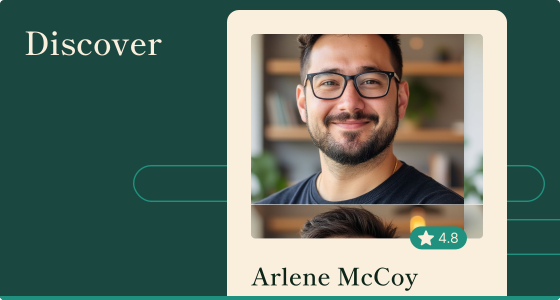
Fill out the quick form or book a discovery call. Share your team's goals, skill gaps, and preferred format – whether it's a focused 2-hour session, a half-day deep dive, or a full-day intensive.
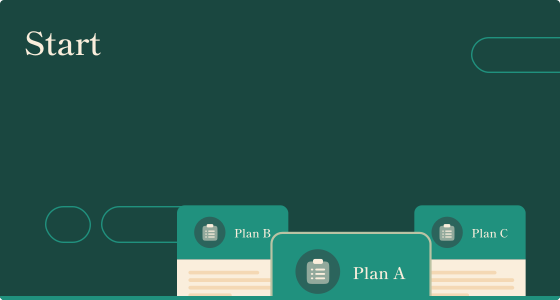
Based on your requirements, we shortlist 2-3 workshop hosts from our vetted network. You'll get their profiles, past workshop topics, and reviews – then pick the one that fits best.
Your host tailors the curriculum to your team's context. They'll align on agenda, exercises, and outcomes ahead of time so there are no surprises – just a session that delivers exactly what you need.
Your team gets a hands-on, interactive session led by a real practitioner. After the workshop, you'll receive materials, action items, and optional follow-up sessions to reinforce what was learned.
Choose a format that fits your team's needs and schedule. Every workshop is fully customizable.
Only about 10% of the value from AI comes from the algorithms themselves, and another 20% from the technology needed to implement them. The remaining 70% comes from rethinking the people component (BCG, 2026). Yet only about 5% of organizations have reaped substantial financial gains from AI.
AI transformation is a workforce problem before it is a technology problem. The tools are already in the building, licensed, provisioned, and used by a handful of enthusiasts while everyone else carries on exactly as before. The companies getting returns behave differently: they plan to upskill more than 50% of their employees on AI, against 20% at the laggards, and 88% of their managers actively model AI use in their own decision-making, against 25% (BCG, 2026). None of that happens by installing something.
AI adoption has outrun the capability to use it, and no amount of additional tooling closes that distance. A workshop is the standard response, which raises a harder question that most provider pages skip entirely. What should happen in the room, who belongs there, and how would you know afterward whether it worked?
AI transformation fails on a learning gap, not a technology gap. Across a study of more than 1,250 firms worldwide, only 5% are achieving AI value at scale, and a full 60% are not achieving material value at all, reporting minimal revenue and cost gains despite substantial investment (BCG, 2025). The failure traces to brittle workflows and misalignment with how people actually work, rather than to the quality of the models.
That number deserves a moment. The default outcome for an enterprise AI initiative is no measurable return, which makes it the base rate any new AI programme has to beat rather than a risk to be managed at the edges.
The models work. What breaks is the distance between a demo and a Tuesday morning, and the pilots that fail are the ones that never made contact with a real workflow.
Generative AI tools get provisioned, a few people experiment, and the organization records adoption because licenses were issued. Six months later nobody can name a single process that runs differently. AI initiatives that never touch how the work actually gets done don't show up in the numbers, however good the proof of concept looked.
Employers know it, too: 63% name skill gaps as the biggest barrier to business transformation over the 2025-2030 period, ahead of every other obstacle (World Economic Forum, Future of Jobs Report 2025). Naming the barrier is not the same as clearing it. Turning that into changed behavior is a sequencing problem, and organizations running a broader program often pair the session with digital transformation coaching to hold the sequence together.
Rolling out AI training is not the same as changing behaviour. Bespoke, persona-based learning journeys deliver employee AI adoption at a level 20 times higher than a broad-based approach (BCG, 2026). The difference is not how much training you buy. It is whether the training is built around the work the person in the room actually does.
That gap has nothing to do with intelligence or effort inside the company. An internal team knows its own workflows better than any outsider will, but it has never watched thirty other teams attempt the same thing and fail in the same three places. An external practitioner has, and that pattern recognition is what shortens the distance between a pilot and a process.
Which means the partner is the variable that moves the outcome. And if the partner is the variable, the individual partner deserves more scrutiny than the logo on the invoice.
An AI transformation workshop is a practitioner-led working session where a team maps AI to the team's own workflows, ranks use cases by effort and impact, and leaves with a roadmap the team can execute. The session starts from the team's real tasks rather than a generic industry curriculum.
A lecture, a tool demo, or a self-paced course delivers information; a workshop delivers a use-case register and a roadmap the team owns. Formats run from two hours to a full day, and the deliverable is a document a manager can be held to in a quarterly review.
A working AI transformation session runs through five stages. The sequence starts with a baseline audit of how the team works today and ends with a prioritized roadmap carrying named owners and dates.
Three of the seven providers ranking on page one publish an agenda for their workshops. The rest publish a duration and a price, and leave the buyer to imagine everything in between. A well-run session follows this sequence:
The session produces four artifacts the team keeps. A use-case register, a prioritized AI roadmap with owners and dates, a set of AI governance guardrails, and a written summary of what was decided.
Every provider in this category promises customization. In practice, the exercises get built from the workflows surfaced in step one, so a regulated finance back office and a creative agency run genuinely different sessions from the same five-stage structure. The audit step makes that possible, and it is the step most agendas skip.
Tools appear in step three and nowhere else. ChatGPT, Microsoft Copilot, Claude, and Google Gemini all show up in practice exercises, but which one earns its place depends entirely on what the team does with it. A tool tour is what a provider delivers when it skipped the audit.
Decision-makers and workflow owners belong in the same room. Leadership-only sessions deliver an AI strategy nobody executes, and all-hands sessions produce enthusiasm nobody governs.
| Attribute | Leadership only | Whole team | Decision-makers plus workflow owners |
|---|---|---|---|
| Typical group size | 5-20 participants | 20-50 participants | 10-30 participants |
| Session output | Strategy and budget direction | Broad tool familiarity | Ranked use-case register and roadmap |
| Decision authority in the room | High | Low | High |
| Workflow ownership in the room | Low | High | High |
| Documented failure mode | Roadmap has no owner who touches the work | Enthusiasm with no mandate or budget | Hardest invite list to assemble |
The mixed cohort is the format that works, and it also takes the most thought before the invites go out. Business leaders who never see the workflow can't rank the use cases honestly, and the people who own the workflow can't authorize a change to it.
Format length and attendee mix are the same decision. A two-hour fundamentals session suits a 5-20 person leadership group setting direction. A full-day bootcamp suits 10-50 people when workflow owners are in the room and the goal is a roadmap somebody has to deliver.
Managers set the ceiling on AI transformation. Leadership hands down the mandate and individual contributors do the work, but the manager controls the one resource that decides everything - protected time to try something new and get it wrong twice.
One school of thought argues AI transformation has to start bottom-up with the individual contributors who feel the friction daily. Another argues it dies in the middle. Both are describing the same failure from opposite ends.
The resolution is unglamorous. Invite the people who can approve a change to how the work gets done, invite the people who actually do the work, and accept that the manager layer is a change management problem before it is a training problem. Teams that keep hitting this wall often bring in a change management mentor alongside the session, and engineering organizations usually find the same problem wearing a different hat, which is where engineering management coaching earns its place.
Start with four tests before you pay - the facilitator's name and track record, the agenda, the deliverables you keep, and the follow-up plan for the weeks after the room empties. Most providers fail three of the four, and the failures are visible before any money changes hands.
Apply these tests to any provider, including this one:
Together the four tests tell you whether a provider is building AI capabilities inside your team or delivering a strategic AI presentation with good slides.
The facilitator is the variable, and most providers will not name them. None of the seven providers ranking on page one for this term publishes the name of the individual who will run your session, their employer, or any selection standard at all. You book a company and get assigned a trainer.
Name, employer, and selection standard are all published on a MentorCruise workshop-host profile before a team books. The AI transformation hosts include Miriam Teng, a GenAI Transformation Strategist at Amazon, alongside Mehdi Bozzo-Rey, Founder of Quantum Advantage Partners, and Jess Jeetley MBE. Each carries a public rating on their profile, and the platform accepts 8% of workshop-host applicants through a three-stage process of application review, portfolio assessment, and a trial session.
If tailoring the session to the room is what separates a 20x adoption result from a broad-based one, then the identity of the person doing the tailoring is the decision.
Every provider says the content is customized; almost none customize the expert. A network of 6,700+ vetted mentors and workshop hosts means the host gets selected after the team states its need, so a team in regulated financial services and a team in consumer apps get different people, not the same person with different slides. Buyers who want the same credential transparency for one-to-one support can browse vetted AI mentor profiles on the same basis.
Logistics is the fourth test and the easiest to check. MentorCruise matches a host within 48 hours and runs a four-stage process through customization, scheduling, delivery, and structured follow-up. Ask any provider what their equivalent looks like, and note how many of them have one.
A single session will not transform an organization, and any provider suggesting otherwise is selling. If managers don't protect time for people to apply what they learned, teams revert to their old workflows inside a month. The session is the start of the work, rather than the work itself.
That limitation should change what you shop for. A provider that hands over a roadmap and disappears has sold an afternoon, and an 8% acceptance rate means nothing if nobody follows up in week three.
A team AI transformation workshop costs from $250 for a two-hour fundamentals session to $900 for a full-day bootcamp, against a category where a typical half day runs $3,000 to $12,000.
| Format | Duration | Min team | Max team | MentorCruise starting price | Category benchmark |
|---|---|---|---|---|---|
| Fundamentals workshop | 2 hours | 5 | 20 | $250 | No published benchmark |
| Deep Dive | 4 hours | 10 | 30 | $500 | $3,000 to $12,000 |
| Bootcamp | 6-8 hours | 10 | 50 | $900 | No published benchmark |
Independent 2026 cost guides put a typical half-day team AI workshop at $3,000 to $12,000 for 10 to 25 participants. Four of the seven providers ranking for this term publish no price at all, so no market average exists to quote. What exists is a wide range and a lot of quote forms.
Of the two providers that do publish, one lists a flat rate of $75,000 plus travel, regardless of whether 10 people attend or 100. Another charges $495 per student, which for a 20-person team lands close to $10,000. Both figures are competitor claims rather than market data, and neither tells you what happens inside the session.
Because the price scales with format and group size rather than sitting at one flat rate, a six-person team isn't subsidizing a sixty-person one. The practical effect is that AI training at the entry tier can be approved by a team lead without a procurement cycle, which is usually the difference between a workshop that happens this quarter and one that gets deferred to next.
To prove the workshop paid for itself, track four numbers within 90 days - the change in a baseline AI-capability assessment, weekly active use of AI tools inside named workflows, hours reclaimed on the tasks logged during the session, and how many use cases reached a live pilot.
Run the baseline assessment before the session and again at day 90. The delta is the cleanest number available, and it measures AI capabilities across the team rather than enthusiasm on the day.
Hours reclaimed is the number finance will actually engage with, because it converts directly to money. Its baseline gets measured in the room during the audit step, which is why an agenda that opens with an audit matters well beyond the agenda itself.
Pipeline movement is the fourth number. Count how many use cases moved from the register into a live pilot, and how many of those reached production.
Weekly active use inside the named workflows from the use-case register is the only adoption metric worth reporting. A license is a purchase. AI adoption gets measured in workflows while seats get measured in invoices, and board decks routinely confuse the two.
This is where a 60% no-material-value rate stops being an industry statistic and becomes a personal one. The L\&D lead who championed the session gets asked in Q3 what happened to the AI initiative, and "we rolled out licenses" is not an answer that survives the meeting. Productivity has to show up in a task somebody named out loud.
Against a base rate where most organizations get nothing material back, satisfaction scores are the wrong thing to price. The real exposure is a session that goes well and changes nothing afterward. MentorCruise publishes a 97% satisfaction rate across all services and carries a satisfaction guarantee, and no other provider in this category publishes either one.
A retention argument sits alongside the productivity one. Productivity growth is 40% higher at the companies most exposed to AI than at the least, and the skills required for the most AI-exposed jobs are changing more than twice as fast as for the least (PwC, 2026 Global AI Jobs Barometer). Both are worth raising internally when the training budget gets questioned. For individuals who want to keep going after the session ends, AI coaching for professionals picks up where a team workshop stops.
Ninety days gives you leading indicators, not a return. A full return on an AI transformation program takes longer than a quarter, and any provider promising a hard ROI figure by the end of one is guessing.
Say that to finance at the start. The alternative is a Q3 conversation where the goalposts appear to have moved, which is a worse position than an honest 90-day forecast that lands.
Share what your team needs and get matched with a vetted AI transformation host within 48 hours. The form asks for team size, topic, and where the team is starting from, which is exactly what the host uses to build the audit step before anyone walks into the room.
If you're not sure how deep to go, start with the two-hour fundamentals session. It is the cheapest way to find out whether the roadmap is worth building.
Yes, and some teams should. The evidence to weigh is that unsupported AI use can actively backfire: in a pre-registered trial of 758 consultants, those using AI on tasks outside its capability were 19 percentage points less likely to reach a correct answer than those working without it (Harvard/BCG, 2023). A self-run session works when someone internal has both the facilitation skill and the standing to challenge senior people in the room. Most teams have one or the other, and the half that goes missing is usually the standing.
AI tool training teaches people to use a tool, while an AI transformation workshop decides which of the team's workflows should change and in what order. One produces skills, the other produces a ranked roadmap with owners. Teams that buy tool training first often end up buying the transformation session afterward, once it becomes clear that everyone can prompt and nothing has changed.
Three groups need to be in the room - the people with authority to approve a change in how the team works, the owners of the workflows under discussion, and whoever has to defend the roadmap in a budget meeting. A room missing any of the three produces a plan nobody executes.
Three variables set the cost - duration, group size, and the depth of pre-session work. A two-hour session with 10 participants sits at the bottom of the range, and a full-day bootcamp with 50 people sits at the top. Pricing models matter too: some providers charge one flat rate regardless of group size, and others charge per student, which penalizes larger teams.
Lead with hours reclaimed on named workflows, which converts directly to money and has a baseline measured in the room during the audit step, so the number holds up under questioning. Support it with assessment score movement, weekly active use inside those workflows, and how many use cases reached a live pilot. Be clear that a 90-day figure is a leading indicator, not a final return.
Our hosts are experienced professionals from leading companies who bring real-world expertise to every session. Here's a sample of who's available.
See all our corporate training programs – AI tools, leadership, sales, marketing and more.
Reviews
Andrei has been an amazing mentor, helping me navigate the challenges of managing an engineering team, modernising our legacy SaaS platform and moving us into the era of AI software development.
Patrick
Director, Strategic Projects

Alessandro taught me to use competency matrices as objective decision-making tools, challenge assumptions from my own teams, and translate technical language into management language for executive conversations.
Roman
Engineering Manager

Matthew helped me think through several tricky leadership moments – particularly around how to navigate executive relationships, clarify influence, and prepare for a high-stakes offsite. I left each session clearer, calmer, and more confident in how I was showing up at the executive level.
Kimmy
Director of Team Enablement
Ready when you are
Tell us your goals and team size. We'll match you with 2-3 vetted hosts within 48 hours.