Bring in a vetted expert to train your team with a hands-on, interactive workshop. Flexible formats, proven results, and zero hassle – we handle the matching so you can focus on learning.
Tell us about your team and we'll reach out within 24 hours.
Our team will reach out to within 24 hours.
Our workshop hosts work at



























Skip the one-size-fits-all sessions. Get expert instruction that's relevant, hands-on, and made for your team.
satisfaction rate
faster goal achievement
available workshop hosts

"Andrei has been an amazing mentor, helping me navigate the challenges of managing an engineering team, modernising our legacy SaaS platform and moving us into the era of AI software development."

We're not a generic training marketplace. Every workshop host on MentorCruise is a vetted professional with real-world experience at top companies.

Every host goes through a rigorous vetting process. Only 8% of applicants are accepted, so you're always working with the best.

Workshops start from $250. No hidden fees, no long-term contracts. Pay per session or negotiate a package for your team.

Tell us your goals and team size – we'll match you with the right host, coordinate scheduling, and make sure everything runs smoothly.

No cookie-cutter content. Hosts tailor every session to your team's industry, skill level, and specific challenges.
From first inquiry to post-workshop follow-up, we handle the logistics so your team can focus on learning.
Fill out the quick form or book a discovery call. Share your team's goals, skill gaps, and preferred format – whether it's a focused 2-hour session, a half-day deep dive, or a full-day intensive.
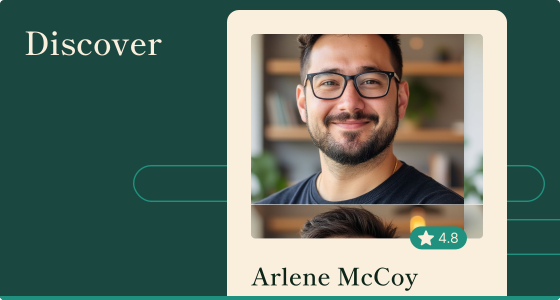
Based on your requirements, we shortlist 2-3 workshop hosts from our vetted network. You'll get their profiles, past workshop topics, and reviews – then pick the one that fits best.

Your host tailors the curriculum to your team's context. They'll align on agenda, exercises, and outcomes ahead of time so there are no surprises – just a session that delivers exactly what you need.

Your team gets a hands-on, interactive session led by a real practitioner. After the workshop, you'll receive materials, action items, and optional follow-up sessions to reinforce what was learned.
Choose a format that fits your team's needs and schedule. Every workshop is fully customizable.
Most AI strategy workshops deliver a prioritized roadmap and a board deck, then stop one step short of every decision an engineering leader actually has to make. Ninety percent of software development professionals now use AI at work, up 14 points in a single year (DORA's 2025 AI report). The question stopped being whether.
Nearly every AI strategy workshop on the first page of Google ends the same way, with a prioritized list of use cases and a deck for the board. That session will help a leadership team rank forty ideas by impact and effort, and it will not tell a single engineer whether they're allowed to paste customer data into a chatbot. The roadmap is a fine artifact. It settles nothing that has to be settled by Monday.
Four decisions sit underneath every real AI strategy in an engineering org. Who signs the AI usage policy. What that policy actually approves. Who is answerable when AI-assisted code breaks production, and what to do about the AI coding tools half the team already installed without asking. The rest of this page answers those four.
No single role owns the AI usage policy well. The workable answer is co-ownership, where engineering owns the standard, security owns data and access, and Legal advises on exposure. One executive stays accountable for the whole thing, and every approved tool has a named owner behind it.
| Decision | CTO or VP Engineering | CISO or security lead | Legal |
|---|---|---|---|
| Which tools and tiers are approved | Accountable. Owns the approved list and the standard behind it. | Consulted. Vets each tier's data terms, SSO requirement, and access model. | Informed. Flags licensing terms that block an approval. |
| Which data classes may touch which tools | Consulted. Maps the rule onto how the team actually works. | Accountable. Owns the data classification and the boundaries. | Consulted. Advises on regulated and contractual data. |
| IP and licensing exposure | Informed. Applies the resulting rule at code review. | Informed. | Accountable. Owns the position on generated code and vendor terms. |
| Incident response and the reviewer of record | Accountable. Names the reviewer and owns the postmortem. | Consulted. Runs the security side of the incident. | Informed. Consulted when disclosure is in play. |
| Exceptions and time-boxed approvals | Accountable. Grants exceptions and expires them. | Consulted. Sets the conditions an exception has to meet. | Informed. |
| Policy review cadence | Accountable. Owns the review date and the early-review trigger. | Consulted. Brings new tools and new threats to the review. | Consulted. Brings regulatory and contractual changes. |
Co-ownership without a single accountable executive produces a committee, and a committee produces a draft that never ships. Pick the one person who will answer for the policy in front of the board, then let the other two own their columns. That is a leadership problem before it is a tooling one, which is why teams often start with leadership workshops for engineering managers rather than a tools session.
The most common way an AI usage policy dies is being handed to Legal as its only owner. The result is consistent across practitioner accounts of engineering policy work (metacto, 2026): a document that is legally tidy and operationally useless, because it has nothing to say about agentic tools, repository access, or what a code reviewer is supposed to check. Legal cannot write a rule for a system Legal has never watched run.
A workshop host who has already had that argument with their own CISO shortens it considerably. That is the practical difference between a facilitator and a practitioner, and it is worth more than any framework.
Sequencing matters here more than most leadership teams expect. A clear and communicated AI stance is the first of seven capabilities that amplify AI's impact on software delivery (DORA AI Capabilities Model, 2025). First. Not seventh, and not something an org gets to once the tooling budget is spent.
Exceptions deserve one line of their own. Every exception needs a route, an approver, and a time box, or the exceptions quietly become the policy.
An AI usage policy makes ten decisions for an engineering team, and the difference between a usable policy and a decorative one is whether each decision is specific enough to act on without asking. The structure below follows an engineering AI usage policy template from metacto (2026), reframed around the decision each section has to reach.
| Decision the section has to make | What "specific enough to act on" looks like |
|---|---|
| Purpose and scope | Names who the policy binds, including contractors and agents acting for the org, and which systems and repos fall inside it. |
| Approved tools and tiers | Lists the product, the tier, and the account type. "Copilot Business on the company tenant behind SSO" is a rule. "Copilot" is a shrug. |
| Prohibited data classes | Maps public, internal, confidential, and restricted data to the tools permitted to touch each class. Names secrets, credentials, and customer data explicitly. |
| Agentic tool rules | A separate approval gate for tools that execute commands, modify files, or reach repos. Names the permissions granted and the branches they may touch. |
| Human review requirements | States that AI-assisted code gets a human reviewer, and names what that reviewer checks beyond whether the tests pass. |
| High-impact code rules | Defines what counts as high impact, such as auth, payments, migrations, and anything touching customer data, and which extra controls apply there. |
| IP and licensing terms | States the org's position on generated code, attribution, and any tool that trains on submitted content. |
| Logging and monitoring | Names what is logged, where the logs live, and who can query them, so "what did the tool touch" is a query rather than a forensic exercise. |
| Exceptions path | Names the approver, the response time in days rather than quarters, and the expiry date on every exception granted. |
| Review cadence | Names a date, an owner, and the triggers that force an early review, such as a new tool tier, an incident, or a change in vendor terms. |
Two of those ten rows carry most of the weight, and both get skipped routinely. Some orgs call the whole document an acceptable-use policy, and the label changes nothing about the ten decisions underneath it.
"Copilot is approved" gives an engineer nothing to act on. The policy has to name the product, the tier, and the account type, because the consumer and enterprise tiers of the same tool routinely differ on whether prompts are retained and what a vendor may do with submitted content. Naming the product without naming the tier approves everything and nothing.
Agentic tools need their own row for the same reason. A tool that can execute commands, modify files, and reach the repository does not belong in the same approval bucket as autocomplete, because the blast radius is different by an order of magnitude. Teams standardizing on one of these usually pair the policy decision with a hands-on session, such as a Claude Code workshop for teams, so the rules and the tool land in the same week.
Here's the honest part. A good free AI usage policy template is a ten-minute download, and it will hand over every one of the ten headings above. What no template can do is make the ten decisions inside them, because it has never met a specific stack, a specific data classification, or a specific incident history.
The headings are free. The decisions are the work.
The company remains responsible, and inside the company the answer has to be a named human. For every AI-assisted change that reaches a customer, one person should be traceable as the reviewer of record in under a minute. Not during the postmortem.
Decide it before the incident, in the policy, on an ordinary Tuesday. "The tool wrote it" has never been an answer, and it gets less useful as the volume of AI-assisted code climbs. At 90% AI adoption among software development professionals (DORA, 2025), the number of AI-assisted changes reaching production only goes one way.
Where legal responsibility ultimately sits is a question for a company's own counsel. What a policy can settle in advance is who inside the company was answerable, what they checked, and what evidence exists that they checked it. Those three things are an operational decision, and an engineering leader can make them without a lawyer in the room.
Which leads to the fence around this entire page. A workshop does not produce a legally binding policy, and it does not replace Legal. It decides what the policy has to say, and Legal turns those decisions into a document and signs it.
The individual-practitioner version of this problem is a review discipline rather than a governance one, and engineers benefit from reading the validation playbook for AI code alongside whatever the policy ends up saying. A policy that names a reviewer and a reviewer who knows what to look for are two different controls. An org needs both.
Shadow AI is the use of AI tools inside a company without approval or oversight (IBM's definition of shadow AI), and the fix is almost never prohibition, because the motivation is almost never evasion. People reach for an unapproved tool because it makes the work faster, and the approved path takes a quarter.
The count matters less than what it tells a leader. If eleven engineers are using a tool nobody approved, the approval path is slower than the work. That is a process finding, not a discipline problem, and treating it as a discipline problem drives the tools underground where nobody can see them at all.
The response has three parts, and none of them is a witch hunt.
Find out which AI tools are actually in use, by asking rather than auditing. Make the approved path faster than the unapproved one, which usually means approving something good within days. And give people a real exceptions route with a named approver, so the answer to "can I try this?" is a decision rather than silence.
The data-exposure question underneath shadow AI is a genuine security concern, and it belongs with the people who own it. Where the risk concentrates in credentials, secrets, or customer data reaching a tool with unclear retention terms, cybersecurity workshops for teams do more good than another policy paragraph.
AI enablement, AI training, and AI governance are three different jobs, and buying one does not deliver the other two. AI enablement is the work of making the approved path the fastest path. AI training teaches the skill.
AI governance sets the standard and the oversight that keeps both honest. Most orgs buy the training, watch the skill land, and then wonder why AI adoption stalls anyway. It stalls because the approved tool is slower to get than the unapproved one, and no amount of training fixes a procurement problem.
Roll AI out in four stages, and put the policy decision at the front rather than the end. The clearest sequencing answer available runs experiment, adopt, measure, then optimize for cost, a staged frame published by Swarmia (2026). MentorCruise's contribution is where the policy and the workshop sit inside that sequence.
The policy decision belongs at the front of that sequence. It's what makes stage two survivable, because the moment a pilot becomes a rollout, forty engineers inherit rules that three people invented on a Friday.
That mapping is also how the workshop formats earn their place. A two-hour Fundamentals session fits a pilot group drafting the first AI usage policy and deciding who owns it. A Deep Dive or Bootcamp fits the point where the policy widens to the whole engineering org, and MentorCruise matches a host within 48 hours either way.
Broader AI workshops for teams cover the enablement layer around both.
One thing this page will not do is quote an ROI number. The strongest engineering source in this space refuses to give one, on the record, on the grounds that isolating an AI productivity gain is methodologically impossible and potentially misleading. A provider who hands over a clean percentage before meeting the team is selling something.
Good AI strategy workshop providers give straight answers to five questions, and weak ones deflect all five. Every provider in this market claims the workshop is customized. Only some can name the mechanism.
Two of those five do most of the work. Ask any provider for their acceptance rate, and most cannot give one, which tells a buyer that the screening is a conversation rather than a standard. MentorCruise accepts 8% of workshop-host applicants, and the 97% satisfaction rate across MentorCruise services is the same claim seen from the other end.
One is the bar at the door. The other is what happens in the room once that bar is set.
Price answers the last question, and the market makes it easy. Workshops in this category are typically priced as consulting engagements, and several are given away free as lead magnets for a much larger delivery contract. Neither shape suits an engineering leader with a real but bounded budget and a decision to make this month.
Three published formats, starting at $250 for two hours, occupy the middle that the rest of the market skipped.
An AI usage policy written by a consultancy is a document. The same policy written with a practitioner host, someone who has owned the approved-tools list and sat in the postmortem after AI-assisted code broke production, is a control. The difference shows up in the specifics.
A practitioner knows which of the ten decisions their own org got wrong the first time, and says so out loud. That is also the only version of customization worth paying for. It has a mechanism behind it: 64+ AI Strategy workshop hosts with profiles readable before booking, so a buyer can pick the one who has shipped in their kind of org, at their scale, under their constraints.
Read the profiles first. Then ask the host the second question on the list above, and listen to how fast the answer comes.
An AI strategy workshop is a guided session where a leadership team decides how an organization will use AI. Most stop at a prioritized use-case list and a deck for the board. An engineering-leadership version goes further and settles the decisions underneath. Approved tools and tiers, permitted data classes, the code-review standard for AI-assisted code, and the reviewer of record.
Four roles need to be in the room: the executive accountable for the AI usage policy, the security lead owning data classification and access, the staff engineer owning the rules and the code-review standard, and whoever administers the tool accounts. The tool administrator matters because the approved tiers and the access controls belong to them. A short session suits a small decision group, and a full day suits a wider rollout.
No. A certification credentials a person, and programs exist for anyone needing an individual formally credentialed in AI governance. MentorCruise does not offer one. A workshop produces a decision, and that is what a team needs when the goal is an AI usage policy, a named owner, and a rollout sequence by the end of the month.
No, not on its own. A workshop produces the decisions the policy has to encode: approved tools and tiers, permitted data classes, the review standard for AI-assisted code, and the named owner accountable when it breaks. Legal turns those decisions into a document and signs it. A provider claiming to replace counsel is selling something it cannot deliver.
Ask, and then check the profile. Only 8% of workshop-host applicants are accepted at MentorCruise, and all 64+ AI Strategy host profiles are readable before a team commits. Ask the host directly whether they have owned an approved-tools list and sat in an incident postmortem inside their own engineering org. The specificity of the answer is the signal.
Our hosts are experienced professionals from leading companies who bring real-world expertise to every session. Here's a sample of who's available.

Principal UX, Service Design & AI Strategy at Aragon Consulting

Senior UX Design Manager at Apple | ex-Google, ex-Microsoft

Senior Staff Software Engineer at Meta

Executive Director, Data & AI at Estée Lauder

Creator, Consultant & Agency Founder at Vera House Studios

Head Of Commercial Operations, AU at Yahoo

Director at Amazon

Founder, Investor & AI-native Operator at Gringo (acq. Corpay), Eskolare
See all our corporate training programs – AI tools, leadership, sales, marketing and more.
Reviews
Andrei has been an amazing mentor, helping me navigate the challenges of managing an engineering team, modernising our legacy SaaS platform and moving us into the era of AI software development.
Patrick
Director, Strategic Projects

Alessandro taught me to use competency matrices as objective decision-making tools, challenge assumptions from my own teams, and translate technical language into management language for executive conversations.
Roman
Engineering Manager

Matthew helped me think through several tricky leadership moments – particularly around how to navigate executive relationships, clarify influence, and prepare for a high-stakes offsite. I left each session clearer, calmer, and more confident in how I was showing up at the executive level.
Kimmy
Director of Team Enablement
Ready when you are
Tell us your goals and team size. We'll match you with 2-3 vetted hosts within 48 hours.



