Bring in a vetted expert to train your team with a hands-on, interactive workshop. Flexible formats, proven results, and zero hassle – we handle the matching so you can focus on learning.
Tell us about your team and we'll reach out within 24 hours.
Our team will reach out to within 24 hours.
Our workshop hosts work at



























Skip the one-size-fits-all sessions. Get expert instruction that's relevant, hands-on, and made for your team.
satisfaction rate
faster goal achievement
available workshop hosts

"Andrei has been an amazing mentor, helping me navigate the challenges of managing an engineering team, modernising our legacy SaaS platform and moving us into the era of AI software development."

We're not a generic training marketplace. Every workshop host on MentorCruise is a vetted professional with real-world experience at top companies.

Every host goes through a rigorous vetting process. Only 8% of applicants are accepted, so you're always working with the best.

Workshops start from $250. No hidden fees, no long-term contracts. Pay per session or negotiate a package for your team.

Tell us your goals and team size – we'll match you with the right host, coordinate scheduling, and make sure everything runs smoothly.

No cookie-cutter content. Hosts tailor every session to your team's industry, skill level, and specific challenges.
From first inquiry to post-workshop follow-up, we handle the logistics so your team can focus on learning.
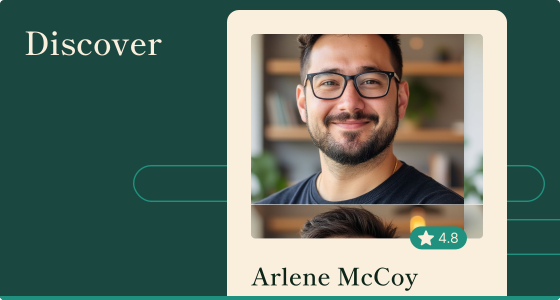
Fill out the quick form or book a discovery call. Share your team's goals, skill gaps, and preferred format – whether it's a focused 2-hour session, a half-day deep dive, or a full-day intensive.
Based on your requirements, we shortlist 2-3 workshop hosts from our vetted network. You'll get their profiles, past workshop topics, and reviews – then pick the one that fits best.

Your host tailors the curriculum to your team's context. They'll align on agenda, exercises, and outcomes ahead of time so there are no surprises – just a session that delivers exactly what you need.

Your team gets a hands-on, interactive session led by a real practitioner. After the workshop, you'll receive materials, action items, and optional follow-up sessions to reinforce what was learned.
Choose a format that fits your team's needs and schedule. Every workshop is fully customizable.
Engineering teams buying Claude Code training are paying for judgment about their own codebase, because the features are already free. Anthropic gives the official course away, Coursera hosts a Vanderbilt one, and Frontend Masters runs a third taught by an engineer from Anthropic's own Claude Code team. What none of them can teach is what your team should delegate to the agent, what it must review line by line, and what belongs in your CLAUDE.md.
Organizations with a mature, organization-wide AI-literacy program report significant positive AI ROI 42% of the time, against 21% overall (DataCamp with YouGov, 2026, surveying 500+ US and UK enterprise leaders). That finding is about workforce capability, not about any particular training format. It explains why the budget line exists at all, and it says nothing about whether a two-hour workshop is the right way to spend it.
So the rest of this page arbitrates instead of pitching. It covers what a Claude Code workshop teaches, when a free course beats paying anyone, when internal training beats buying anything, and the five questions worth asking any provider. The quieter reason engineering leaders start looking is a team already shipping AI-written code that nobody has fully read, which is where what a mentor teaches that AI can't starts to bite.
A Claude Code workshop covers seven capabilities. Those are the CLAUDE.md, context management, Plan Mode and permissions, hooks, sub-agents, MCP (Model Context Protocol), and reviewing AI-written diffs. Together those seven are the whole surface area of the tool as an engineering team meets it in practice.
Every one of them can be learned from a video, and that is precisely the point of writing the list down. It gives you something to check a provider's curriculum against before you pay for it. Here's what each one means, and what a team should walk out able to do:
Those seven are starting points, not a syllabus. The pre-workshop planning call is where a host cuts them down to what your team actually needs, which for a team already living in Plan Mode might mean skipping the first three outright and spending the whole session on review discipline instead. Teams running more than one agent often book expert-led Cursor workshops separately, rather than trying to cover two tools properly in one afternoon.
None of this is Claude-Code-specific dogma, either. AI coding tools raise the same three questions about delegation, review, and standards, and the skills transfer more than the vendors like to admit. That's why some teams have one senior engineer find an agentic coding mentor and bring the pattern back before committing budget for everyone else.
Free courses teach the tool. Internal training teaches your codebase. A Claude Code workshop does both, and the right choice depends on one thing: whether anyone in-house already knows Claude Code well enough to hold a room of engineers for four hours.
Enterprise plans for Claude Code include dedicated support, custom deployment guidance, onboarding assistance, and priority response times (Anthropic's Claude Code for Enterprise, 2026). Instructor-led training is not on that list. The tool vendor supplies the tool, the docs, and a free self-paced course, and live team enablement is left to somebody else, which is the honest structural reason a third party exists in this market at all.
| Free self-paced course | Internal training | External workshop | Multi-week team program | |
|---|---|---|---|---|
| Typical cost | $0 | A senior engineer's time, plus the work they aren't doing that week | From $250 (2 hours), $500 (half-day), $900 (full-day) | Quoted per team. See the AI transformation program for teams |
| Who teaches it | Anthropic, Vanderbilt via Coursera, or Frontend Masters | Whoever on your team picked it up first | A screened external workshop host | A matched host across a fixed program |
| Tailored to your codebase | No. Fixed curriculum, demo repos | Yes, by definition | Yes, scoped on a pre-workshop planning call | Yes, and revisited as the org changes |
| Live feedback on your team's work | None. Video, quiz, no reviewer | Yes, limited by one person's bandwidth | Yes, on your repo, in the session | Yes, across weeks |
| Certificate issued | Yes. Certificate of completion | No | No. MentorCruise issues no certificate | No |
| Time to first session | Tonight | Whenever your senior engineer has a free week | Hosts matched within 48 hours | The next program start date |
| Where the knowledge ends up | In one engineer's head | With the person who taught it, and in whatever doc gets written afterward | In a CLAUDE.md the team wrote together | Across the engineering org, over months |
Two rows in that table are worth saying out loud. MentorCruise loses the certificate row, because some providers issue a verifiable credential and MentorCruise issues none. And most team-training providers won't quote a price until you've sat through a discovery call, which is the only reason publishing $250, $500, and $900 counts as a differentiator rather than as basic manners.
A free Claude Code course is the right call when your team needs the feature tour and nothing else. Anthropic Academy's Claude Code in Action is free, runs about an hour across roughly 15 lectures, and issues a certificate of completion. Coursera's Vanderbilt course is free to enroll, six modules, around five hours.
Frontend Masters gives its Claude Code course away too, and it's taught by Lydia Hallie, who works on the Claude Code team at Anthropic. That is a stronger instructor credential than most paid training in this category can claim. Being coy about any of it would be pointless, because an engineering leader who has spent twenty minutes searching has already found all three.
So if nobody on your team has opened Claude Code yet, start there. Send the links around, give the developers a Friday afternoon, and come back when the questions stop being "what does Plan Mode do" and start being "what are we actually allowed to let it merge".
Internal training is the better spend when a senior engineer already uses Claude Code well and can teach it. Your senior engineer knows the codebase, the conventions, and the architectural arguments still open on the team. No external host arrives with any of it, and the ones claiming otherwise are selling.
The cost is that engineer's time, and the honest question is whether a week of their calendar is cheaper than $900. Sometimes it obviously is. Sometimes the answer is a polite silence around the table.
The failure mode is predictable, though. Your internal expert is also your most loaded engineer, the session slips twice, and the CLAUDE.md never gets written. If that's the shape of your last three internal initiatives, an external session is partly buying you expertise and mostly buying you a date in the calendar that survives contact with a sprint.
Three decisions determine whether Claude Code makes an engineering team faster or simply noisier, and all three depend on the codebase in front of you. No course can make them, because no course has seen your repo, your test coverage, or the module everyone avoids. That is the whole argument for paying a person.
That argument rests on one mechanism. The mechanism is the pre-workshop planning call, and every provider claims customization while very few name the thing that produces it.
The call is where a host learns what your team argues about before anyone opens a laptop. What engineering leaders dread is the host who arrives with a generic deck and opens with "so, what did you want to cover today?"
Delegation boundaries are a team agreement because Plan Mode and permissions can enforce a boundary but cannot decide where the boundary belongs. Whether Claude Code may refactor a payment module unsupervised, or may only propose the diff and wait, is a judgment about blast radius, test coverage, and how far your team trusts its own CI.
Six engineers will answer that six ways, and most teams discover the disagreement during a code review at 6pm on a Thursday. A workshop is one of the few settings where the answer gets settled once, together, out loud, with someone in the room who has watched other teams get it wrong.
A CLAUDE.md is only useful if the whole team agrees with it, because a standards file that half the team ignores is worse than no file at all. Writing one is easy. It encodes things a generic course has never seen: your test strategy, your service boundaries, the two directories where the old conventions still apply.
Getting six engineers to agree on what goes in it is the actual work, and it is the part that goes faster with a neutral party running the room. Individual engineers who need to go deeper afterward can work with a Claude Code mentor one-to-one, which is a different purchase from a team workshop and usually a much smaller one.
Reviewing AI-written diffs is a habit, and habits need live feedback, because reading a 400-line diff someone else wrote is a different skill from writing 400 lines. That skill degrades quietly when the volume goes up. A video course cannot watch an engineer review and then point out the gap.
A workshop host can, and that is the whole of the difference. Teams that never build the habit ship the velocity gain and the debt in the same sprint. There's a written version of the discipline in this playbook for validating AI-written code, and it makes a decent pre-read to send around before any session.
To evaluate a Claude Code training provider, ask five questions and watch how each one gets answered. Some produce a straight answer. Some produce a calendar invite.
The five are deliberately boring, and boring questions are harder to talk around.
Notice which of the five a provider will answer in public. Answering all five without a sales call proves nothing about teaching quality on its own, but it does prove nothing is being held back for a negotiation later. That is a cheap signal to check before spending a Tuesday on a discovery call, and it filters the market faster than any comparison grid.
When the questions your engineers are asking have moved past "what does Plan Mode do", request a Claude Code workshop with a single form. MentorCruise handpicks 2-3 workshop hosts and comes back within 48 hours, and the format gets chosen after the planning call rather than before it. Bring the repo you actually argue about.
Yes. Anthropic Academy's Claude Code in Action is free, runs about an hour across roughly 15 lectures, and issues a certificate of completion. It's genuinely good, and it's the fastest route from zero to competent with the tool.
The decisions your team has to make about how it uses Claude Code are a separate question, and a slower one, and no self-paced course is built to answer them.
It depends on who can teach. A course teaches the tool, costs nothing, and starts tonight. Internal training teaches your codebase, and works only when someone in-house already knows Claude Code well enough to hold a room of engineers.
A workshop is what a team buys when nobody in-house does, or when the one person who does has no free week in their calendar this quarter.
Yes. Teams typically bring a sanitized repo or a live branch, and the host builds the exercises around it during the pre-workshop planning call rather than on a demo project. The CLAUDE.md the team writes during the session is one it keeps and commits, along with whatever hooks and permissions get configured.
Scope and confidentiality are worth settling on that planning call, before anyone shares a screen.
Every workshop host is hand-screened, and only 8% of applicants are accepted. The figure matters mainly because of what it's compared against: no other provider in this category publishes an acceptance rate at all.
"Vetted experts" is a claim almost every training provider makes, and almost none of them attach a number to it. Ask for the number, and treat a shrug as an answer.
No. MentorCruise does not issue a certificate or certification for workshops. Some providers do, and a few issue a verifiable credential, so if a credential is the actual goal, that's a legitimate reason to pick one of them instead.
A workshop is built around what a team can do on Monday morning, not around what goes on a LinkedIn profile. Those are different purchases, and they're worth not confusing.
Our hosts are experienced professionals from leading companies who bring real-world expertise to every session. Here's a sample of who's available.

Senior Product Manager, AI at Uber

CEO at Engineering Peak Impact

Senior Data Engineer at Amazon

Head of WJY Studios

Principal Engineer at AMD

B2B Marketing & Startup Leader | 3x exits at Cold.inc

Senior Software Engineer at Netflix

Tech Lead (AI & Data Science) at Learning Collider
See all our corporate training programs – AI tools, leadership, sales, marketing and more.
Reviews
Andrei has been an amazing mentor, helping me navigate the challenges of managing an engineering team, modernising our legacy SaaS platform and moving us into the era of AI software development.
Patrick
Director, Strategic Projects

Alessandro taught me to use competency matrices as objective decision-making tools, challenge assumptions from my own teams, and translate technical language into management language for executive conversations.
Roman
Engineering Manager

Matthew helped me think through several tricky leadership moments – particularly around how to navigate executive relationships, clarify influence, and prepare for a high-stakes offsite. I left each session clearer, calmer, and more confident in how I was showing up at the executive level.
Kimmy
Director of Team Enablement
Ready when you are
Tell us your goals and team size. We'll match you with 2-3 vetted hosts within 48 hours.



