Bring in a vetted expert to train your team with a hands-on, interactive workshop. Flexible formats, proven results, and zero hassle – we handle the matching so you can focus on learning.
Tell us about your team and we'll reach out within 24 hours.
Our team will reach out to within 24 hours.
Our workshop hosts work at


























Skip the one-size-fits-all sessions. Get expert instruction that's relevant, hands-on, and made for your team.
satisfaction rate
faster goal achievement
available workshop hosts

"Matthew helped me think through several tricky leadership moments – particularly around how to navigate executive relationships, clarify influence, and prepare for a high-stakes offsite. I left each session clearer, calmer, and more confident in how I was showing up at the executive level."

We're not a generic training marketplace. Every workshop host on MentorCruise is a vetted professional with real-world experience at top companies.

Every host goes through a rigorous vetting process. Only 8% of applicants are accepted, so you're always working with the best.

Workshops start from $250. No hidden fees, no long-term contracts. Pay per session or negotiate a package for your team.

Tell us your goals and team size – we'll match you with the right host, coordinate scheduling, and make sure everything runs smoothly.

No cookie-cutter content. Hosts tailor every session to your team's industry, skill level, and specific challenges.
From first inquiry to post-workshop follow-up, we handle the logistics so your team can focus on learning.
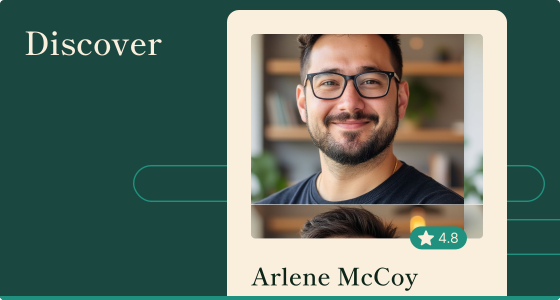
Fill out the quick form or book a discovery call. Share your team's goals, skill gaps, and preferred format – whether it's a focused 2-hour session, a half-day deep dive, or a full-day intensive.
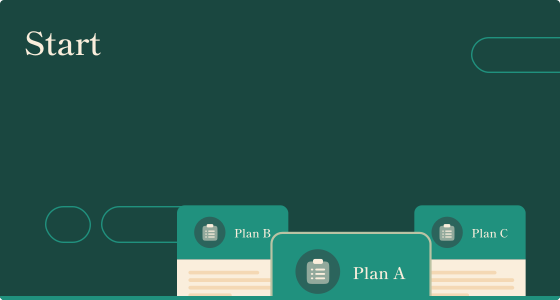
Based on your requirements, we shortlist 2-3 workshop hosts from our vetted network. You'll get their profiles, past workshop topics, and reviews – then pick the one that fits best.

Your host tailors the curriculum to your team's context. They'll align on agenda, exercises, and outcomes ahead of time so there are no surprises – just a session that delivers exactly what you need.

Your team gets a hands-on, interactive session led by a real practitioner. After the workshop, you'll receive materials, action items, and optional follow-up sessions to reinforce what was learned.
Choose a format that fits your team's needs and schedule. Every workshop is fully customizable.
The same AI tools make one team faster and another one fragile. Higher AI adoption is associated with an increase in both software delivery throughput and software delivery instability, according to DORA's research on AI at Google. The tooling magnifies what a team already is, which makes management practice the variable a workshop can actually move.
Management training built for 2019 assumes work arrives at human speed, and that the constraint on a team is how much the team can produce. That constraint has moved. A draft now lands in seconds, and the bottleneck sits downstream in review, in allocation, and in what a team agrees "done" means. Left alone, teams drift apart by default on exactly those questions, with each manager quietly settling them a different way.
None of that is a tooling problem, so no license purchase fixes it. Each one is a management decision that used to have an obvious answer and now doesn't. The people best placed to teach the new answers are the ones who have already managed a team through the change, rather than trainers who have read about it. A workshop is one of the few formats where a team can settle those decisions together, in one room, in an afternoon.
The same tools make one team faster and another one fragile because AI changes how fast work arrives without changing how work gets allocated, reviewed, or measured. Only 5% of companies are achieving AI value at scale. Fully 60% of companies are not achieving material value at all, despite substantial investment (The Widening AI Value Gap, BCG, 2025, n=1,250+).
The mechanism behind that split is documented. AI magnifies the strengths of high-performing organizations and the dysfunctions of struggling ones (DORA, Google). A team with clear ownership, a shared definition of done, and the habit of reading delivery data gets faster. A team without those three habits gets more output and less certainty about whether the output is any good.
AI value creation splits 10/20/70. Only 10% of AI value creation comes from algorithms, 20% comes from technology infrastructure, and 70% comes from people, processes, and change management (BCG on the AI skills gap, 2026). That 70% is management work under another name, and buying more licenses moves none of it.
Collaboration is where the split becomes visible first. A generated draft still has to be handed to a person, checked by a person, and owned by a person. Teams that never renegotiated those handoffs are running 2019 collaboration rules against 2026 output speed, and the strain surfaces as review queues rather than as a tooling complaint.
Fragile has a shape a manager can recognize: delivery speed rises for a quarter, then incidents rise, review queues lengthen, and the same two senior people become the constraint on everything downstream. Nothing in that sequence is caused by the model, and nothing in that sequence gets fixed by a better model. The difference between two companies buying identical licenses sits in management skills and in whether anyone rewrote the operating rules when the speed changed.
Five operational decisions quietly change once AI arrives on a team, and management skills built around the old version of each decision now misfire. A management workshop worth buying starts by finding out which of the five is actually broken on a given team. Most teams have one or two, not five.
| Operational decision | Before AI-assisted work | After AI-assisted work |
|---|---|---|
| Allocating work | Assign by who has capacity | Assign by who can verify the output |
| Definition of done | Written and reviewed | Written, verified, and understood by someone accountable |
| Review load | Roughly proportional to team size | Rises faster than output, concentrates on seniors |
| Measuring speed | Throughput | Throughput read alongside instability |
| Junior skill formation | Learned by doing the first draft | First draft is generated, so learning has to be designed in |
Allocation stops being a capacity question once anyone on the team can produce a first draft in seconds. Capacity stopped being the scarce resource. Verification judgment is the scarce resource now, and verification judgment sits unevenly across a team.
The evidence for that is uncomfortably specific. Inside the frontier of what AI does well, consultants completed 12.2% more tasks, 25.1% more quickly, and at over 40% higher quality. Outside that frontier, the same consultants were 19 percentage points less likely to produce a correct solution than colleagues working with no AI at all (Navigating the Jagged Technological Frontier, Dell'Acqua et al., 2023, HBS Working Paper 24-013 with BCG).
Knowing which side of that line a task sits on is now part of assigning it. Kuai Yu, a Director of Engineering who has built teams at Google and Citadel, teaches delegation and team-scaling as a MentorCruise workshop host. The same judgment gets built one manager at a time through engineering management coaching, and a room of managers can settle it in an afternoon.
Done has to be redefined before review load absorbs the gains, because a faster first draft moves the work to whoever checks it. Output rises. Review capacity doesn't. The gap lands on the four or five people senior enough to catch a plausible-looking mistake.
Distrust makes the arithmetic worse. 30% of developers currently report little to no trust in the code generated by AI (DORA, Google). Work nobody trusts gets read twice, and the second read lands on a senior calendar rather than on a tooling budget. Review load is a management cost wearing a technical disguise.
No outside party should hand a team its definition of done. A team that adopts someone else's standard gets compliance and not much else. The work worth paying for is deciding what verification means for this codebase, these results, and this risk tolerance, then writing the answer down somewhere the whole team can argue with it. A standard the team wrote gets enforced by the team.
Juniors stop learning from the work the model now does, because the first draft used to be the training. Below-average performers improved 43% with AI support. Above-average performers improved 17% (HBS/BCG, 2023). The gap between the two groups compressed, which sounds like good news and reads very differently from a manager's chair. The juniors who gained the most gained it from a tool they can't yet doubt.
That compression masks a signal managers used to rely on. Output stops revealing who is developing judgment and who is passing along work nobody has understood. The difference surfaces two years later, when the second group is asked to review something, and by then the repair is expensive.
Ivan Novak has run engineering teams through startup hypergrowth and hosts workshops on this exact failure mode: how review load concentrates, and how juniors keep building judgment when the first draft arrives for free. A practitioner who has watched a review queue collapse teaches the problem differently than a professional trainer working from a slide deck. See Ivan's mentor profile for the specific ground he covers.
To tell whether the tooling actually made a team faster, read throughput and instability on the same chart. Throughput alone will report a win even when the tooling delivered nothing, because a team can ship more and break more in the same quarter. Baseline both numbers before the session, then re-read at 30, 60, and 90 days.
Here is the instrument that produces a defensible answer:
Baselining is the step teams skip and later regret. A number captured after the session has nothing to compare against, and a 30-day reading with no starting point is an opinion with a decimal place.
The 30/60/90 cadence exists because the three readings answer different questions. At 30 days you learn whether anyone changed a behavior. At 60 you learn whether the change survived contact with a deadline. At 90 you learn whether the results moved.
Most of these readings come from tooling a team already has. Review latency and change failure rate sit in the same systems that produced the throughput chart. Junior contribution usually needs a human to define it once, and after that the number is countable every sprint.
Management training programs that report satisfaction scores are measuring the wrong thing. A happy room proves the session was enjoyable. Only the delivery data proves anything changed, and delivery data is the evidence that survives a conversation with a CFO.
Ask five questions of any provider. The answers separate a real workshop from a repackaged seminar faster than any brochure, and two of the five are worth asking MentorCruise as hard as anyone else.
The fourth question is the one this page can't answer on a provider's behalf. A workshop that ends without a written artifact simply ends. A workshop that ends with a definition of done the team wrote, or a measurement plan with a baseline already in it, leaves something a manager can hold people to six weeks later.
Only 8% of MentorCruise workshop-host applicants are accepted, through application review, portfolio assessment, and a trial session. Ruby Gleber, a Product Manager at Meta, hosts through that same process. Selectivity is a means to the practitioner standard rather than a marketing line, and the 8% figure is worth asking any provider to publish for their own bench.
Delivery mode deserves the same directness. Virtual works for most Fundamentals sessions and for distributed teams who already collaborate online. A provider that recommends onsite for every room is selling travel, and a provider that never recommends it has not asked what the room is for.
A management workshop is the wrong purchase when the problem is structural rather than practical. A workshop won't fix understaffing, a broken incentive, or a leadership team that models the opposite of what the session teaches. Two days of good facilitation against a bad comp plan loses to the comp plan every time.
A workshop is also the wrong purchase for pure knowledge transfer. If a team needs a defined syllabus with a right answer at the end, a recorded course is cheaper and works fine. Coaching one manager through a specific problem beats a group session when only one person carries the problem.
The honest test is whether the team has a decision to make together. Allocation rules, definitions of done, and measurement standards are group decisions, and group decisions are what a room is for.
Where a session doesn't land, there should be a remedy rather than a survey. Satisfaction across MentorCruise services runs at 97%, and the remaining 3% is why a remedy exists at all. Among the seven providers ranking for management workshops, three publish a satisfaction percentage and none publish a guarantee, refund, or remedy of any kind.
The room needs the managers carrying review responsibility for work they didn't write themselves. Review responsibility sorts a room better than seniority now. Tenure stopped being a useful sorting rule the moment a two-year engineer and a twelve-year engineer both started shipping generated first drafts.
A mixed-seniority room works when everyone present owns the same decision. A room of people who all approve, reject, and merge other people's output can argue productively about what "done" means, whatever the titles say. A room that mixes people who own that decision with people who don't produces a session where half the attendees watch.
Group sizes follow the same logic. Fundamentals runs 5-20 people and suits one team settling one decision. Deep Dive runs 10-30 and suits two or three teams that have to agree with each other. Bootcamp runs 10-50 and suits a department rebuilding standards across the whole group.
Composition is the first thing worth customizing. Which of the five operational decisions is broken determines who needs to be there, and a team management mentor can help scope that before anyone books a room. The people who have to manage the decision afterwards should be the people making it.
From $250, a Fundamentals session runs 2 hours for 5-20 people, and MentorCruise publishes that price. Published corporate rates for in-person AI training run $1,000 to $3,000 per day, per person, with packages from $12,000 to $250,000 (published AI training rates, Bizzuka, 2024). Those are per-person, per-day figures set against a per-session figure, so read the units before reading the gap. The only honest comparison is per-session against per-session, and few providers publish either number.
Size the session to the number of broken decisions rather than to headcount. One broken decision is a 2-hour Fundamentals session, from $250. Two or three is a half-day Deep Dive, from $500. A team rebuilding allocation, definition of done, and measurement together is a full-day Bootcamp, from $900, because those three decisions contradict each other unless they get settled in one room. Headcount decides which tier a team fits inside, not which tier the problem needs.
Matching happens within 48 hours of a request. Host selection, scheduling, and coordination are handled centrally by MentorCruise, an online mentoring marketplace founded in 2018 rather than a training agency working through a course catalog. No provider in the ranking set publishes a matching turnaround at all, which makes 48 hours a number worth holding others to. A team still chasing a date three weeks in has already lost part of what it paid for.
Leadership work covers direction and judgment: deciding where a team is going, where AI value actually comes from, and where the frontier sits. Management training covers the operational layer underneath, including how work gets allocated, how work gets reviewed, and how progress gets measured once direction is set. Teams needing the first should look at leadership workshops for teams. The leadership vs management question is worth settling before either gets booked.
Yes, management workshops run virtually, and onsite and hybrid are both available. Virtual suits distributed teams and shorter sessions aimed at one behavior change. Onsite earns its cost when a room has to rebuild a shared standard and argue it out in person. Hybrid works when a core group sits together and a minority joins remotely, though a room split evenly between the two rarely goes well.
Duration should follow the goal, not the budget. Two hours changes one behavior, such as how work gets allocated when anyone can generate a draft. A half day works through a real backlog with the team's own examples on screen. A full day rebuilds a team standard from scratch, and that needs room for disagreement, drafting, and a written outcome nobody has to reconstruct later.
Management workshops with MentorCruise start from $250 for a 2-hour Fundamentals session for 5-20 people. A half-day Deep Dive starts from $500 and a full-day Bootcamp from $900, priced per workshop rather than per seat. Matching, scheduling, and coordination happen within 48 hours and carry no separate fee, so the published price is the price.
Read throughput alongside instability, and never throughput on its own. A team that ships more while breaking more has not improved, and throughput alone will report a win anyway. Satisfaction scores, including a 97% rate, measure whether a room enjoyed a session rather than whether the team's results changed.
Our hosts are experienced professionals from leading companies who bring real-world expertise to every session. Here's a sample of who's available.

Senior Software Engineering Manager at EX-Descript

Co-Founder (ex-Reddit)

Senior Product Manager, AI at Uber

CEO at Engineering Peak Impact

Principal UX, Service Design & AI Strategy at Aragon Consulting

B2B Marketing & Startup Leader | 3x exits at Cold.inc
CEO | Fractional C- Suite at Inside Startups

Product GTM Strategy & Operations at Amazon
See all our corporate training programs – AI tools, leadership, sales, marketing and more.
Reviews

Andrei has been an amazing mentor, helping me navigate the challenges of managing an engineering team, modernising our legacy SaaS platform and moving us into the era of AI software development.
Patrick
Director, Strategic Projects

Alessandro taught me to use competency matrices as objective decision-making tools, challenge assumptions from my own teams, and translate technical language into management language for executive conversations.
Roman
Engineering Manager
Matthew helped me think through several tricky leadership moments – particularly around how to navigate executive relationships, clarify influence, and prepare for a high-stakes offsite. I left each session clearer, calmer, and more confident in how I was showing up at the executive level.
Kimmy
Director of Team Enablement
Ready when you are
Tell us your goals and team size. We'll match you with 2-3 vetted hosts within 48 hours.



