Bring in a vetted expert to train your team with a hands-on, interactive workshop. Flexible formats, proven results, and zero hassle – we handle the matching so you can focus on learning.
Tell us about your team and we'll reach out within 24 hours.
Our team will reach out to within 24 hours.






Skip the one-size-fits-all sessions. Get expert instruction that's relevant, hands-on, and made for your team.
satisfaction rate
faster goal achievement
available workshop hosts

"Matthew helped me think through several tricky leadership moments – particularly around how to navigate executive relationships, clarify influence, and prepare for a high-stakes offsite. I left each session clearer, calmer, and more confident in how I was showing up at the executive level."

We're not a generic training marketplace. Every workshop host on MentorCruise is a vetted professional with real-world experience at top companies.

Every host goes through a rigorous vetting process. Only 8% of applicants are accepted, so you're always working with the best.

Workshops start from $250. No hidden fees, no long-term contracts. Pay per session or negotiate a package for your team.

Tell us your goals and team size – we'll match you with the right host, coordinate scheduling, and make sure everything runs smoothly.

No cookie-cutter content. Hosts tailor every session to your team's industry, skill level, and specific challenges.
From first inquiry to post-workshop follow-up, we make the entire process seamless.
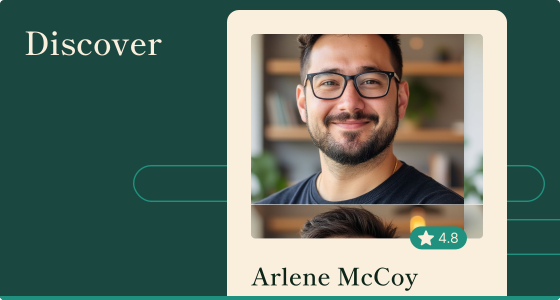
Fill out the quick form or book a discovery call. Share your team's goals, skill gaps, and preferred format – whether it's a focused 2-hour session, a half-day deep dive, or a full-day intensive.
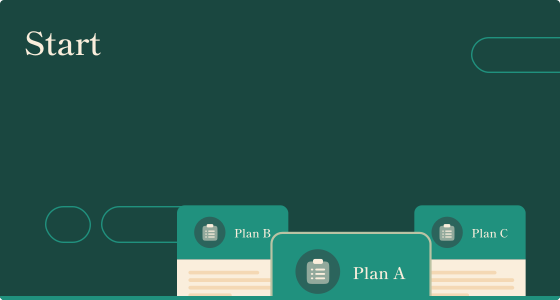
Based on your requirements, we shortlist 2-3 workshop hosts from our vetted network. You'll get their profiles, past workshop topics, and reviews – then pick the one that fits best.

Your host tailors the curriculum to your team's context. They'll align on agenda, exercises, and outcomes ahead of time so there are no surprises – just a session that delivers exactly what you need.

Your team gets a hands-on, interactive session led by a real practitioner. After the workshop, you'll receive materials, action items, and optional follow-up sessions to reinforce what was learned.
Choose a format that fits your team's needs and schedule. Every workshop is fully customizable.
Only 5% of companies are achieving AI value at scale, and the leaders at those companies expect to upskill more than half their employees, against 20% at the laggards (BCG's widening AI value gap analysis, 2025). That's the whole gap. The tools got bought everywhere, and the decisions around them changed almost nowhere.
Fully 60% of companies are getting no material value from AI at all, despite substantial investment. What separates them from the 5% rarely comes down to the model or the infrastructure budget, and almost always comes down to whether anyone changed how the team works, decides, and reviews what gets shipped. That's a leadership job, not a procurement one.
Which is why leadership workshops for teams are now an AI adoption decision rather than a soft-skills line item. MentorCruise runs expert-led leadership workshops for teams, matched to a vetted workshop host within 48 hours. The reason to book one in 2026 has less to do with communication style than with whether the AI investment already sitting on the books returns anything at all.
A leadership workshop is a live, facilitated session where a team practices real leadership decisions instead of sitting through a lecture. Most run two to eight hours, in person or as a virtual session, and cover one defined problem rather than a broad curriculum.
A leadership workshop is a single event, not a multi-month leadership development program, and that difference drives both the budget and what a team can expect afterwards. The strongest sessions are built around the decisions a team is currently getting wrong, so the practice transfers back to the work the same week.
A team leadership workshop should cover six skill areas: delegation, conflict resolution, coaching skills, emotional intelligence, communication, and decision-making. Every leadership development agenda on this search names roughly the same six, wrapped in different words like collaboration, influence, and presence. The disagreement is about which version of each one a given team actually needs.
The skills a first-time manager needs aren't a lighter version of the senior set, which is why new manager coaching and executive work look nothing alike. Delegation is the clearest example. A new manager is learning to hand work off, and a director is learning to hand decisions off and live with the ones that come back wrong.
The fourth column is the one no provider in this page-one field has written yet. AI didn't add a seventh skill to the list. It changed what most of the existing six actually require.
| Skill area | What a new manager needs | What an experienced leader needs | What AI changed about it |
|---|---|---|---|
| Delegation | Handing off work without quietly taking it back | Delegating decisions, not just tasks | Judging which work is safe to hand to a model, and which needs someone who can tell when it is wrong |
| Conflict resolution | Walking toward a disagreement instead of around it | Surfacing the conflict a team is hiding | Arguments about whether AI output is good enough now arrive weekly, and nobody's title settles them |
| Coaching skills | Asking before telling | Building coaches instead of only coaching | Reviewing work the author cannot fully explain |
| Emotional intelligence | Reading a room you are suddenly responsible for | Reading a room that manages its signals around you | Reading a team that is quietly anxious about what it is being replaced by |
| Communication | Saying the hard thing once, clearly | Making a decision legible three levels down | Explaining where the line on AI use sits, and why it sits there |
| Decision-making | Deciding with incomplete information | Deciding when the downside lands on someone else | Deciding what the team is accountable for when a model wrote the first draft |
Most teams don't need all six in one session, and trying to buy all six is how a workshop becomes a day out of the office. Coaching skills and delegation are the two rows teams most often get wrong at the same time, so that pairing is a reasonable place to start. A team management mentor works the same list one person at a time, over months, which fits better when the gap sits with one person, not the group.
AI adoption stalls on leadership because the failures are all decisions, and a license can't supply a decision. Someone has to decide the safe work to hand a model, name the reviewer, and set the response to a confident error. Those three calls don't ship with the tool.
Every provider on page one of this search is selling the 2019 version of leadership training. Not one of them mentions the single largest thing that has changed about the job. The constraint is organizational, and it shows up as performance nobody can quite explain: velocity up, quality unreadable, and nobody able to say which of the two is real.
70% of AI value creation happens outside the technology because the technology is the easy part to buy. AI value creation splits three ways: 10% from algorithms, 20% from technology infrastructure, and 70% from people, processes, and change management (BCG's AI skills gap analysis, 2026).
You already bought the 10 and the 20. The licenses are provisioned, the infrastructure is stood up, and the invoices cleared last quarter. Nobody bought the 70.
The same analysis found that persona-based learning journeys deliver employee AI adoption 20 times higher than a broad-based approach. Role-specific beats generic by a factor of twenty, which is a strong argument against buying the engineering leads the same AI literacy module as the finance team.
A change management mentor spends the whole week inside that 70%, sequencing who changes what, in which order, and what gets checked afterwards. A workshop is a smaller version of the same work, compressed into a room with the people who have to make the calls.
Access without judgment makes output worse because the model doesn't announce where its reliable range ends. In a pre-registered randomized controlled trial with 758 consultants, the ones working outside AI's reliable range were 19 percentage points less likely to produce a correct solution than colleagues working without AI at all (Dell'Acqua et al., HBS Working Paper 24-013, 2023).
Inside that range, the same tool was excellent. Consultants completed 12.2% more tasks, 25.1% more quickly, and at over 40% higher quality. Below-average performers improved 43% and above-average performers 17%, which is the half of the result everyone quotes.
Both findings came out of the same trial, with the same tool, on the same day. The only variable was whether the task sat inside the range where the model is reliable. That's a pre-registered research design with 758 people in it, not a vendor survey.
Nobody in that trial could see where the line was, and your team can't see it either. The people adopting fastest are the ones producing the confident errors.
When that lands, it won't look like an AI problem. It'll look like a performance problem, and the wrong thing gets managed. Finding the line, for this team and this work, is the leadership job, and it's worth 19 percentage points.
Someone has to own what the AI produces, because accountability is the one part of the work a model can't accept. If the code that merged is wrong, or the forecast that went into the plan is wrong, a person answers for it. Nobody has ever put a model's name in an incident review.
DORA's 2026 analysis describes AI's primary role in software development as an amplifier: AI magnifies the organizational strengths and weaknesses a team already has. Higher AI adoption correlates with increased software delivery throughput and increased instability, at the same time.
A team with clear ownership gets faster. A team without it gets faster at shipping work nobody can account for. Amplifiers don't correct drift, they accelerate it, and teams drift apart by default.
Around 30% of developers report little to no trust in AI-generated code. Somebody is still merging it. The distance between what people believe about the output and what people ship anyway is where the accountability question actually lives.
There's no figure for how many teams have decided who is accountable for what a model wrote, because almost nobody has decided. That isn't a tooling gap, and no procurement cycle closes it. It's a call someone with authority makes out loud, once, and then holds people to.
Leadership workshops for teams cost from $250 for a two-hour session, from $500 for a half day, and from $900 for a full day at MentorCruise. Published corporate training rates run $1,000 to $3,000 per day per person. That gap is a pricing model difference, not a discount.
The real confusion on this search is per person versus per group versus per workshop. Three meters, three very different bills for the same room.
| Attribute | Per person, per day | Per group, flat rate | Per workshop, by format (MentorCruise) | Quote on request |
|---|---|---|---|---|
| What the price buys | One attendee, for one day of delivery | One session, up to a group cap | One session, by duration and group band | Unknown until a sales call |
| Published figure | $1,000 to $3,000 per day per person for in-person delivery | Starting at $4,000 per group of up to 50 employees, for a 60-minute virtual session | From $250 for 2 hours (5-20 people); from $500 for 4 hours (10-30); from $900 for a full day (10-50) | None |
| What a 15-person team pays for one day | $15,000 to $45,000 at the published range | Not sold at full-day length | From $900 | Unknown |
| What changes when the team grows | Every extra attendee adds a full fee | Flat to the cap, then a second booking | Flat inside the band, then the next format up | Unknown |
| Competing providers on this search publishing it | None; the range comes from a published cost guide | 1 of 7 | 0 of 7 | 6 of 7 |
Bizzuka publishes a corporate training cost guide rather than a leadership-workshop benchmark, and puts in-person delivery at $1,000 to $3,000 per day per person, with corporate packages between $12,000 and $250,000 depending on scope. One provider on this search publishes a price of its own, starting at $4,000 per group of up to 50 employees, for a 60-minute virtual session. Six of seven competing providers won't give you a number without a call first.
Fifteen people, one day, at the published per-person range: somewhere between $15,000 and $45,000. The same day as a Bootcamp starts at $900.
Those are starting prices. The final number depends on the host and what the team wants built, and a full-day Bootcamp for fifty people isn't going to land at $900. The point isn't the figure. It's that the meter isn't running per head.
Start with the decision the team is getting wrong, then let the room size and the depth required pick the format. Five steps, in this order.
Name the decision the team is getting wrong. Not the skill gap, the decision. "Our seniors won't push back on each other's AI-assisted pull requests" is bookable, and "better communication" is not.
Count who has to be in the room for that decision to change. That number picks the format before duration does. Five to twenty people is a Fundamentals room, and ten to fifty is a Bootcamp.
Match the duration to whether you need awareness or practice. Two hours moves what people know. A full day moves what they do, whether the session runs in person or virtual.
Ask what the team will practice on. The answer should be the team's own decisions, not a case study about a fictional company. A MentorCruise workshop host reviews the team's skill level, stack, and objectives on a call before building a custom session, which is what a fixed course catalog structurally cannot do.
Check who does the work after you sign. MentorCruise matches a workshop host within 48 hours and handles scheduling and coordination. No competing provider on this search publishes a turnaround commitment of any kind, and at least one openly hands facilitation back to you.
A good workshop facilitator has done the job being taught, recently enough to still remember what it cost. A bad one has a deck about it. The gap between those two is most of what a team is actually buying, and leadership training rarely makes it visible.
The providers on this search publish decades in business, one founder's book sales, the number of people trained, and a competency framework. Those are proxies for quality. None of them is a filter, and a filter is the only one of the four a buyer can check.
8% of workshop-host applicants are accepted at MentorCruise, across 677+ leadership workshop hosts. Zero of the seven competing providers on this search publish an acceptance rate, a rejection criterion, or any number at all.
The sharper question in 2026 is whether the person standing in front of the team has led one through an AI rollout or has read about one. Ask what broke. Ask what they'd do differently, and listen for whether the answer has a scar in it.
The traits that make someone good at technical leadership skills are not the traits that make a good trainer, and most leadership training workshops buy the second. Practice-based delivery beats lecture-based delivery, which is why the expert in the room matters more than the deck.
A leadership workshop can't create lasting change on its own. Leadership development needs practice and coaching afterwards, and any provider saying otherwise is selling a day out of the office.
Regular usage is sharply higher among employees who receive at least five hours of training and have access to in-person training and coaching (BCG, 2025). The 2-hour Fundamentals workshop sits below that. It's a test of whether facilitated practice moves this team, not a program that finishes the job.
Which is the honest way to buy it. Run Fundamentals against one real decision, check six weeks later whether anything actually changed, and commit to the Deep Dive or the Bootcamp only if it did.
A leadership workshop also won't teach the team to use the tools. If the gap is hands-on skill rather than judgment, book an AI workshop for your team instead.
And if one person needs the work rather than the group, leadership coaching for individuals is the cheaper answer. A workshop changes what a group decides together, and it's a poor way to fix a single manager.
It depends on whether you want awareness or practice. Two hours moves what people know, and a full day moves what they do. Against the dose, both are short: regular AI usage is sharply higher among employees who get at least five hours of training plus in-person coaching (BCG, 2025). Treat a two-hour session as a test, and budget the follow-up before booking the first one.
Yes. A MentorCruise workshop host reviews the team's skill level, stack, and objectives on a call before building the session, so the exercises run on decisions the team is currently getting wrong. A fixed course catalog structurally can't do that, because the content was written before anyone knew who would be in the room. Bring the specific decision that needs to move.
It depends on who already has authority on the topic. Run it in-house when that person also has the room's respect, because authority plus respect is most of what a facilitator provides. Bring someone in when the team's own leadership is currently getting the decision wrong, or when the most senior person present would stop people being honest.
Whoever is most senior in the room sets the ceiling on how honest the practice gets. A mixed-seniority room changes what people will say out loud, so either split the session by level or accept the limit and design around it. Collaboration exercises work fine across levels, and candid practice on a live conflict usually doesn't.
A leadership workshop is for judgment calls, and management training is for mechanics. Management training covers running 1:1s, performance reviews, and hiring loops, while team leader training sits between the two. The judgment gap is where AI changed the job most. No process document says which work is safe to hand to a model.
The form on this page takes five fields: name, work email, company, team size, and topic. A vetted workshop host is matched within 48 hours, and the host and the team shape the session together before anything is scheduled.
The most useful thing to bring to that conversation is the decision the team is currently getting wrong, stated the way someone would say it out loud in a retro. Hosts build better sessions from one specific, awkward example than from a list of competencies.
And if the gap is one manager rather than the team, engineering management coaching is the smaller door.
Our hosts are experienced professionals from leading companies who bring real-world expertise to every session. Here's a sample of who's available.
CEO | Fractional C- Suite at Inside Startups

Senior Engineering Manager at Amazon

CTO at Kanaria Tech

Lead Product Manager at SAP

Group Product Manager at ING

Founder at MentorCruise

Chief Marketing Officer

CTO and Co-founder at MyImmune Corporation
Everything you need to know about our Leadership workshops.
You don't have to! Simply fill out our inquiry form and tell us what your team needs. We'll handpick 2-3 hosts who match your requirements based on their expertise, industry experience, and availability. Each host profile includes their background, past workshop topics, and reviews from previous clients.
We offer three formats: a focused 2-hour session for targeted topics, a half-day (4-hour) deep dive for comprehensive training, and a full-day bootcamp (6-8 hours) for intensive development. All workshops are conducted virtually via video conferencing and include interactive elements like Q&A, group exercises, and case studies. Some hosts also offer multi-session programs.
Absolutely! Every workshop is customized to your team. Your host will have a pre-workshop planning call to understand your industry context, specific challenges, and desired outcomes. The content, examples, and exercises will all be directly relevant to your team's day-to-day work.
Pricing depends on the format and host experience. 2-hour focused sessions start from $250, half-day deep dives from $500, and full-day bootcamps from $900. We also offer package deals for teams that want recurring or multi-topic training. Fill out our inquiry form for a custom quote.
Simply fill out the inquiry form on this page or visit our Teams signup page. Share your team's goals and preferred format, and we'll match you with 2-3 suitable hosts within 48 hours. Once you pick a host, we'll coordinate scheduling and logistics.
Every workshop includes presentation materials, templates, and action items. Most hosts also provide a recording of the session, follow-up resources, and some offer optional Q&A check-in sessions 2-4 weeks later to reinforce learnings and address questions that come up during implementation.
We typically match you with a host within 48 hours. From there, most workshops can be scheduled within 1-2 weeks, depending on host availability and customization needed. For urgent requests, we can sometimes arrange sessions within a few days.
We stand behind the quality of our hosts. If your team isn't satisfied, reach out and we'll work with you to make it right – whether that means a follow-up session, a different host, or a refund. Our 97% satisfaction rate speaks for itself, but we want every team to have a great experience.
We've already delivered 1-on-1 mentorship to thousands of students, professionals, managers and executives. Even better, they've left an average rating of 4.9 out of 5 for our mentors.
Request a workshopStart with a discovery call or browse trainers to see who fits your needs.
Tailored training plans for your team’s goals
Flexible formats and scheduling
Get started with a free trial