Bring in a vetted expert to train your team with a hands-on, interactive workshop. Flexible formats, proven results, and zero hassle – we handle the matching so you can focus on learning.
Tell us about your team and we'll reach out within 24 hours.
Our team will reach out to within 24 hours.






Skip the one-size-fits-all sessions. Get expert instruction that's relevant, hands-on, and made for your team.
satisfaction rate
faster goal achievement
available workshop hosts

"Andrei has been an amazing mentor, helping me navigate the challenges of managing an engineering team, modernising our legacy SaaS platform and moving us into the era of AI software development."

We're not a generic training marketplace. Every workshop host on MentorCruise is a vetted professional with real-world experience at top companies.

Every host goes through a rigorous vetting process. Only 8% of applicants are accepted, so you're always working with the best.

Workshops start from $250. No hidden fees, no long-term contracts. Pay per session or negotiate a package for your team.

Tell us your goals and team size – we'll match you with the right host, coordinate scheduling, and make sure everything runs smoothly.

No cookie-cutter content. Hosts tailor every session to your team's industry, skill level, and specific challenges.
From first inquiry to post-workshop follow-up, we make the entire process seamless.
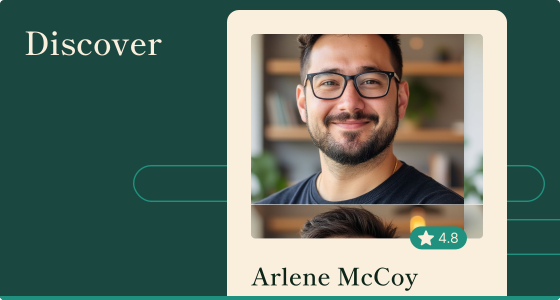
Fill out the quick form or book a discovery call. Share your team's goals, skill gaps, and preferred format – whether it's a focused 2-hour session, a half-day deep dive, or a full-day intensive.
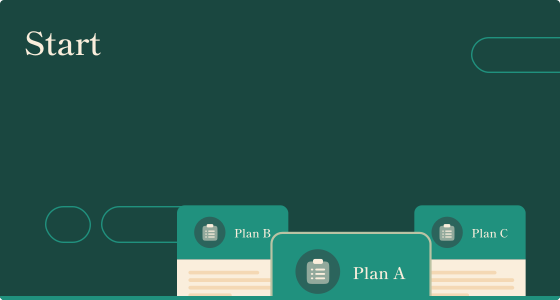
Based on your requirements, we shortlist 2-3 workshop hosts from our vetted network. You'll get their profiles, past workshop topics, and reviews – then pick the one that fits best.
Your host tailors the curriculum to your team's context. They'll align on agenda, exercises, and outcomes ahead of time so there are no surprises – just a session that delivers exactly what you need.
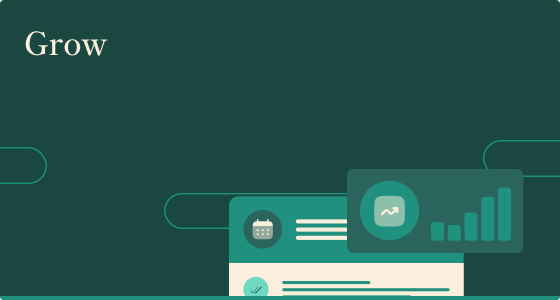
Your team gets a hands-on, interactive session led by a real practitioner. After the workshop, you'll receive materials, action items, and optional follow-up sessions to reinforce what was learned.
Choose a format that fits your team's needs and schedule. Every workshop is fully customizable.
Hire the consultant when the answer you need is a one-off. Train the team when the same class of question comes back next quarter. Every provider in this market sells one side of that decision without ever mentioning that a decision existed.
Search for AI consulting training and five different products come back: an AI consulting engagement, a certification, an online course, a software platform, and a workshop. Not one of them arbitrates between the five. MentorCruise sells the workshop, and the consultant, and the 90-day sprint, so it costs nothing here to be honest about which one a team actually needs.
The decision matters because most corporate spending on artificial intelligence (AI) is currently producing nothing. Only 5% of companies in a 2025 study of more than 1,250 firms worldwide are achieving AI value at scale, and fully 60% are not achieving material value at all, reporting minimal revenue and cost gains despite substantial investment. At the 5% getting value, more than 50% of employees are expected to be upskilled in AI in 2025, compared with only 20% at the laggards.
An AI consulting workshop is training in placement. The work of a client-facing team splits four ways - the pitch, the research, the analysis, and the deliverable - and AI belongs in different amounts in each. The skill is placement, and placement is what an untrained team gets wrong.
Anyone can learn the prompts in an afternoon. Knowing the parts of a live engagement able to absorb a model's output safely, and the parts that cannot, is what takes a practitioner to teach. A good workshop walks a team through all four stages using their own engagements rather than a case study about a fictional retailer.
Here is what that covers in practice:
Those are skills rather than topics, and the difference shows up in the deliverable instead of in a post-session quiz. A team that has done this can tell a client why one section of the report was model-assisted and why the recommendation on page four was not.
One clarification, since the search results blur them. This is training for consultants who already advise clients. Becoming an AI consultant is a different path entirely, and it belongs to a different page.
The evidence says AI does two opposite things to consultants, depending entirely on the task. Start with the number that hurts. On tasks sitting outside AI's capability, consultants using AI were 19 percentage points less likely to produce a correct solution than consultants working with no AI at all.
Inside AI's capability, the same population completed 12.2% more tasks, 25.1% more quickly, and produced results of more than 40% higher quality than the control group, across 18 realistic consulting tasks. Both halves come from the same experiment.
A pre-registered randomized field experiment run by Harvard Business School with Boston Consulting Group (BCG) put 758 consultants, roughly 7% of BCG's individual contributors, through those tasks with and without AI support. The numbers come from Dell'Acqua, Mollick, Lakhani, and colleagues, in Harvard Business School Working Paper 24-013 (2023).
The study also named the pattern: the jagged technological frontier. AI is sharply good at some consulting tasks and sharply bad at others, and the boundary between them is invisible from the outside.
Nothing about a task's apparent difficulty predicts which side of the frontier it falls on. A consultant cannot feel the edge coming, which is exactly why unsupported AI use produces a coin-flip rather than a lift.
Buying the team a license puts them on the frontier without a map. That is the whole case for training over tooling. Knowing where the frontier sits inside one sector's client work is a teachable capability, and it is the only thing an AI consulting workshop actually sells.
The skill split answers the objection most partners raise first, which is that senior people don't need this. Below-average performers improved 43%. Above-average performers improved 17%.
The gains were real at every level and largest at the bottom, so the people who benefit most are usually the ones a partner would have left off the invite list.
A fixed syllabus is a map of someone else's frontier. The frontier moves with the task, and the tasks depend on the sector, the client, and the deliverable. A healthcare-advisory consultant and a fintech-agency consultant do not do the same work, so they do not share a frontier.
A packaged course hands them the identical module anyway, and calls the overlap a curriculum.
That is why the workshop has to be built from the team's own engagements. A host who has run AI-assisted client work in the same sector already knows the analyses a model quietly gets wrong there. A syllabus written before anyone met the team knows nothing about it.
Hire a consultant when the answer you need is one-off and you can act on it once. Train the team when the same class of question will come back every quarter, because the consultant leaves and the judgment was what you were buying. Five options are on the table, and this is what each one costs.
| Option | What it costs (published) | What it actually buys | What the evidence says |
|---|---|---|---|
| Hire an AI consultant for an engagement | Almost never published. Priced per engagement, per firm. | An answer, a roadmap, and a set of recommendations, delivered by someone who then leaves. | The consultant hands over the 10% (algorithms) and part of the 20% (technology infrastructure). The other 70% stays with the team. |
| Buy a packaged corporate workshop | A customized half-day workshop from a specialist AI training firm is $75,000 plus travel. An AI training cost survey puts corporate training packages at $12,000 to $250,000 depending on scope, and in-person workshops at $1,000 to $3,000 per day per person. | A fixed curriculum, delivered to the team, usually written before anyone at the vendor met the team. | Broad-based programs are the comparison group that BCG's custom-built, persona-based learning journeys outperformed on adoption by a factor of 20. |
| Buy an online course | Individual AI courses run $500 to $15,000 per person. | Self-paced video, completed alone, on the learner's own time, with no client work attached. | Regular AI usage climbs sharply only for employees who get at least five hours of training plus in-person training and coaching. Only one-third of employees say they have been properly trained. |
| Hire an AI specialist onto the team | Salary, plus the exposure if the hire doesn't stick. Replacing an employee costs one-half to two times their annual salary (Gallup, 2019). | One person who knows AI, sitting next to eleven consultants who still don't. | One hire does not move a team of twelve, and the client work is produced by the twelve. |
| Train the team you already have | Fundamentals from $250 (2 hours, 5 to 20 people). Deep Dive from $500 (4 hours, 10 to 30). Bootcamp from $900 (full day, 10 to 50). | Two hours, half a day, or a full day of a practitioner working through the team's own live engagements. | The randomized trial's gains land on the consultants doing the work, and the judgment stays in the building after the session ends. |
The arithmetic under those five rows is the buy-versus-build argument in one number. Only 10% of AI value creation comes from algorithms, and 20% comes from technology infrastructure, while 70% comes from people, processes, and change management.
A consultant can sell a firm the 10%. The 70% is the team, and the team does not leave when the engagement ends.
Notice what the price columns do and do not say. The per-person qualifier on the course and workshop ranges is doing real work there, because a $250 Fundamentals session covers 5 to 20 people in total rather than one seat. Run the comparison half-day against half-day, per head against per head, and the arithmetic makes the argument without help.
Almost nobody in this market publishes a price at all. That makes the comparison harder than it should be, and it is worth remembering when a proposal arrives carrying a number and no basis for the number.
Go and hire the consultant when the work is genuinely one-off, when the deadline is shorter than the learning curve, or when nobody on the team has enough context to brief the problem in the first place. Those three cases are real, they are common, and a workshop will not fix any of them.
One-off means one-off. A single AI due-diligence question on a single acquisition does not need twelve people trained; it needs one expert for two weeks. If a client wants an AI implementation roadmap by the end of the month, the month will end long before the training compounds, and the honest answer is to buy the roadmap from someone who has already built four of them.
And if the team cannot yet describe the problem well enough to write a brief, training them to point AI at it only accelerates the wrong work. That is the case people miss. A capability gap and a context gap look identical from the outside, and only one of them is fixed by a workshop.
In all three situations the right move is to hire a vetted AI consultant and get the answer. A workshop page saying so out loud is not a concession made reluctantly. It is the same logic the rest of this page runs on.
The pivot back is straightforward. A consultant is the right call when a firm needs an answer; a workshop is the right call when a firm needs the capability to keep producing answers, and most teams need both. The order matters, because a team that has been trained can brief the consultant properly and evaluate what comes back rather than nodding at a deck.
A workshop will not, on its own, change how a team works. BCG's guidance on the AI skills gap appears under a heading titled "Move beyond workshops and e-learning". The sentence beneath it is blunt: "While workshops lay important groundwork, the real transformation happens when employees apply new skills to their actual work."
That is the seller's own source saying the product is a start rather than a finish. Any provider claiming otherwise has not read it.
The concession is worth making, because the same BCG research points at what to do about it. Custom-built, persona-based learning journeys deliver employee AI adoption at a level 20 times higher than a broad-based approach, which is the argument for a workshop built around the team's real client work and against a generic curriculum.
It is also the argument for what has to happen once the room empties. Skills that are never applied to live client work within a few weeks do not survive contact with a busy quarter. Nobody forgets on a schedule, but a consultant who returns to an inbox and three deadlines will default to the way they worked in March, and the training becomes a line item nobody can point to.
So the honest shape of this is a ladder rather than an event. The workshop is the entry point, and a 90-day AI sprint is what comes next - applied work on the team's own engagements, at $2,997 per quarter. Book the follow-on before the workshop rather than after it, because the calendar is what usually kills it.
Start with the filter that does most of the work. A host should have done AI-assisted client work in your sector, not taught a course about it. The frontier is defined by the work itself, and only a practitioner with real deliverables behind them can show a team where its edges sit.
The rest of the checklist is the set of questions a buyer should be able to put to any provider, this one included:
Hosts on MentorCruise clear an 8% acceptance bar, and that bar exists to answer the first criterion on the list rather than to decorate a page. A buyer should treat it as the answer to a question rather than as a badge. The 97% satisfaction figure MentorCruise reports is platform-wide across its services and not an AI-consulting-workshop number, so weight it accordingly.
A host with real client work behind them beats a host who has only taught the course, because the frontier is learnable only from the inside. A practitioner already knows the model's quiet failure modes in a regulated sector, its invented citations behind a paywall, and the parts of a pitch it makes measurably worse. A trainer knows the syllabus.
Route by the gap that actually exists. If the gap is general AI fluency across the whole company rather than client-facing advisory work, the broader AI workshop is the better fit. If the real gap is who owns the AI policy and who is accountable when it goes wrong, that is an AI strategy workshop.
If what is needed is an answer rather than a capability, it is the consultant. And if it is this - a client-facing team that has to use AI in delivery without embarrassing itself in front of a client - the form at the top of this page matches a host within 48 hours.
The 10-20-70 rule is BCG's finding that 10% of AI value creation comes from algorithms, 20% from technology infrastructure, and 70% from people, processes, and change management. Buying a tool, or buying an expert who arrives holding a tool, addresses roughly 10% of the problem. The other 70% is how a team works, and training plus applied practice buys that where a license does not.
It depends on one variable: whether the team has live client work to apply the training to within a few weeks. When it does, the workshop is worth it, because applied practice converts a session into changed deliverables. When the workshop is a calendar entry with no engagement behind it, it is not worth it at any price, and the team will be back where it started by the next quarter.
More than most teams budget for. Regular AI usage climbs sharply only for employees with at least five hours of training plus in-person training and coaching, and only one-third of employees say they have been properly trained at all (BCG, 2025). That threshold honestly puts a two-hour Fundamentals session in the introduction category, while the four-hour Deep Dive and the full-day Bootcamp sit above the line.
Ask the host for one client deliverable built with AI and one deliberately built without it, and the reasoning behind each. A practitioner answers in ninety seconds, with specifics; someone who has only taught the syllabus cannot. Hosts clear an 8% acceptance bar and matching happens within 48 hours, so a buyer can ask on a call before committing any budget.
Our hosts are experienced professionals from leading companies who bring real-world expertise to every session. Here's a sample of who's available.

Senior Manager, AI Engineering at Workday

Director of Forward Deployed Engineering at Indicium AI

Principal UX, Service Design & AI Strategy at Aragon Consulting

SEO/GEO AI Search specialist at Amplfyr

Founder & AI Automation Consultant at AzenFlow

Helping founders build AI-powered companies | Certified Executive Coach | Harvard Certified | HubSpot’s #1 Strategic Consultant | President’s Club 2024 | Google-Selected Trainer at HubSpot

Technical Leader & Senior Software Engineer | Performance & Career Mentor at Engineering Peak Impact

AI Deployment Strategist at Mistral AI
Everything you need to know about our AI Consulting workshops.
You don't have to! Simply fill out our inquiry form and tell us what your team needs. We'll handpick 2-3 hosts who match your requirements based on their expertise, industry experience, and availability. Each host profile includes their background, past workshop topics, and reviews from previous clients.
We offer three formats: a focused 2-hour session for targeted topics, a half-day (4-hour) deep dive for comprehensive training, and a full-day bootcamp (6-8 hours) for intensive development. All workshops are conducted virtually via video conferencing and include interactive elements like Q&A, group exercises, and case studies. Some hosts also offer multi-session programs.
Absolutely! Every workshop is customized to your team. Your host will have a pre-workshop planning call to understand your industry context, specific challenges, and desired outcomes. The content, examples, and exercises will all be directly relevant to your team's day-to-day work.
Pricing depends on the format and host experience. 2-hour focused sessions start from $250, half-day deep dives from $500, and full-day bootcamps from $900. We also offer package deals for teams that want recurring or multi-topic training. Fill out our inquiry form for a custom quote.
Simply fill out the inquiry form on this page or visit our Teams signup page. Share your team's goals and preferred format, and we'll match you with 2-3 suitable hosts within 48 hours. Once you pick a host, we'll coordinate scheduling and logistics.
Every workshop includes presentation materials, templates, and action items. Most hosts also provide a recording of the session, follow-up resources, and some offer optional Q&A check-in sessions 2-4 weeks later to reinforce learnings and address questions that come up during implementation.
We typically match you with a host within 48 hours. From there, most workshops can be scheduled within 1-2 weeks, depending on host availability and customization needed. For urgent requests, we can sometimes arrange sessions within a few days.
We stand behind the quality of our hosts. If your team isn't satisfied, reach out and we'll work with you to make it right – whether that means a follow-up session, a different host, or a refund. Our 97% satisfaction rate speaks for itself, but we want every team to have a great experience.
We've already delivered 1-on-1 mentorship to thousands of students, professionals, managers and executives. Even better, they've left an average rating of 4.9 out of 5 for our mentors.
Request a workshopStart with a discovery call or browse trainers to see who fits your needs.
Tailored training plans for your team’s goals
Flexible formats and scheduling
Get started with a free trial