Bring in a vetted expert to train your team with a hands-on, interactive workshop. Flexible formats, proven results, and zero hassle – we handle the matching so you can focus on learning.
Tell us about your team and we'll reach out within 24 hours.
Our team will reach out to within 24 hours.
Our workshop hosts work at


























Skip the one-size-fits-all sessions. Get expert instruction that's relevant, hands-on, and made for your team.
satisfaction rate
faster goal achievement
available workshop hosts

"Andrei has been an amazing mentor, helping me navigate the challenges of managing an engineering team, modernising our legacy SaaS platform and moving us into the era of AI software development."

We're not a generic training marketplace. Every workshop host on MentorCruise is a vetted professional with real-world experience at top companies.

Every host goes through a rigorous vetting process. Only 8% of applicants are accepted, so you're always working with the best.

Workshops start from $250. No hidden fees, no long-term contracts. Pay per session or negotiate a package for your team.

Tell us your goals and team size – we'll match you with the right host, coordinate scheduling, and make sure everything runs smoothly.

No cookie-cutter content. Hosts tailor every session to your team's industry, skill level, and specific challenges.
From first inquiry to post-workshop follow-up, we handle the logistics so your team can focus on learning.
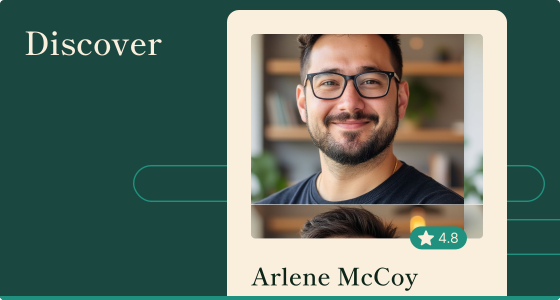
Fill out the quick form or book a discovery call. Share your team's goals, skill gaps, and preferred format – whether it's a focused 2-hour session, a half-day deep dive, or a full-day intensive.
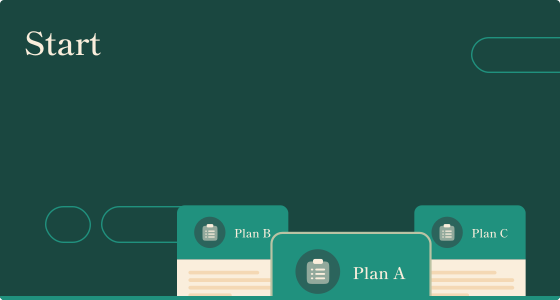
Based on your requirements, we shortlist 2-3 workshop hosts from our vetted network. You'll get their profiles, past workshop topics, and reviews – then pick the one that fits best.
Your host tailors the curriculum to your team's context. They'll align on agenda, exercises, and outcomes ahead of time so there are no surprises – just a session that delivers exactly what you need.
Your team gets a hands-on, interactive session led by a real practitioner. After the workshop, you'll receive materials, action items, and optional follow-up sessions to reinforce what was learned.
Choose a format that fits your team's needs and schedule. Every workshop is fully customizable.
The hard part of AI automation was never the tool. The hard part is the triage before the build, and the ownership on the Monday after it breaks. Most training in this category teaches the tool and skips both, and only 5% of companies are achieving AI value at scale while 60% get no material value at all, despite substantial investment (BCG, n=1,250+ firms).
Every provider competing for this search names ChatGPT, Microsoft Copilot, Claude, or Google Gemini. Not one of them names n8n, Zapier, or Make, the tools that actually connect one system to another. They are selling AI literacy and calling it automation, and the research says the split matters: 10% of AI value creation comes from the algorithms, 20% from the technology, and 70% from people, processes, and change management (BCG).
Conceding that is what earns the right to sell anything afterwards. "Most people think it's an automation tool," says MIT economist David Autor. "We'll take what we're doing and then the machine will do it for us better. Done. But actually, automation is extremely hard."
The work worth automating is repetitive, non-differentiating, and easy to check: status reporting, ticket triage, and the copy-paste between two systems that never learned to talk to each other. Most teams start from the work they hate. Better to start from the work they can verify, because verification decides whether an automation saves time or merely relocates the effort.
Here is the triage method. It needs the people who own the handoffs in the room, not only the team leaders who own the budget.
Three of the six pieces of work below survive the triage outright, two survive only in part, and one should be left alone. The pattern separating them is not difficulty. It is whether a human can check the output faster than they could have produced it.
| The work | Why it looks automatable | What actually decides it | Verdict |
|---|---|---|---|
| Weekly status reporting | The data already sits in the ticket tracker, the repo, and a spreadsheet, and the writing is formulaic | The person who lived the week can check the output in about 30 seconds | Automate |
| Ticket and inbound triage | Volume is high, categories are stable, and the routing rules are already written down | Routing is checkable at a glance. The call on a genuinely ambiguous ticket is not | Automate the routing, not the escalation |
| Copy-paste between two systems | The work is mechanical and nobody in the team wants it | Upstream systems rename fields without warning, so someone has to notice when they do | Automate, with a review date attached |
| Meeting notes to action items | Transcription is a solved problem and the summaries are good | Deciding what counts as an action item is the meeting. The notes are only the record | Automate the retrieval, not the decision |
| First-draft documents | The blank page is the slow part, and the tools are genuinely good at it | The person who has to defend the document can check it faster than they could write it | Automate, with the author named as owner |
| Candidate screening | Resumes are structured, the volume is painful, and the criteria look like rules | A wrong rejection is invisible, permanent, and unappealable | Leave it alone |
None of this requires an engineer, which is rather the point. If the team needs a standing second opinion instead of a one-off session, the cheaper monthly commitment is to find an automation mentor or a business operations mentor and keep the conversation running.
Do not automate the judgment step. On tasks that sat outside what the tool could actually do, consultants using AI were 19 percentage points less likely to produce the correct answer than consultants using no AI at all (Harvard Business School and BCG, pre-registered randomized controlled trial, n=758).
Inside the set of tasks the tool was good at, the same consultants finished 12.2% more tasks, 25.1% faster, at more than 40% higher quality. Same tool, same trained professionals, different task. The tool was fine, the people were fine, and what failed was the triage.
That is worth sitting with, because a tool pointed at work it cannot do does not fail loudly. It fails by producing something plausible. A confident wrong answer costs more than no answer, and it costs most when the person receiving it has no time to check.
"It's not a limitation of AI," Autor notes. "It's a challenge of designing it in a way that collaborates effectively with human capacities." The practical translation is narrower than it sounds, and it is the operating rule the rest of this page runs on.
So what does that look like on a Tuesday? A workflow tool that pulls last week's closed tickets, formats them, and drops a draft into Slack is automating retrieval and assembly, and a human can check it at a glance. A workflow tool that decides which tickets count as incidents is automating a decision, and that one is worth building by hand.
None of the eight providers competing for this search cites a single independent study. Eight vendor pages, zero citations between them, and a great deal of confidence about outcomes. A number a buyer can check beats an adjective every time.
Somebody has to own every automation the team builds, because an automation is not a deliverable that finishes. It is a small piece of infrastructure with a recurring cost, and infrastructure without an owner rots quietly.
The ownership model is three fields, and all three get assigned in the room rather than in a follow-up email nobody sends. Every automation leaves the workshop with a named owner, a review date, and a documented off-switch.
Governance, meaning who is allowed to use what and who signs the policy off, is a different question and a different session. This page is about the artifact: the specific automation that now runs the weekly reporting, and what happens to it when the person who built it changes jobs.
Every automation ships with a recurring human cost, and almost nobody puts that cost in the business case. Someone checks that it still runs. Someone notices when the upstream system quietly renames a field, and someone re-reads the output the week it starts looking strange.
Only 10% of AI value creation comes from the algorithms and 20% from the technology, which leaves 70% on people, processes, and change management (BCG). That 70% is not an abstraction. It is somebody's calendar.
So the machine writes the report, and now someone has to read the report to check the machine. Progress.
An automation that saves four hours a week and costs someone two hours a week to babysit is still a win. It is a very different win from the one in the ROI slide, though, and the gap between those two numbers is the thing worth tracking. Name the tax before the build and the business case survives contact with reality.
The automation probably already exists, built by someone nobody trained, running in a personal account. 74% of frontline employees now describe themselves as AI users (BCG, AI at Work 2026, n approximately 12,000), while 30% of desk workers have had no AI training at all (Slack Workforce Index, 2024).
Put those two facts next to each other and the ownership problem writes itself. A rule someone built in a personal ChatGPT account now quietly formats part of the weekly report, undocumented, with a bus factor of one. Nobody has checked what it touches.
For a team with staff in the EU there is also a floor underneath all of this. Since 2 February 2025, EU AI Act Article 4 has required providers and deployers to take measures to ensure a sufficient level of AI literacy among staff dealing with the operation and use of AI systems on their behalf. It is a literacy duty, not an automation registry, and no workshop certifies compliance with it.
Three tool classes get sold as one purchase, and a team that buys the wrong one automates nothing. Assistants draft, workflow tools connect systems, and agents decide, and most AI automation training only covers the first.
The distinction matters because the buyer's mental model of automation is usually the assistant. That is the class every provider in this search names, and it is the class least likely to automate an actual process.
| Tool class | What it does | What it actually automates | What it costs you | When a team needs it |
|---|---|---|---|---|
| AI assistants (ChatGPT, Microsoft Copilot, Claude, Google Gemini) | Drafts, summarizes, answers questions, and rewrites on request | The blank page, one person at a time. The process itself is untouched | Per-seat subscriptions, plus the time spent prompting and re-prompting | When individual people are slow at first drafts, research, and summaries |
| Workflow automation (n8n, Zapier, Make) | Connects business applications and moves data between them on a trigger | The handoff, which was never anybody's job in the first place | Build time up front, then maintenance every time an upstream system changes | When work dies in the gaps between two systems or two people |
| AI agents | Plans a sequence of steps, calls other tools, and acts without a human in every loop | The decision and the execution together, which is why the failure mode is expensive | Engineering time, monitoring, and a much higher cost of being wrong | When a process is stable, well instrumented, and already automated at the workflow layer |
Most teams asking for AI automation training need the middle row and get sold the top one. That is the whole problem in one sentence, and naming the middle row is unusual enough in this market to be worth saying out loud.
If the work being automated is code review or the development workflow itself, expert-led AI workflows workshops cover that ground instead. There is no sense buying the same session twice.
A workshop is the wrong purchase when the team needs tool fluency, because a $40 online course will teach that better and cheaper than any workshop can. The individual course market is genuinely good and genuinely cheap. One person who needs to learn how Zapier works can learn it for the price of a lunch.
The honest limit of a course is a fact about the format rather than a marketing claim. A course teaches a tool to a person. A workshop arbitrates a process between people, and getting six people who each own a different piece of a broken handoff into one room to agree on which piece gets automated and who maintains it afterwards is a different product entirely.
The category deserves the skepticism it gets, and that includes this page's corner of it. Only 5.5% of knowledge workers meet the bar for AI proficiency, while 62% say they have received training (Section, The AI Proficiency Report, n=5,026). AI training volume is up and AI skills are not, which is as true of workshops as it is of courses.
What does correlate with adoption is volume plus a human in the room. Regular AI usage is sharply higher for employees who receive at least five hours of training and have access to in-person training and coaching (BCG, AI at Work 2025). That is a correlation and not a promise, and it is the honest shape of the argument for buying a workshop at all.
The same scrutiny belongs on the number MentorCruise publishes about itself. A 97% satisfaction rate measures whether people enjoyed the session rather than whether anything got automated. The falsifiable half of the guarantee is the remediation path, which no competitor in this search publishes at all:
The pricing argument is structural rather than statistical. The bands are published on the page above, at $250, $500, and $900, and five of the eight providers competing for this search publish no price at all.
An AI automation workshop covers four modules in this order: audit the workflow, triage what is actually automatable, build one automation in the room against a real process, then assign the owner and the review date before anyone leaves. Here is what the team walks out holding.
Who teaches it decides whether any of that happens. The host roster for this topic already includes Matthias Marin, Founder and AI Automation Consultant at AzenFlow, which is a credential a buyer can check in one click rather than take on trust. Before the session, a pre-workshop planning call puts the team's real process, stack, industry, and learning objectives on the table, and that call is the difference between a tailored workshop and a promise of one.
The commercial facts are short. Workshops run from $250 for a two-hour session up to $900 for a full day, and a workshop host is matched within 48 hours of the request.
Format follows the work rather than the other way around. A team automating one reporting process needs a couple of hours, and a team rebuilding how six people hand work to each other needs a day. To request an AI automation workshop, the team submits a single inquiry form and the matching happens from there.
The only reliable method is a baseline taken before the automation goes live, because afterwards nobody remembers how long the task used to take. Time the work across a normal week, write the number down, and re-measure the same way 30 days later. Measuring AI ROI properly is its own discipline, and it is the subject of expert-led AI productivity workshops rather than this one.
The workshop survives when the team leaves the room with an owner and a review date rather than a prompt library. An automation somebody owns and reviews on a calendar keeps running, and a technique nobody owns quietly disappears. MentorCruise provides optional check-in sessions two to four weeks after the workshop, and that is the moment to review whether the automation still runs, not to re-teach the tool.
It depends on the tool class, and workflow tools like n8n, Zapier, and Make are built for non-engineers. The person who owns the broken process is usually the right person to automate it, while agents are a different matter and usually need someone technical. A vetted workshop host who works as a practicing automation consultant can tell the difference, which is most of the value of having one in the room.
An AI automation workshop automates specific work inside a team: the reporting, the triage, and the handoffs. Expert-led AI strategy workshops set the rules on who is allowed to use what. Expert-led AI transformation workshops handle org-level change across multiple teams. If the open question is who owns the AI policy rather than which process to automate, the strategy session is the right purchase.
Yes, but banning it makes the problem worse, because a ban only pushes the automation further out of sight. Inventory the automations instead, and ask what each one touches, who would notice if it stopped, and who would fix it. Anything touching customer data, money, or a decision about a person gets a named owner this week, and everything else gets a review date.
Our hosts are experienced professionals from leading companies who bring real-world expertise to every session. Here's a sample of who's available.

Founder at MentorCruise

Head Of Commercial Operations, AU at Yahoo

Founder / Growth Marketer at GetJoan, Kibora, Flaviar

Principal UX, Service Design & AI Strategy at Aragon Consulting

Founder, Investor & AI-native Operator at Gringo (acq. Corpay), Eskolare

Manager, Product & GTM at Amazon

AI Teacher / Educator at Gooseberry AI

Senior Engineering Manager at Knauf Digital GmbH
See all our corporate training programs – AI tools, leadership, sales, marketing and more.
Reviews
Andrei has been an amazing mentor, helping me navigate the challenges of managing an engineering team, modernising our legacy SaaS platform and moving us into the era of AI software development.
Patrick
Director, Strategic Projects

Alessandro taught me to use competency matrices as objective decision-making tools, challenge assumptions from my own teams, and translate technical language into management language for executive conversations.
Roman
Engineering Manager

Matthew helped me think through several tricky leadership moments – particularly around how to navigate executive relationships, clarify influence, and prepare for a high-stakes offsite. I left each session clearer, calmer, and more confident in how I was showing up at the executive level.
Kimmy
Director of Team Enablement
Ready when you are
Tell us your goals and team size. We'll match you with 2-3 vetted hosts within 48 hours.



