Bring in a vetted expert to train your team with a hands-on, interactive workshop. Flexible formats, proven results, and zero hassle – we handle the matching so you can focus on learning.
Tell us about your team and we'll reach out within 24 hours.
Our team will reach out to within 24 hours.






Skip the one-size-fits-all sessions. Get expert instruction that's relevant, hands-on, and made for your team.
satisfaction rate
faster goal achievement
available workshop hosts

"Andrei has been an amazing mentor, helping me navigate the challenges of managing an engineering team, modernising our legacy SaaS platform and moving us into the era of AI software development."

We're not a generic training marketplace. Every workshop host on MentorCruise is a vetted professional with real-world experience at top companies.

Every host goes through a rigorous vetting process. Only 8% of applicants are accepted, so you're always working with the best.

Workshops start from $250. No hidden fees, no long-term contracts. Pay per session or negotiate a package for your team.

Tell us your goals and team size – we'll match you with the right host, coordinate scheduling, and make sure everything runs smoothly.

No cookie-cutter content. Hosts tailor every session to your team's industry, skill level, and specific challenges.
From first inquiry to post-workshop follow-up, we make the entire process seamless.
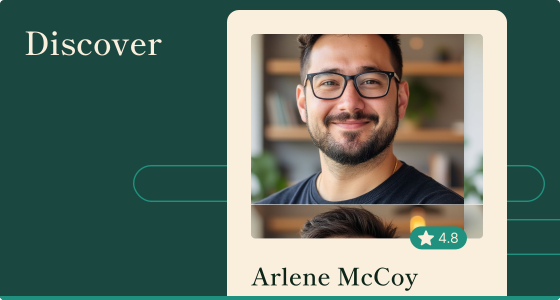
Fill out the quick form or book a discovery call. Share your team's goals, skill gaps, and preferred format – whether it's a focused 2-hour session, a half-day deep dive, or a full-day intensive.
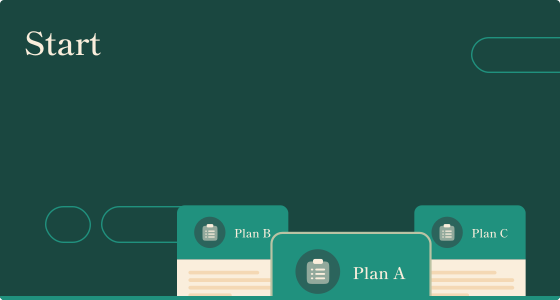
Based on your requirements, we shortlist 2-3 workshop hosts from our vetted network. You'll get their profiles, past workshop topics, and reviews – then pick the one that fits best.

Your host tailors the curriculum to your team's context. They'll align on agenda, exercises, and outcomes ahead of time so there are no surprises – just a session that delivers exactly what you need.

Your team gets a hands-on, interactive session led by a real practitioner. After the workshop, you'll receive materials, action items, and optional follow-up sessions to reinforce what was learned.
Choose a format that fits your team's needs and schedule. Every workshop is fully customizable.
Seventy percent of Fortune 100 companies now use Claude, but most teams are barely scratching the surface. The gap between having access to an AI tool and knowing how to apply it to real work is where productivity gains live - and where most organizations stall.
90% of global enterprises face severe AI skills shortages by 2026, with an estimated $5.5 trillion in losses at stake (IDC, 2026). And 82% of enterprises already provide AI training, yet 59% still report skills gaps (DataCamp, 2026). Generic AI literacy programs don't close that gap because they teach tool interfaces, not tool application.
Claude training - led by practitioners who've built with Claude in production environments - translates general AI awareness into practical workflows your team can use on Monday morning. A team that's completed a Claude-specific workshop can build agentic coding pipelines, automate document review, and design prompt systems tailored to their codebase. That's why the workshop host's real-world Claude expertise matters more than their slide deck.
A structured Claude workshop covers five core areas that move teams from casual prompting to systematic Claude adoption: prompt engineering, context management, agentic workflows, role-specific applications, and integration with existing tools. The specific curriculum depends on your team - these modules are a framework that a workshop host tailors to your tech stack, skill level, and immediate priorities.
Structured prompting teaches teams to design prompt systems that produce consistent, auditable outputs - not just one-off queries that get lucky. Teams learn to build reusable prompt templates, define output schemas, and create evaluation criteria for Claude's responses. The difference matters: ad-hoc prompting produces inconsistent results across team members, while structured prompt systems create reliable workflows anyone on the team can run.
This includes working with Claude's extended thinking capabilities, where teams learn to use reasoning traces for complex analysis tasks. For engineering teams, that means designing prompts that handle multi-step code generation with specific architectural constraints. For product teams, it means building analysis templates that synthesize user research across hundreds of data points.
Agentic development - where Claude autonomously executes multi-step tasks like refactoring codebases, running test suites, and deploying changes - is the most in-demand skill across Claude training programs because it produces the largest productivity gains and has the steepest learning curve.
Teams learn to set up Claude Code for terminal-native agentic development, including CLAUDE.md configuration files that give Claude persistent context about their codebase. They practice orchestrating multi-agent workflows where Claude handles research, implementation, and testing in sequence. And they learn to connect Claude to internal databases, APIs, and documentation through the Model Context Protocol (MCP) - giving Claude access to the context it needs to work effectively on their specific systems.
The reason agentic coding requires structured training rather than self-directed experimentation: the failure modes aren't obvious. A team member experimenting alone might get Claude to write code that compiles but misses architectural patterns. A workshop host who's built agentic systems in production can teach teams to recognize and prevent those failure modes before they ship.
Every role leaves with a workflow they can use immediately, not just developers. Product managers learn to use Claude for competitive analysis, user research synthesis, and PRD drafting. Content and marketing teams learn to build structured content workflows with quality checks.
Operations teams learn to automate document-heavy processes - contract review, compliance checking, and data extraction from unstructured sources.
The key is customization. A workshop host matched to your team's composition adjusts the curriculum so every attendee walks out with a workflow they can use immediately. An AI coaching session for a product team looks entirely different from one designed for a backend engineering squad.
Context engineering - controlling what Claude knows about your project, codebase, and constraints - runs through every module. Whether your team is building prompts, orchestrating agents, or automating operations, effective context management is what separates useful Claude output from generic responses. A workshop host teaches teams to structure their context through project files, system prompts, and MCP connections rather than relying on ad-hoc pasting into chat windows.
Claude training delivers different value by role - engineering teams gain agentic coding workflows, product teams learn structured analysis, and operations teams automate document-heavy processes. The workshop format means each role gets hands-on practice with their actual work, not hypothetical exercises.
| Role / Team | Primary Claude use case | Key workshop outcome | Example deliverable |
|---|---|---|---|
| Engineering / Development | Agentic coding, Claude Code setup, multi-agent orchestration | Ship code faster with AI-assisted development pipelines | Custom CLAUDE.md config for your codebase |
| Product management | User research synthesis, competitive analysis, PRD drafting | Structured analysis workflows that reduce research cycle time | Reusable prompt template for competitive intel |
| Content / Marketing | Content workflows, audience research, SEO analysis | Consistent content production with built-in quality checks | Content pipeline with Claude-powered editing stages |
| Operations / Leadership | Document processing, compliance checking, data extraction | Automated workflows for repetitive document-heavy tasks | Contract review automation with exception flagging |
Hosts like Andrei Gavrila (Technical Director), Nicola Croce (Product Manager AI at Microsoft), and Alexandre Blanchet (Python Software Engineer) show the breadth of expertise available. MentorCruise's host roster spans engineering, product, content, and operations - so workshops can be matched to the team's actual composition rather than forcing a developer-only curriculum.
That breadth matters more than it seems. Most Claude training providers come from an engineering background and default to coding-focused workshops. A team that includes product managers, marketers, and operations leads needs a host who can translate Claude's capabilities into each role's daily work - not just demonstrate code generation.
Developers across frontend, backend, and full-stack roles benefit differently from Claude training. Frontend developers focus on component generation and UI testing workflows. Backend developers learn to use Claude for API design, database query optimization, and infrastructure-as-code generation.
Full-stack teams learn to chain these workflows together into end-to-end development pipelines. Teams working with machine learning tools often focus on Claude's data analysis and model evaluation capabilities.
The common thread across every role: AI fluency. Not the abstract kind that comes from reading about AI capabilities, but the practical kind where each team member can identify the Claude workflow that saves them two hours a day and actually build it. A workshop compresses what would take months of individual experimentation into a single structured session.
For teams that include both technical and non-technical roles, a workshop host can structure the session with shared fundamentals in the first half and role-specific breakouts in the second. The AI mentor matching process considers this kind of team composition when pairing you with the right host.
Organizations with mature, hands-on upskilling programs are nearly twice as likely to report significant positive AI ROI compared to those relying on passive video content (DataCamp, 2026). The gap isn't access to AI courses - it's the format.
Here's the honest truth: Anthropic provides 17 free self-paced courses on Skilljar, and they're excellent for individual onboarding. If a single team member wants to learn Claude's interface and basic prompting, those courses are a solid starting point. They cover the fundamentals well, and they're free.
But self-paced content can't replicate what a live, expert-led workshop does: real-time feedback on your team's actual code, customized exercises using your tech stack, and a structured curriculum that addresses your specific skill gaps.
The distinction isn't about content quality - it's about format. Watching a video on agentic coding is fundamentally different from having a practitioner debug your team's first multi-agent workflow in real time.
Every major research source points to the same conclusion: training access alone doesn't produce AI competence. Only 35% of leaders feel prepared for AI roles despite significant training investment (BCG, 2025). The OECD's 2025 AI skills report confirms that hands-on workshop formats combining structured learning with applied practice show the strongest skill transfer. And a landmark NBER study found 14-15% productivity gains from structured generative AI implementation, with the highest gains for newer workers (Brynjolfsson et al., 2023).
| Training format | Customization level | Feedback loop | Skill transfer rate | Cost |
|---|---|---|---|---|
| Self-paced courses (e.g., Anthropic Skilljar) | None - fixed curriculum | None - no live interaction | Low - individual retention varies widely | Free |
| Generic AI workshops | Minimal - covers multiple tools broadly | Limited - shared Q\&A time | Moderate - some hands-on practice | $500-$3,000+ |
| Claude-specific expert workshops | High - tailored to team's tech stack and projects | Continuous - live feedback on your actual work | High - immediate application to real workflows | From $250 per workshop |
Here's what that looks like in practice. A developer who watches a video on Claude Code goes back to their desk with general awareness. A developer who spent four hours building agentic workflows on their own codebase, with a practitioner catching mistakes in real time, goes back ready to ship.
Free courses teach Claude's interface. Expert-led workshops teach Claude applied to your team's specific problems. The difference shows up in whether the training actually changes how your team works, or just checks a box on the L\&D dashboard.
Evaluate Claude workshop providers on five criteria: instructor vetting, curriculum customization, format flexibility, logistics support, and pricing transparency. These aren't abstract ideals - they're the differences that determine whether your team actually applies what they learn.
The first question to ask any provider: how do you screen your workshop hosts? The difference between a practitioner who's built agentic workflows in production and someone who's completed an online course is the difference between training that sticks and training that wastes a morning.
Look for providers that can tell you their acceptance rate and describe their vetting process. Ask whether hosts have hands-on experience with Claude specifically - not just general AI familiarity. Only 8% of applicants are accepted as workshop hosts on MentorCruise, and each is screened for demonstrated Claude expertise in their domain.
Why does vetting matter this much? Because Claude updates rapidly. A host who learned Claude six months ago and hasn't shipped anything since will teach outdated patterns.
A practitioner actively building with Claude in production knows which capabilities are stable, which are experimental, and which shortcuts create technical debt.
A well-designed workshop is built around the team's goals, not the host's standard deck. Ask providers whether they conduct a pre-workshop needs assessment. The best ones will want to understand your team's current Claude usage, their tech stack, and what specific outcomes you're targeting before designing the session.
The second criterion separates useful training from forgettable training. The workshop should use your team's actual projects, codebase, or documents as examples - not generic demos that don't map to your daily work.
Structured sessions with clear learning outcomes beat open-ended "ask me anything" formats. But structure shouldn't mean rigidity. The best providers offer multiple format options: a 2-hour fundamentals session for teams just getting started, a half-day deep dive for teams with some Claude experience, or a full-day bootcamp for end-to-end skill-building.
If a workshop uses generic sample data, attendees have to do the translation work themselves after the session - figuring out how to apply what they learned to their actual projects. Most don't. A customized workshop removes that translation step entirely.
Here's what to evaluate for the remaining three criteria:
The weight you put on each criterion depends on your team's situation. A team that already knows exactly what it needs might prioritize pricing and scheduling speed. A team exploring Claude adoption for the first time should weight customization and instructor vetting more heavily.
Either way, having the criteria defined before you start comparing providers saves weeks of disorganized vendor calls.
A Claude workshop typically covers five core areas: prompt engineering and structured outputs, context management, agentic workflows using Claude Code, role-specific applications, and integration with existing tools through the Model Context Protocol. The exact curriculum depends on the team's skill level and objectives - hosts customize content based on a pre-workshop needs assessment rather than following a fixed syllabus.
Yes. Anthropic provides 17 free self-paced courses through Skilljar, including completion certificates. These courses cover Claude's interface, basic prompting, and API usage - a solid starting point for individual learning.
Live workshops add what self-paced courses can't: customization to your team's tech stack, real-time feedback on your actual work, and structured practice that produces faster skill transfer.
Agentic coding is when Claude autonomously executes multi-step development tasks - writing code, running tests, refactoring, and deploying changes with minimal human intervention. Teams need structured training because the failure modes aren't intuitive: Claude can produce code that compiles but violates architectural patterns, or chain tasks in an order that creates subtle bugs. A workshop host who's built agentic systems in production teaches teams to set guardrails before those failures reach production.
Yes. MentorCruise's workshop customization starts with a pre-workshop needs assessment where the host reviews the team's tech stack, current Claude usage, and target outcomes. The host then builds the curriculum around the team's actual projects and tools. A Python software engineer hosting a workshop for a data engineering team, for example, would structure exercises around the team's existing data pipelines rather than generic examples.
Workshop pricing starts at $250 for a 2-hour Fundamentals session, $500 for a half-day Deep Dive, and $900 for a full-day Bootcamp. All pricing is transparent and visible before you request a workshop - no hidden fees and no mandatory sales calls. Many providers in the AI training space charge $2,800-$3,200 for comparable sessions or hide pricing entirely behind contact forms. MentorCruise maintains a 97% satisfaction rate across all workshop formats.
Our hosts are experienced professionals from leading companies who bring real-world expertise to every session. Here's a sample of who's available.

Tech Lead (AI & Data Science) at Learning Collider

Senior Data Engineer at Amazon

Principal Solutions Architect + Open Source

CTO and Co-founder at MyImmune Corporation

B2B Marketing & Startup Leader | 3x exits at Cold.inc

Senior Software Engineer at Netflix

Technical Lead at RTL

Senior Product Manager, AI at Uber
Everything you need to know about our Claude workshops.
You don't have to! Simply fill out our inquiry form and tell us what your team needs. We'll handpick 2-3 hosts who match your requirements based on their expertise, industry experience, and availability. Each host profile includes their background, past workshop topics, and reviews from previous clients.
We offer three formats: a focused 2-hour session for targeted topics, a half-day (4-hour) deep dive for comprehensive training, and a full-day bootcamp (6-8 hours) for intensive development. All workshops are conducted virtually via video conferencing and include interactive elements like Q&A, group exercises, and case studies. Some hosts also offer multi-session programs.
Absolutely! Every workshop is customized to your team. Your host will have a pre-workshop planning call to understand your industry context, specific challenges, and desired outcomes. The content, examples, and exercises will all be directly relevant to your team's day-to-day work.
Pricing depends on the format and host experience. 2-hour focused sessions start from $250, half-day deep dives from $500, and full-day bootcamps from $900. We also offer package deals for teams that want recurring or multi-topic training. Fill out our inquiry form for a custom quote.
Simply fill out the inquiry form on this page or visit our Teams signup page. Share your team's goals and preferred format, and we'll match you with 2-3 suitable hosts within 48 hours. Once you pick a host, we'll coordinate scheduling and logistics.
Every workshop includes presentation materials, templates, and action items. Most hosts also provide a recording of the session, follow-up resources, and some offer optional Q&A check-in sessions 2-4 weeks later to reinforce learnings and address questions that come up during implementation.
We typically match you with a host within 48 hours. From there, most workshops can be scheduled within 1-2 weeks, depending on host availability and customization needed. For urgent requests, we can sometimes arrange sessions within a few days.
We stand behind the quality of our hosts. If your team isn't satisfied, reach out and we'll work with you to make it right – whether that means a follow-up session, a different host, or a refund. Our 97% satisfaction rate speaks for itself, but we want every team to have a great experience.
We've already delivered 1-on-1 mentorship to thousands of students, professionals, managers and executives. Even better, they've left an average rating of 4.9 out of 5 for our mentors.
Request a workshopStart with a discovery call or browse trainers to see who fits your needs.
Tailored training plans for your team’s goals
Flexible formats and scheduling
Get started with a free trial